
LSZH Cable Requirements in Dubai 2026: What Every Business Must Know Before Installing Structured Cabling
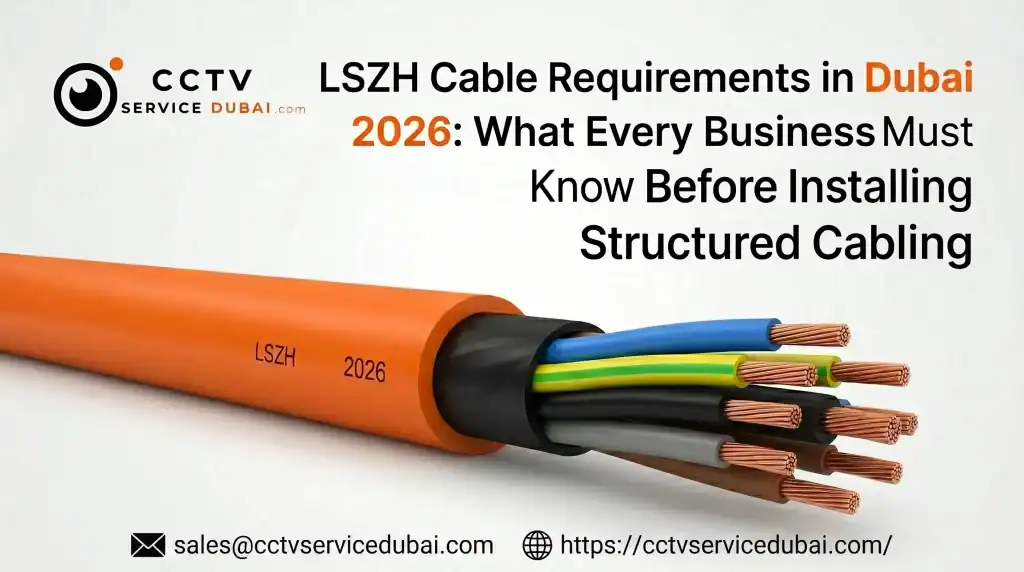
Most businesses in Dubai receive a structured cabling quotation without a single mention of LSZH. The contractor pulls standard PVC-jacketed Cat6A through the ceiling void, signs off the job, and hands over the completion certificate. Six months later, the building faces a Dubai Civil Defence inspection — and the cabling fails. LSZH cable requirements in Dubai are one of the least discussed and most frequently violated aspects of commercial structured cabling installations in the UAE. This guide explains exactly what LSZH cable requirements in Dubai mean, who enforces LSZH cable requirements in Dubai, which spaces are mandated, what the technical standards require, and why using standard PVC cable in plenum spaces is a compliance risk that can block your building permit renewal. What Is LSZH Cable? (And Why Dubai Requires It) LSZH stands for Low Smoke Zero Halogen. It refers to the jacket compound used on a cable — not the conductor or the data performance category. A Cat6A LSZH cable delivers identical network performance to a Cat6A PVC cable. The difference is entirely in what happens when the cable catches fire. Standard PVC cable in a fire: When PVC (polyvinyl chloride) cable burns, it releases dense black smoke, hydrochloric acid gas, and a range of toxic compounds including polychlorinated biphenyls. The hydrochloric acid corrodes electronics, damages lungs, and dramatically reduces visibility in escape routes. In a sealed ceiling void above an occupied office floor in Business Bay, a burning PVC cable run creates conditions that make evacuation extremely dangerous. LSZH cable in a fire: LSZH cable jackets contain no halogens — no chlorine, no fluorine, no bromine. When an LSZH cable burns, it produces minimal smoke, no acid gas, and significantly lower toxicity. Light transmittance during combustion must exceed 70% under IEC 61034 testing — meaning visibility in an evacuation corridor remains usable even if LSZH cables are burning nearby. This is the technical reason behind LSZH cable requirements in Dubai. In a city of high-rise commercial towers with dense, sealed ceiling voids, air-handling systems, and large occupancy counts, the difference between PVC and LSZH in a fire event is the difference between a managed evacuation and a mass casualty scenario. Dubai Civil Defence understood this years before most markets — LSZH cable requirements in Dubai are codified in the UAE Fire and Life Safety Code, Chapters 1 and 8. LSZH Cable Requirements in Dubai: The Regulatory Framework UAE Fire and Life Safety Code (Chapters 1, 6 & 8) LSZH cable requirements in Dubai are grounded in the UAE Fire and Life Safety Code of Practice, which specifies that LSZH cable jackets are mandatory for all enclosed spaces in UAE commercial buildings. Chapter 1, Section 34 and Chapter 8 of this code mandate LSZH sheathing to ensure cables do not contribute to smoke density or release acid gas that damages the respiratory system of evacuees. The code references international standards that LSZH cable must meet for compliance: IEC 61034 — Smoke density test. Light transmittance must remain above 60% minimum (70% target). This is the core LSZH smoke performance test. IEC 60754 — Halogen acid gas emission. Maximum halogen content below 0.5%. This confirms zero-halogen compliance. IEC 60332-1 / 60332-3 — Flame propagation testing on single cables and bundled cable installations. Bundled runs in ceiling voids must meet the stricter IEC 60332-3 standard. BS 7629-1 — For fire alarm and life safety circuits, fire circuit integrity at temperatures up to 950°C. LSZH cable requirements in Dubai apply to cables carrying both structured data (Cat6A, fibre optic) and security system wiring (CCTV, access control, fire alarm) in plenum and enclosed spaces. Dubai Civil Defence Registration All cables installed in commercial buildings in Dubai must be Dubai Civil Defence approved and bear LPCB (Loss Prevention Certification Board) or BASEC certification. DCD registration applies to fire safety cables specifically, but LSZH cable requirements in Dubai for structured cabling fall under the broader Dubai Civil Defence building inspection framework. When a DCD inspector assesses a commercial building, cable jacket markings are physically checked in accessible ceiling voids and communications rooms. Free Zone Specific Requirements LSZH cable requirements in Dubai extend across all major free zones, each with its own landlord overlay on top of the base UAE Fire Code: JAFZA (Jebel Ali Free Zone Authority) — Trakhees enforces Dubai Civil Defence requirements. LSZH cable requirements in Dubai for JAFZA warehouses apply to all plenum and enclosed routing, including high-bay industrial ceiling voids. DIFC (Dubai International Financial Centre) — DIFC’s own building management standards require LSZH throughout, not only in plenum spaces. All horizontal cabling in DIFC office fit-outs should be LSZH-rated as standard. DMCC (Dubai Multi Commodities Centre, JLT) — DMCC building management applies LSZH cable requirements in Dubai consistently across all tower fit-outs. Dubai Internet City / Dubai Media City — TECOM group manages these free zones and specifies LSZH for all structured cabling installations. If your business is in a Dubai free zone and your structured cabling contractor has not mentioned LSZH cable requirements in Dubai, treat this as a red flag. Where LSZH Cable Is Required in Dubai: Defined Spaces Understanding exactly which spaces trigger LSZH cable requirements in Dubai prevents the most common mistake: specifying LSZH only for part of a cable run while using PVC for the rest. Plenum Spaces A plenum space is any enclosed area used for the movement of environmental air — typically the void above a suspended ceiling (return air plenum) or the raised floor cavity below a data centre floor. Air-handling plenums are the primary trigger for LSZH cable requirements in Dubai. When structured cabling runs through these spaces, LSZH is mandatory because a fire in a plenum space pumps toxic combustion products directly into the building’s air circulation system. In practice, almost every commercial office in Dubai has a suspended ceiling with a return air plenum above it. This means LSZH cable requirements in Dubai apply to virtually every horizontal cable run in every commercial building. Vertical Riser Shafts Cable
How to Integrate Structured Cabling with CCTV and Access Control in Dubai: A Complete Guide for 2026

Most businesses in Dubai install CCTV, access control, and network cabling as three separate projects — and pay 30–35% more than they need to. Integrating structured cabling with CCTV and access control in Dubai on a single converged infrastructure is now the industry standard for new builds and office fit-outs. This guide explains exactly how integrating structured cabling with CCTV and access control in Dubai works, the step-by-step process for integrating structured cabling with CCTV and access control in Dubai, what it costs in AED, and why it outperforms the fragmented three-contractor model — three separate contractors, three separate cable runs, and three separate maintenance contracts. The result is a building with tangled conduits, overlapping wiring, redundant equipment rooms, and systems that cannot communicate with each other. When one fails, nobody knows whose responsibility it is. The smarter approach — and the one that every SIRA-aligned new build and fit-out in Dubai is now adopting — is integrating structured cabling with CCTV and access control in Dubai on a single unified network infrastructure from day one. This guide explains exactly how to integrate structured cabling with CCTV and access control in Dubai, what it costs in AED, which areas of Dubai benefit most, and why a single-contractor approach outperforms the fragmented model in every measurable way. Why Integrate Structured Cabling with CCTV and Access Control in Dubai? The traditional model of separate cabling for each system made sense when CCTV ran on coaxial cable and access control readers used proprietary wiring. That era ended with the shift to IP-based systems. Today, every IP CCTV camera, every ZKTeco or Hikvision biometric reader, every PoE access point, and every network switch runs on the same Cat6A or fibre infrastructure. Separating these systems into independent cable plants is now wasteful, expensive, and harder to maintain. When you integrate structured cabling with CCTV and access control in Dubai, you achieve five measurable outcomes: 1. Single Cable Infrastructure One Cat6A cable to each camera position delivers both power (via PoE) and data. The same infrastructure carries your access control readers, Wi-Fi access points, and data network. No duplicate cable runs. No separate coaxial installation for CCTV. Integrating structured cabling with CCTV and access control in Dubai eliminates 30–40% of total cabling material costs for most commercial projects.2. Centralised Management All systems terminate at a single communications room or server rack. Your CCTV NVR, access control controller, and network switch sit in the same cabinet. Faults are diagnosed in one place. Integrating structured cabling with CCTV and access control in Dubai means your IT team, security team, and facilities team all look at the same infrastructure.3. SIRA Compliance Simplification SIRA inspections for commercial properties in Dubai assess both your CCTV installation and your physical security infrastructure. When your structured cabling with CCTV and access control in Dubai is designed together and documented together, the inspection process is faster and the compliance record is cleaner.4. Future Scalability Adding a new camera, a new access reader, or a new Wi-Fi access point requires plugging into an existing structured outlet — not pulling new cable through walls. Integrating structured cabling with CCTV and access control in Dubai with spare capacity built in costs almost nothing extra at installation time and saves AED 3,000–8,000 per addition later.5. PoE Power Consolidation Modern IP cameras, access control readers, and wireless access points all run on Power over Ethernet. A unified PoE switch powers everything through the structured cabling infrastructure. Integrating structured cabling with CCTV and access control in Dubai with PoE eliminates separate power adapters at every camera and reader location — a significant saving on large commercial sites. How Structured Cabling with CCTV and Access Control Works in Dubai The integration of structured cabling with CCTV and access control in Dubai follows a converged network architecture. Understanding this architecture is essential before you request quotations — it determines every hardware decision from cable category to switch specification. Integrating structured cabling with CCTV and access control in Dubai on a converged IP network is fundamentally different from running separate coaxial and proprietary wiring, and the performance difference is significant. Here is how each layer works: The Horizontal Cable Layer (Cat6A to Every Endpoint) Cat6A is the standard for new builds and fit-outs in Dubai as of 2026. Each endpoint — whether an IP CCTV camera, a ZKTeco fingerprint reader, a Hikvision biometric terminal, or a Wi-Fi access point — receives a dedicated Cat6A run from the communications room.For integrating structured cabling with CCTV and access control in Dubai: IP CCTV cameras require Cat6A with PoE support (802.3at or 802.3bt for PTZ cameras) ZKTeco and Hikvision biometric access control readers connect via Cat6A with PoE Door controllers connect to the structured cabling backbone via Cat6 or Cat6A Electric locks connect via low-voltage cable from the door controller (not the structured cabling run) The Backbone Layer (Fibre Between Floors) Multi-floor buildings in Business Bay, DIFC, and Sheikh Zayed Road commercial towers require a fibre optic backbone between floors. Integrating structured cabling with CCTV and access control in Dubai for multi-floor properties uses OM4 or OS2 fibre between the communications rooms on each floor and the main equipment room. This ensures that CCTV video from upper floors reaches the NVR without signal degradation across long cable runs. The LSZH Compliance Layer Dubai Civil Defence requires LSZH (Low Smoke Zero Halogen) cable jackets in plenum spaces, false ceilings, and air-handling zones. When integrating structured cabling with CCTV and access control in Dubai in commercial buildings, all horizontal cable runs through ceiling voids must use LSZH-rated Cat6A. Standard PVC-jacketed cable is not compliant for ceiling installation in Dubai commercial buildings. The PoE Switch Layer The heart of integrated structured cabling with CCTV and access control in Dubai is the managed PoE switch in the communications room. A 24-port managed PoE switch powers and connects: Up to 20+ IP CCTV cameras 4–8 biometric access control readers 4–6 Wi-Fi access points Additional data points for desktop computers This
Structured Cabling Cost in Dubai 2026: Full Price Breakdown in AED
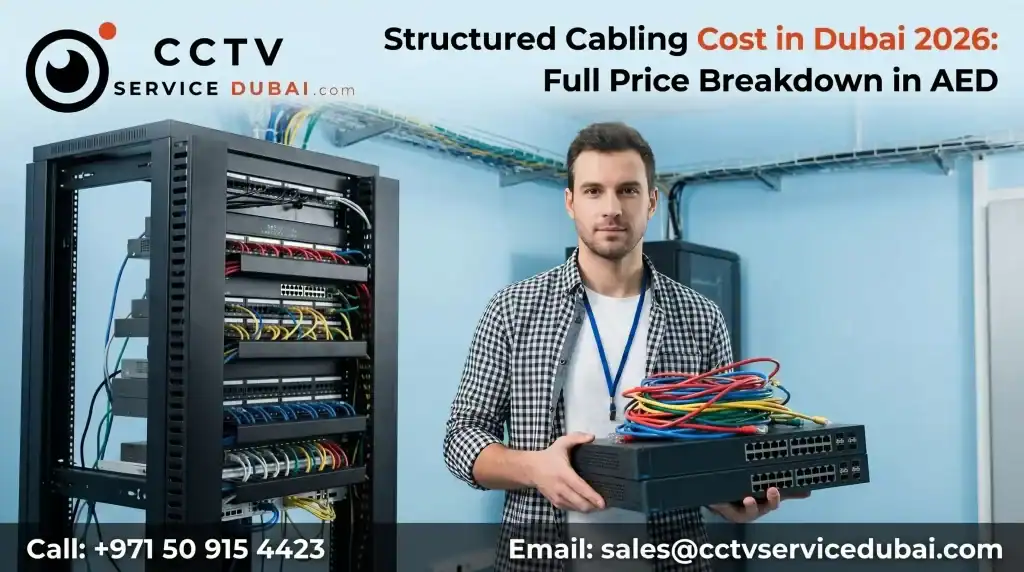
Every IT manager, facility manager, and business owner fitting out a new office in Dubai asks the same question before calling anyone: how much does structured cabling actually cost? The problem is that almost every structured cabling company in Dubai answers with “it depends” and asks you to book a survey before sharing a single number. This post gives you real structured cabling cost in Dubai and structured cabling installation cost in Dubai in AED — broken down by office size, cable category, property type, and location. These are working benchmarks based on what professional installations actually cost across Dubai’s commercial market in 2026. They are not exact quotes — every project has site-specific variables — but they are close enough to help you budget accurately, compare proposals fairly, and know immediately if a quote is reasonable or inflated. Why Structured Cabling Cost in Dubai Varies Before the numbers, understand the four factors that drive structured cabling cost in Dubai more than anything else: 1. Cable category: Cat6A is the standard for new Dubai office installations in 2026. Cat6A supports 10 Gbps over a full 100-metre run and future-proofs your network for the next 10+ years. Cat6 is cheaper upfront but increasingly short-sighted — the cabling outlives the equipment by 3–5 times, so specifying Cat6 to save cost today means a full re-pull within 5–7 years. Cat6A is the right choice in 2026 because it future-proofs for 10 Gbps deployment that is becoming the standard, and the cost difference per drop is moderate compared to the cabling lifecycle. 2. Number of data points (drops): Each cable run from the patch panel to an outlet is one “drop.” A typical Dubai office fit-out of 50 workstations involves 100–150 cable drops — covering workstations, Wi-Fi access points, printers, IP phones, CCTV cameras, and AV screens. Structured cabling cost in Dubai scales primarily with drop count. 3. Site conditions: A fresh shell-and-core office in a Business Bay tower is the easiest installation — open ceiling, clean runs, no existing infrastructure to work around. A retrofit in an occupied Deira trading office with false ceilings, existing cable trays, and active staff is significantly more expensive in labour time.4. Fibre backbone requirement: Multi-floor offices and buildings need a fibre optic backbone between floors — structured cabling cost in Dubai for multi-storey installations always includes a fibre component in addition to the copper horizontal runs. Structured Cabling Cost in Dubai: Per Drop Pricing in AED The most useful way to understand structured cabling cost in Dubai is per data point (drop) — the price for a single cable run from patch panel to outlet, fully terminated, labelled, and Fluke-tested. Cable Category Per Drop Cost in AED (supply + install) Notes Cat6 UTP (standard) AED 120 – 200 per drop 1 Gbps full run, budget option Cat6A UTP (10G copper) AED 180 – 280 per drop 10 Gbps full 100m run, 2026 standard Cat6A LSZH (fire-rated) AED 200 – 320 per drop Required in plenum/raised floor spaces by Dubai Civil Defence Fibre optic (multimode OM4) AED 350 – 600 per drop Fibre optic cabling cost Dubai for backbones, long runs, data centres Fibre optic (singlemode OS2) AED 400 – 700 per drop Inter-building campus links, telco connections These per-drop costs represent the full structured cabling installation cost in Dubai in AED — cable supply, conduit, face plates, keystones, patch panel termination, cable labelling, and Fluke DSX certification. Understanding the structured cabling installation cost in Dubai per drop is the most accurate way to compare quotes from different providers. They do not include patch panel hardware, network switch, or server room fitout — those are separate line items. Structured Cabling Cost in Dubai by Office Size Small Office (1–20 Workstations) A small office fit-out in Dubai — a typical SME unit in JLT, a retail back-office in Deira, or a startup space in Business Bay — typically requires 30–60 data drops covering workstations, Wi-Fi access points, a printer, and IP phones. Spec Estimated Structured Cabling Cost in Dubai 30 drops, Cat6A, single floor AED 6,500 – 10,000 45 drops, Cat6A + LSZH, single floor AED 9,500 – 15,000 Including patch panel + 12U wall rack Add AED 1,500 – 3,000 Total small office range AED 8,000 – 18,000 Best suited for: JLT offices, Deira trading companies, Bur Dubai retail back-offices, small Business Bay suites. The network cabling cost in Dubai for this size is the most accessible entry point for SMEs. Medium Office (20–75 Workstations) The most common structured cabling project size in Dubai — a standard office floor in a Business Bay or Downtown tower, a mid-size company in JLT, or a hotel department office. Expect 80–150 data drops across the floor. Spec Estimated Structured Cabling Cost in Dubai 80 drops, Cat6A, single floor AED 16,000 – 26,000 120 drops, Cat6A LSZH, single floor AED 26,000 – 42,000 Fibre backbone to server room (per floor link) Add AED 3,500 – 7,000 24U server rack + patch panels Add AED 3,000 – 6,000 Total medium office range AED 22,000 – 55,000 Best suited for: Business Bay offices, Downtown Dubai corporate floors, DIFC financial firms, JLT and Dubai Marina mid-size companies. Network cabling cost in Dubai at this level is most accurately predicted with a Fluke-verified drop count. Large Office / Multi-Floor (75–250+ Workstations) Large corporate fit-outs — a full building floor in Business Bay, a logistics company headquarters in Al Quoz, or a multi-department corporate campus. These projects involve 200–500+ drops, fibre backbone between floors, and structured server room design. Spec Estimated Structured Cabling Cost in Dubai 200 drops, Cat6A LSZH, single floor AED 42,000 – 75,000 350 drops, Cat6A LSZH, multi-floor with fibre backbone AED 75,000 – 140,000 500+ drops, full building with server room fit-out AED 120,000 – 250,000+ Total large office range AED 42,000 – 250,000+ Best suited for: Corporate headquarters in Business Bay and Downtown Dubai, government offices, large logistics companies in Jebel Ali, hospital and university campuses. Structured Cabling Cost in Dubai