

CCTV Camera Installation in Abu Dhabi: Complete Guide, Cost & Requirements
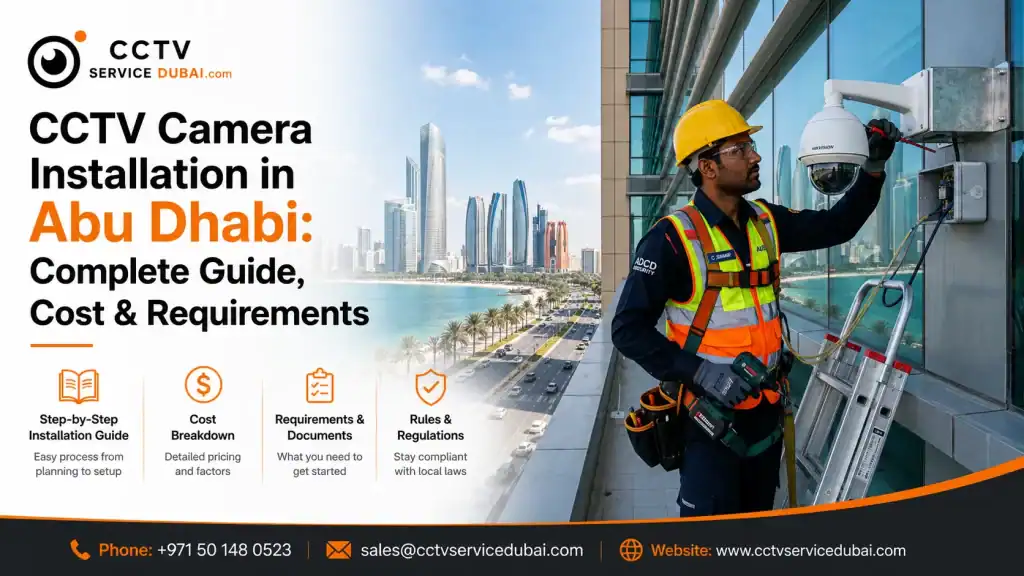
Professional CCTV camera installation abu dhabi involves far more than mounting cameras and connecting an NVR. A reliable system needs a proper site assessment, correct camera positioning, suitable equipment, structured cabling, adequate storage, testing, documentation, and compliance with Abu Dhabi’s monitoring regulations under the Abu Dhabi Monitoring and Control Centre (ADMCC). Expect to budget roughly AED 1,200–4,500 for the compliance permit alone, plus equipment and labour on top, with approval typically taking two to ten working days depending on premise type. This guide walks through how installation works, what actually drives the cost, how to choose a company, and what to check before signing a quote. What Is CCTV Camera Installation in Abu Dhabi? CCTV installation is the process of designing, installing, configuring, and testing a video surveillance system for a residential, commercial, industrial, or institutional property. A professional cctv camera installation abu dhabi project normally starts with a site survey rather than jumping straight into selecting cameras. The installer assesses entrances, exits, reception areas, parking spaces, corridors, storage areas, cash-handling points, restricted zones, and any other location that may need monitoring. The final system can include: CCTV cameras Network Video Recorder (NVR) Hard drives for video storage PoE switches Network and power cabling Monitors UPS or backup power Remote viewing configuration Access control integration Video management software Warning or monitoring signage where applicable The objective is a system that provides useful footage while fitting the property’s operational and regulatory requirements — not simply the maximum number of cameras a budget allows. Why Professional CCTV Installation Matters A CCTV system is only useful when the cameras capture clear, relevant footage and the recordings stay available when you actually need them. Poor installation can result in: Blind spots around entrances Faces obscured by backlighting Incorrect camera angles Poor night-time visibility Damaged or poorly terminated cables Insufficient storage Network interruptions Unstable remote viewing Cameras covering areas that provide little security value Professional security camera installation avoids these problems by designing the system around the actual property rather than installing a predetermined camera count. A warehouse may need long-range perimeter coverage, while a retail store needs detailed views of entrances, counters, aisles, and cash-handling areas — the same 8-camera package will not serve both well. CCTV Regulations and Compliance in Abu Dhabi CCTV and monitoring systems in Abu Dhabi operate within a regulated environment under Abu Dhabi Law Executive Regulations No. 5 of 2011, which established the authority now known as ADMCC. Exact requirements can vary by property type, business activity, and location, so the Abu Dhabi Government’s official Gazette portal remains the authoritative source to verify current rules — businesses shouldn’t rely only on generic CCTV specifications found online. Before beginning a commercial CCTV project, a professional installer should confirm: Applicable regulatory requirements Required approvals or submissions Technical specifications Camera coverage requirements Recording and storage requirements Documentation requirements Installer or system-provider accreditation Inspection or acceptance procedures, where applicable Requirements do change, so confirm the latest applicable rules before finalizing a system design rather than assuming last year’s specification still applies. What Is ADMCC? The Abu Dhabi Monitoring and Control Centre (ADMCC) issues the permits, non-objection certificates, and installer accreditations that make a CCTV system legal to operate in the emirate. It also sets the technical rulebook — camera resolution, mandatory coverage zones, and footage retention periods. A professional cctv camera installation company in Abu Dhabi should be able to explain exactly which requirements apply to your property and what documentation or approvals are needed — not just claim to be “ADMCC compliant” without a certificate to show for it. According to a regulatory review by law firm Al Tamimi & Company on Abu Dhabi’s monitoring and control regulations, operating a monitoring system without ADMCC approval can carry a fine of AED 50,000 to AED 200,000, imprisonment of up to two years, or both, with authorities able to confiscate non-compliant equipment. Day-to-day inspection failures for smaller compliance gaps typically start from AED 5,000. This is not a step worth skipping to save time. How to Choose a CCTV Installation Company in Abu Dhabi Choosing the cheapest quotation is rarely the best approach for a commercial CCTV project. Before hiring a cctv camera installation company in Abu Dhabi, evaluate the provider against the following. 1. Relevant Experience Ask whether the company has completed projects similar to yours. A CCTV system for a retail shop, office, warehouse, villa, hotel, restaurant, school, factory, or construction site can require very different equipment and camera layouts. 2. Site Survey Avoid companies that provide a final quotation without understanding the property. A proper site survey should consider building layout, camera mounting points, lighting conditions, cable routes, network infrastructure, entry and exit points, high-risk areas, recording requirements, and future expansion. 3. Camera Specifications Don’t accept a quotation that simply says “HD cameras.” The proposal should identify resolution, lens type, field of view, night vision, IR range, WDR, low-light performance, weather protection, AI features where required, and camera form factor. 4. Recorder and Storage The NVR and hard drives should be sized according to camera count, resolution, frame rate, recording mode, compression, required retention period, and future camera expansion. A system with excellent cameras but inadequate storage can still fail to meet the property’s operational requirements — and, for regulated premises, its compliance requirements too. 5. After-Sales Support CCTV systems require ongoing maintenance. Ask whether the company provides preventive maintenance, camera cleaning, NVR troubleshooting, hard-drive replacement, cable testing, firmware updates, camera repositioning, remote-viewing support, and system health checks — our CCTV maintenance services page breaks down what a standard service contract usually covers. CCTV Camera Types for Abu Dhabi Properties Different properties need different camera types. A professional installer should recommend cameras according to the environment rather than promoting one model across every site. Dome Cameras Dome cameras are commonly used indoors because their compact design fits well in offices, retail stores, reception areas, corridors, hotels, and commercial buildings, offering a discreet solution while keeping a professional appearance. Bullet Cameras Bullet cameras suit applications where a visible
Whales: Giants of the Ocean
Whales: Giants of the Ocean Whales are among the largest and most remarkable animals on Earth. These marine mammals live in oceans around the world, from warm tropical waters to the cold seas surrounding the poles. Life Beneath the Surface Although whales spend their lives in water, they breathe air through blowholes located on top of their heads. They must regularly return to the surface to breathe before diving again in search of food or traveling through the ocean. Whales are warm-blooded, give birth to live young, and nurse their calves with milk. A thick layer of fat called blubber helps protect them from cold water and stores energy during long migrations. Two Main Groups Whales are generally divided into baleen whales and toothed whales. Baleen whales filter small animals from the water using flexible plates inside their mouths. This group includes blue whales, humpback whales, and gray whales. Toothed whales use teeth to catch fish, squid, and other prey. Many of them also use echolocation, producing sounds and listening for returning echoes to understand their surroundings. Sperm whales, belugas, and orcas belong to this group. The Blue Whale The blue whale is the largest known animal to have ever lived. An adult can grow longer than a city bus and weigh well over one hundred tonnes. Despite its enormous size, it feeds mainly on tiny crustaceans called krill. Communication and Migration Whales communicate using clicks, whistles, pulses, and complex songs. Some sounds can travel across great distances underwater. Humpback whales are especially famous for their long, patterned songs. Many species migrate thousands of kilometres each year. They often feed in cold, nutrient-rich waters before traveling to warmer regions where they mate and give birth. Protecting Whales Commercial hunting once caused severe declines in many whale populations. Today, whales also face threats from fishing gear, ship collisions, underwater noise, pollution, and changes to ocean ecosystems. Conservation programs, safer fishing practices, protected habitats, and international cooperation can help whale populations recover. Protecting whales also supports healthier oceans because these animals play an important role in marine food webs and nutrient cycles. AfsalAfsal, SEO Content Writer at CCTV Service Dubai Afsal writes the guides, cost breakdowns, and compliance explainers published on CCTV Service Dubai. His work covers CCTV camera installation, security system planning, and regulatory requirements across Abu Dhabi, Dubai, and the wider UAE, researched and written in close collaboration with the company’s installation and compliance team to keep every article accurate and current. With a background in SEO and digital content across multiple UAE-based businesses, Afsal focuses on turning technical, regulation-heavy topics — ADMCC and SIRA requirements, camera specifications, storage and retention rules, installation costs — into guides that are actually useful for someone trying to make a decision, not just technically correct. What Afsal Covers CCTV camera installation guides for Abu Dhabi, Dubai, and Sharjah ADMCC and SIRA compliance explainers CCTV system costs, camera types, and equipment comparisons Security camera maintenance and best practices Buying guides for businesses choosing an installation company How This Content Is Put Together Every guide is developed alongside CCTV Service Dubai’s installation team, who bring the hands-on project experience — 5+ years in the field and 500+ completed installations across the UAE. Afsal’s role is to research, verify, and write that experience into guides that are clear, accurate, and genuinely helpful, rather than generic content pulled from unrelated sources. cctvservicedubai.com