

Video Door Phone & Video Intercom Installation: Hikvision vs Dahua vs Panasonic
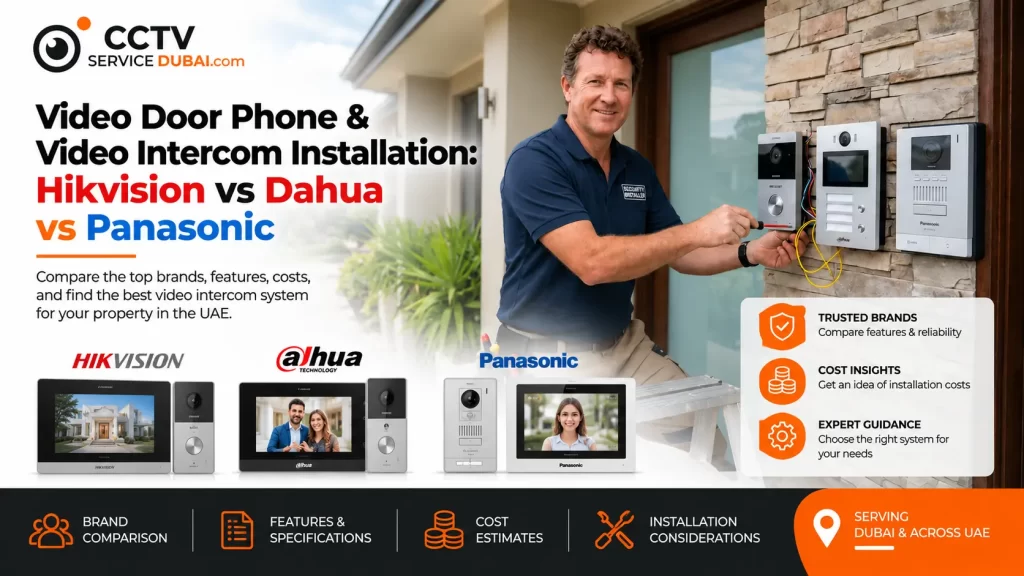
If you’ve already decided that you want a video door phone rather than a basic audio intercom, the next question is usually much harder: which brand should you choose? Hikvision, Dahua, and Panasonic all offer video intercom and video door phone solutions, but they approach the market differently. The right choice isn’t simply the brand with the highest camera resolution or the lowest equipment price. It depends on your property, existing wiring, door or gate hardware, CCTV system, and how much integration you actually need. At CCTV Service Dubai, we see customers comparing these three brands regularly. One customer may already have Hikvision CCTV and want the intercom on the same ecosystem. Another may be replacing an old two-wire system and want to reuse existing cabling. A villa owner may simply want a reliable video door phone with electric lock release. That makes the installation approach just as important as the hardware. By the end of this guide, you’ll understand how Hikvision intercom installation, Dahua intercom installation, and Panasonic intercom installation compare, where each brand makes the most sense, and what to check before choosing an installer. What should you consider before choosing a video intercom brand? The best brand depends on how the system will actually be used. Before comparing models, check these five things: Property type: villa, apartment, office, retail unit, or commercial building Existing wiring: new cabling, network cabling, or older intercom wiring Door or gate: electric lock, magnetic lock, gate motor, or existing release mechanism CCTV integration: whether you want the intercom connected to your cameras Remote access: whether users need to answer calls or release the door from a mobile device This matters because a system that is excellent for a new villa may not be the easiest option for an older property where you want to avoid major rewiring. Hikvision vs Dahua vs Panasonic: which video intercom is better? There is no universal winner. Hikvision is particularly attractive for businesses already using Hikvision security equipment, Dahua offers strong IP and two-wire options, while Panasonic has a strong focus on residential video door phone solutions. Here’s the practical comparison: Feature Hikvision Dahua Panasonic Video door phone Yes Yes Yes IP video intercom Yes Yes Yes Two-wire options Yes Yes Selected systems Mobile connectivity Hik-Connect DMSS on supported systems SmartWiFi on supported models CCTV integration Strong within Hikvision ecosystem Strong within Dahua ecosystem Available on selected models Electric lock integration Yes Yes Yes Villa applications Excellent Excellent Excellent Commercial applications Excellent Excellent Good to excellent depending on system Best fit Integrated security ecosystems Flexible IP/two-wire systems Residential-focused VDP solutions The important point is that model-to-model specifications vary, so the final choice should be based on the exact equipment rather than the brand name alone. Why choose Hikvision for video intercom installation? What makes Hikvision video intercom suitable for modern security systems? Hikvision’s video intercom range includes IP and two-wire systems designed for villas, commercial entrances, and other applications. Its current product range includes door stations with features such as PoE, built-in card readers, IR illumination, WDR, and mobile control through Hik-Connect on supported models. Hikvision also offers indoor stations with touchscreen displays and integration with other security equipment. This makes hikvision intercom installation particularly attractive when the property already uses Hikvision CCTV. A Hikvision indoor station can also provide live viewing of compatible cameras, while supported systems can allow users to answer calls and release the door remotely through the app. When does Hikvision make the most sense? Choose Hikvision when: You already have Hikvision CCTV You want one security ecosystem You need IP or two-wire options You want mobile access on supported systems You need door station and indoor monitor integration You’re installing the system for a villa, office, or commercial entrance For a hikvision video door phone installation, the installer should confirm the exact door station, indoor monitor, power method, network requirements, and lock interface before installation. What about Hikvision video door phone with lock installation? A video door phone becomes significantly more useful when it controls the entrance lock. How does Hikvision video door phone with lock installation work? The typical setup includes: Visitor → Hikvision door station → Indoor monitor/mobile device → Door release → Electric lock The visitor calls from the entrance station. The person inside can view and communicate with them and, where the configuration supports it, activate the door release. The important part is matching the intercom’s relay and power requirements with the actual lock or gate controller. A professional installer should check this before connecting the equipment. Simply connecting an electric lock to a video door phone without checking voltage, relay configuration, power supply, and door hardware can create unreliable operation. Why consider Dahua intercom installation? What makes Dahua video intercom different? Dahua offers IP video intercom systems with separate categories for villa door stations, apartment door stations, indoor monitors, master stations, and complete kits. One of Dahua’s useful options is its 2-wire hybrid video intercom system. This can be particularly relevant when upgrading an older property. Dahua states that its two-wire hybrid solution can transmit power and signal over two wires while using Wi-Fi to connect the indoor monitor to the network. It also supports remote answering, monitoring, and door release through the DMSS mobile app on supported configurations. That gives Dahua a practical advantage for some retrofit projects. When is Dahua a good choice? Dahua can be a strong option when: You already use Dahua CCTV You’re installing an IP intercom You need a villa or apartment solution Existing two-wire cabling needs to be reused Remote monitoring and door release are important You want the intercom connected with other Dahua security equipment Dahua also offers configuration features designed to simplify deployment of its IP and two-wire villa systems. What makes Panasonic intercom installation different? Is Panasonic better for residential video door phone installation? Panasonic has a long-established range of video door phone systems, particularly for residential applications. Its current product range includes basic analog video
Intercom Installers Near You: Cost, Companies & How to Choose the Right Provider
Looking for Intercom Installers Near You? Finding intercom installers near me is easy. Finding an installer who understands your building, wiring, access requirements, and future security needs is a different matter. Many property owners start by comparing the cheapest installation quote or choosing an intercom system based on a product brochure. That’s usually the wrong starting point. The better approach is to look at the type of property, the number of users, the distance between the entrance and indoor units, and whether the intercom needs to work with CCTV or access control. At CCTV Service Dubai, we see this regularly. A customer may already have an old intercom system that works inconsistently, poor-quality wiring, or a gate system that was installed without considering how it will be maintained later. Replacing the equipment alone doesn’t always solve the problem. By the end of this guide, you’ll understand which intercom system suits your property, what intercom system cost can look like, when replacing an old system makes more sense, and what to check before hiring an installation company. Why choosing the right intercom installer matters What should you check before hiring intercom installation companies? The installer matters just as much as the intercom brand you choose. A professional installer should first inspect the entrance, door or gate, existing wiring, power supply, indoor units, and the distance between connected devices. This determines whether a wired, wireless, audio, video, or IP-based system is appropriate. A proper installation should also leave you with: Correctly installed entrance and indoor units Reliable wiring and power Clear audio and video Proper door or gate release functionality Weather protection for outdoor equipment User programming and access configuration Documentation for future maintenance The cheapest quote can become expensive if the installer uses unsuitable cabling or discovers major site issues only after the work has started. Which type of intercom system is right for your property? There isn’t one intercom system that works best for every building. The right choice depends mainly on how the entrance is used. Audio intercom: simple communication without video An audio intercom allows visitors to speak with someone inside before access is granted. It’s a practical option for properties where video verification isn’t essential. Small offices, residential buildings, staff entrances, and certain villa applications can often work well with audio-only systems. The main advantage is simplicity. There are fewer components, installation is generally straightforward, and users don’t have to manage a complicated interface. If your main requirement is simply “Who is at the entrance?”, an audio intercom may be enough. Video intercom: see the visitor before opening the door Video intercom systems add a camera to the entrance station, allowing the person inside to see who is requesting access. This makes them particularly useful for: Villas Apartment buildings Offices Reception areas Private entrances Commercial properties A video intercom is especially useful when the entrance isn’t directly visible from inside the building. Instead of relying only on someone’s voice, the user can visually check the visitor before releasing the door or gate. Smart and IP intercom systems: better control and connectivity Smart and IP-based intercom systems take the concept further by connecting the entrance system to a network. Depending on the system, users may be able to communicate through a monitor, smartphone, or other connected device. These systems can be useful for modern offices, residential developments, serviced properties, and businesses that want their security systems to communicate with each other. However, connectivity shouldn’t be the only reason to choose an IP system. The network infrastructure, internet reliability, cybersecurity requirements, and long-term support should also be considered. What does an intercom system cost in Dubai? The cost of an intercom installation depends heavily on the equipment and the condition of the site. A basic audio system for a simple entrance will naturally cost less than a multi-unit video intercom connected to an automated gate. Indicative factors affecting intercom system cost Requirement Cost impact Basic audio intercom Lower Video intercom Moderate Smart/IP intercom Moderate to higher Multiple indoor monitors Higher Long cable runs Higher Gate integration Higher Door-release integration Higher Existing wiring replacement Higher CCTV/access control integration Higher Don’t compare two quotations only by their final AED figure. Check what each quotation actually includes. A professional quotation should separate equipment, wiring, installation, configuration, and any additional integration work. When should you replace an old home intercom system? Is replacing an old home intercom system better than repairing it? Sometimes repair is the sensible option. But if an old system has repeated faults, damaged wiring, obsolete components, poor audio, or unreliable door release, replacement may be more practical. Common signs that an old system needs replacing include: Intermittent audio No video or poor image quality Door release not working consistently Cracked or damaged entrance equipment Indoor monitors frequently failing Spare parts becoming difficult to source Old wiring causing repeated problems No practical way to integrate with newer security equipment Before replacing everything, an installer should inspect the existing wiring and equipment. In some cases, the cable infrastructure can be reused. In others, replacing the wiring at the same time prevents the new system from inheriting the same problems. What about gate intercom installation? Gate intercom systems have different requirements from a standard door intercom. What does a gate intercom installation need? A gate system may need to account for: Outdoor weather exposure Longer cable distances Gate motor compatibility Power supply Electric lock or gate-release mechanism Vehicle or pedestrian access Audio/video quality over distance CCTV integration For a villa or commercial property with a remote gate, the entrance station needs to be installed where visitors can communicate clearly while remaining protected from weather and physical damage. The indoor station should also be positioned somewhere convenient for the person responsible for approving entry. This is why a gate intercom installation near me search should lead to a site inspection rather than an installation based purely on a phone quotation. Wired vs wireless intercom: which is better? Should you choose a wired
Biometric versus card versus mobile access:which door access control system suits yourDubai business
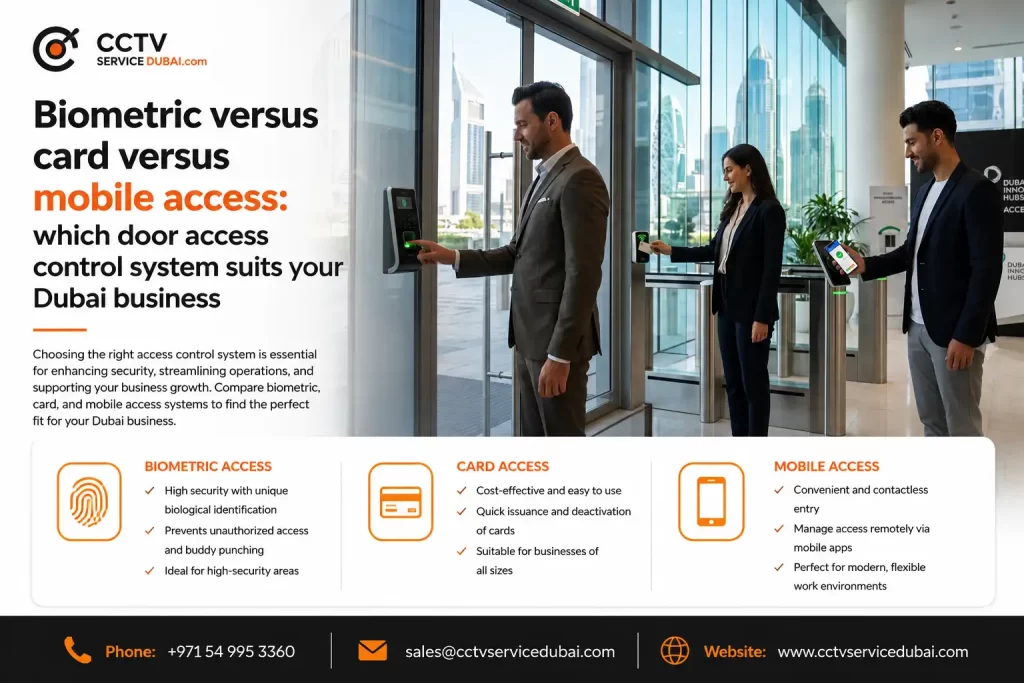
Many Dubai business owners pick an access control system based on what they saw in a brochure, or whatever the cheapest quote included. That’s the wrong starting point. Choosing the right door access control system in Dubai starts with your compliance obligations, your building type, and how the entry system connects to the rest of your security setup. Get those three things right first, and the technology choice becomes obvious. At CCTV Service Dubai, a SIRA-approved installer operating across Dubai, the calls we remember most are from business owners who already installed a system and just failed a SIRA inspection. It happens more than it should, and it’s almost always avoidable. That experience shapes how this comparison works: compliance first, technology second. By the end of this article, you’ll know which technology fits your property type, what a realistic budget looks like in AED, and how to vet an installer before signing anything. Why SIRA compliance comes before technology choice What SIRA approval actually means for door access control installations in Dubai SIRA, the Security Industry Regulatory Agency, governs security system installations across Dubai. Any commercial property, including retail shops, offices, hotels, and warehouses, must use a SIRA-approved contractor for access control work. Using an uncertified installer doesn’t just risk a failed inspection; it can jeopardize your trade licence and may leave you liable for a full redo at your own cost. The approval covers both the company doing the work and the process they follow, from equipment specification to testing documentation. For the installing company, SIRA requires a valid trade licence with the relevant security activity listed, qualified staff with cadre cards, and a minimum team structure. For the system itself, equipment must meet SIRA-approved specifications. None of this is optional, and none of it gets waived because you got a cheaper quote from an uncertified contractor. Civil defense egress rules some installers miss Dubai Civil Defense adds another layer that some smaller installers miss entirely. Any door on an emergency egress route that has electronic access control fitted must fail safe, meaning it unlocks automatically on fire alarm activation or power loss. Doors must also allow free exit from inside without requiring a credential swipe. Clear width minimums of 915 mm, maximum opening force of 133 N, and self-closing requirements on fire-rated doors all apply. If your installer doesn’t raise these points during the survey, treat it as a red flag. A proper SIRA-approved contractor builds civil defense compliance into the design from day one, not as an afterthought when the inspector shows up. This is one of the clearest ways to separate experienced installers from those who will leave you with a compliance problem to fix later. Biometric vs. card vs. mobile: which door access control system fits your Dubai property RFID cards and fobs: the workhorse for most Dubai businesses RFID card systems are the most common door access control option across Dubai offices, retail units, and warehouses. They’re fast, contactless, and straightforward to manage. Adding or revoking a card takes seconds. The trade-off is that the system verifies the card, not the person. Cards get lost, lent to colleagues, or in some cases cloned. Security strength varies significantly depending on whether you’re using modern encrypted credentials or older low-frequency proximity cards, which are relatively easy to copy. For many businesses with fewer than 50 staff, a good-quality RFID system with encrypted cards hits a practical balance of cost and reliability. It’s not a perfect system, but it’s dependable, affordable, and easy to operate without specialist knowledge on site. Biometric readers: fingerprint and facial recognition Biometric systems tie access to the individual, which removes the shared-credential problem entirely. They work well for sensitive areas: server rooms, back-of-house in hospitality, or any space where accountability matters. The costs are higher, enrollment takes time, and you need a clear policy for how biometric data is stored and protected. The UAE’s Federal Decree-Law No. 45 of 2021 on Personal Data Protection requires businesses to document how personal data, including biometrics, is collected, stored, and deleted. For most retail or small-office applications, biometrics are overkill at the main entrance but genuinely useful as a second layer in restricted zones. Think of them as a complement to RFID, not a replacement for every door in the building. Mobile credentials: convenient but phone-dependent App-based access using NFC or Bluetooth is growing fast in Dubai, especially for serviced offices and co-working spaces. These smart access solutions give you the ability to issue or revoke credentials instantly without printing or handing over a physical card. The catch is straightforward: it only works when the employee has a charged, compatible phone with the app installed and functioning. For businesses where phone use is restricted on the floor, such as labs, kitchens, or warehouses, mobile credentials create more problems than they solve. They’re a strong fit for the right environment and a poor fit for the wrong one. Know which you’re running before you commit. How CCTV and intruder alarm integration turns entry control into real security The gap a standalone access control system leaves open An access control system that operates in isolation tells you who badged in at the door. It doesn’t show you what happened next, whether the door was held open after the credential swipe, or whether someone tailgated through behind an authorized user. That’s the gap. A standalone system logs entries; an integrated system gives you the context to act on them. The difference is important. Many businesses only notice this gap after an incident. By then, the footage either doesn’t exist or isn’t linked to the access event. A door held open for 90 seconds after a card swipe, for example, won’t appear in an access log, but it will appear on a camera feed tied to that entry event. That’s the difference the right setup makes, and it’s only possible if the systems are connected from installation day. What a unified setup looks like for retail, hospitality, and