

IP Camera vs CCTV in the UAE: IP, Analog, AHD & Network Camera Guide
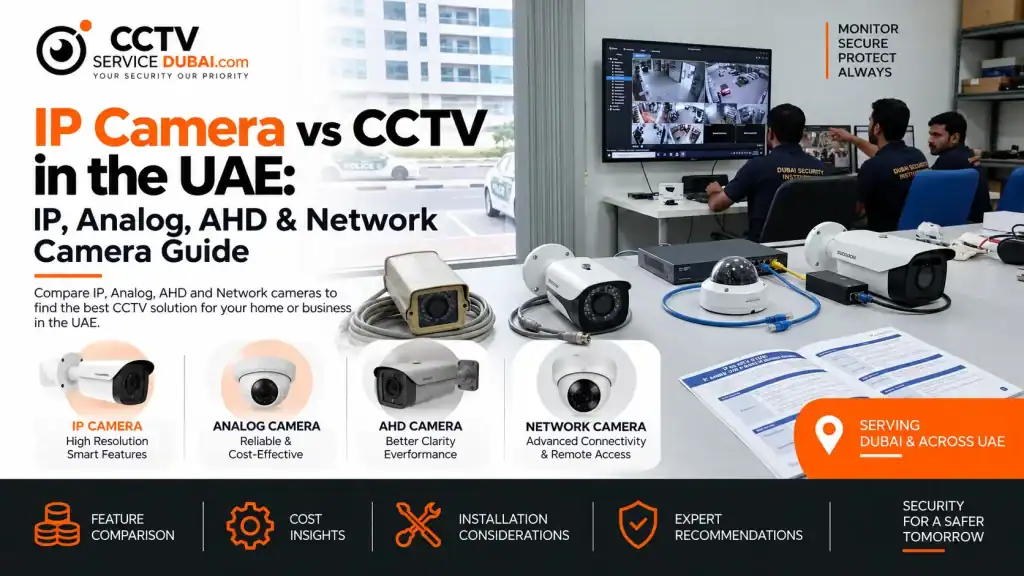
Choosing a CCTV system in the UAE is no longer as simple as picking a camera with the highest megapixel rating. You also need to decide how the cameras will communicate with the recorder, what type of cabling the property already has, how much storage you need, and whether the system needs to support remote monitoring or intelligent features. That is why the IP camera vs CCTV in the UAE question matters. For a new office, villa, retail shop, warehouse, or commercial building, an IP system is often the more flexible choice. But if you already have coaxial cabling and a working analog system, upgrading with HD-over-coax technology such as AHD, TVI, or HDCVI can sometimes be more practical. This guide explains the differences in simple terms so you can choose based on your property rather than simply following a brand or salesperson’s recommendation. Key Takeaway IP cameras are network-based and normally connect to an NVR or network infrastructure, while traditional CCTV cameras use coaxial cabling and a DVR/XVR. Modern HD-over-coax systems can deliver high-resolution video over existing coaxial infrastructure, making them useful for upgrades. The right option depends on whether you are building a new system, upgrading an existing installation, the required resolution, networking infrastructure, budget, and future expansion plans. What Is the Difference Between an IP Camera and CCTV Camera? The main difference is how video is transmitted and recorded. An IP camera converts video into digital data and sends it over a network, normally using Ethernet cabling. The system commonly uses an NVR for recording. A traditional analog CCTV camera sends video through coaxial cable to a DVR. Modern HD-over-coax technologies have significantly improved the image quality available from this type of infrastructure. Feature IP Camera Analog / HD CCTV Transmission Network/Ethernet Coaxial cable Recorder NVR DVR/XVR Typical cabling Cat5e/Cat6 Coaxial Network features Strong More limited Expansion Generally flexible Depends on DVR/XVR Remote viewing Yes, with network setup Yes, with suitable recorder Existing coax reuse No, not directly Yes Intelligent features Widely available Available on modern systems Best suited for New installations Existing coaxial systems and upgrades So, IP camera vs CCTV in the UAE isn’t simply about which technology is newer. It is about matching the system to the building. Is an IP Camera Better Than an Analog CCTV Camera? For many new installations, IP cameras offer greater flexibility, but analog or HD-over-coax can be a better choice when existing coaxial cabling is still usable. IP systems make it easier to build a networked surveillance system with features such as centralized management, PoE connectivity, higher-resolution options, and integration with other systems. However, replacing a complete coaxial infrastructure simply to move to IP may not make financial sense for every existing property. Modern HDCVI systems, for example, are designed specifically to upgrade existing coaxial surveillance infrastructure and can support resolutions including 4K. What Is the Difference Between IP vs Analog Cameras? The most important difference is the infrastructure behind the cameras. IP cameras An IP camera connects to a network. In a typical installation: IP Camera → PoE Switch → Network → NVR Power and data can often travel through the same Ethernet cable when PoE equipment is used. This can simplify installation and make it easier to connect cameras across a structured network. Analog cameras A traditional analog system generally follows: Camera → Coaxial Cable → DVR/XVR → Monitor/Network It is a straightforward architecture and can be particularly useful when the property already has coaxial CCTV cabling. For a business replacing old cameras but keeping the existing cable routes, this can reduce unnecessary rewiring. What Is AHD vs IP Camera? AHD stands for Analog High Definition and is an HD-over-coax technology designed to deliver higher-resolution video through coaxial infrastructure. AHD can be useful when you have an existing analog CCTV installation and want better image quality without completely rebuilding the cabling. This is one reason you should not automatically assume that an old coaxial system must be replaced with IP. Before deciding, an installer should inspect: Existing coaxial cable condition Cable length Connectors Power supply DVR/XVR compatibility Existing camera locations Required resolution Future expansion requirements If the cabling is damaged or unsuitable, a complete infrastructure upgrade may still be the better option. What Is the Difference Between Analog HD and IP Cameras? Analog HD systems such as AHD, TVI and HDCVI can provide significantly better image quality than older standard-definition analog CCTV. The important distinction is that analog HD still uses coaxial-based transmission, while IP cameras use network communication. For example, Dahua’s HDCVI technology is designed to deliver HD video over coaxial cable and support upgrades of existing analog infrastructure. Its current HDCVI range includes cameras with 4K capability. That makes HD-over-coax particularly interesting for: Older villas Existing shops Small offices Warehouses Buildings with established coaxial routes Analog CCTV vs Digital CCTV: Which Should You Choose? The phrase digital CCTV can refer to several different technologies, so it is important to clarify what is actually being proposed. If you are comparing a traditional analog CCTV system with a modern IP surveillance system, IP generally provides more networking and integration flexibility. However, a modern XVR with HD-over-coax cameras can still provide high-resolution surveillance without replacing existing coaxial cabling. The better choice depends on the project rather than the label. Choose IP when: You are installing a new CCTV system. You want a scalable network-based system. You need extensive remote management. You want PoE connectivity. You expect to add cameras later. You need advanced analytics or integrations. Consider HD-over-coax when: The property already has good coaxial cabling. You are replacing old cameras. You want better resolution without major rewiring. The project has a limited number of cameras. Existing DVR/XVR infrastructure can be reused. What Is the Difference Between an Analog Security Camera and a Digital Camera? An analog security camera traditionally sends a video signal through coaxial infrastructure. A digital/IP camera processes video digitally and communicates across a network. But there is an important point: image quality
IP Camera Installation Cost in Dubai: 2026 Price & Setup Guide
If you’re searching for ip camera installation cost in dubai, the price you receive can vary significantly from one property to another. A four-camera villa system and a 16-camera commercial IP CCTV installation may both use network cameras, but the equipment, cabling, storage, installation time, and configuration can be completely different. Many property owners make the mistake of comparing only the camera price. In practice, the total cost depends on the camera specifications, number of cameras, cable routes, NVR, storage, PoE networking, installation difficulty, and features such as remote viewing or intelligent detection. At CCTV Service Dubai, the better approach is to start with the property and work backwards to the equipment. This helps avoid paying for features you don’t need or discovering additional installation costs after the project has started. What determines IP camera installation cost in Dubai? The ip camera installation cost in dubai depends mainly on the size and complexity of the CCTV project. The biggest cost factors are: Number of IP cameras Camera resolution and model Indoor or outdoor installation Cable length and routing NVR capacity Hard-drive storage PoE switches and network equipment Camera mounting requirements Night-vision requirements Intelligent detection features Remote viewing configuration Existing infrastructure A straightforward villa with short cable runs will have very different requirements from a warehouse with multiple floors, outdoor cameras, and long network cable routes. That’s why an accurate quotation should normally follow a site survey. What does an IP camera setup include? A complete cctv ip camera setup is more than the cameras themselves. A typical system can include: IP Cameras → PoE Network → NVR → Storage → Monitor/Remote Access IP cameras The cameras capture the video and should be selected according to where they will be installed. NVR The Network Video Recorder manages and stores footage from the cameras. PoE switch Compatible PoE cameras can receive both power and network connectivity through Ethernet cabling. Hard drive Storage capacity depends on the number of cameras, recording quality, and how many days of footage you want to retain. Network The network connects cameras, the NVR, and remote devices where required. Every component should be sized according to the complete system rather than purchased separately. How much does IP camera installation cost in Dubai? There is no single fixed price for an IP CCTV installation because site conditions can change the project considerably. For budgeting purposes, think about the project in terms of system size rather than just camera price. A small residential setup may require only a few cameras, a compact NVR, and straightforward cabling. A medium commercial system may need more cameras, greater storage, PoE switching, additional networking, and longer cable runs. A larger commercial installation may also require advanced cameras, multiple recording devices, network racks, monitoring screens, and intelligent analytics. The final quotation should clearly separate: Camera cost NVR cost Storage Cabling PoE/network equipment Installation labour Configuration Additional hardware Maintenance, if required This makes it much easier to compare quotations from different installers. Should you choose an IP Pro camera setup? An ip pro camera setup can be useful when standard surveillance cameras aren’t enough for the property. Professional-grade systems can include features such as: Higher-resolution cameras Better low-light performance Advanced lenses PTZ cameras Larger NVRs Greater storage capacity PoE networking Intelligent video analytics Multi-camera monitoring For example, a large warehouse may need high-resolution cameras at loading bays and entrances, while a villa may only require a few strategically positioned fixed cameras. Don’t assume that every location needs the most advanced camera available. The right specification should match the area being monitored. What is an intelligent IP camera setup? An ip camera intelligent camera setup uses cameras or recording equipment with video analytics. Depending on the model, intelligent features can include: Human detection Vehicle detection Intrusion detection Line-crossing detection Motion classification Area monitoring People counting These features can be particularly useful for businesses because they can help reduce unnecessary alerts. For example, instead of triggering an alert every time something moves in an outdoor area, supported analytics can distinguish between people, vehicles, and other movement. However, intelligent features vary between models, so always check what is actually included before paying extra for an “AI” or “smart” camera. What should you consider for an IP camera outdoor installation? An ip camera outdoor installation needs more planning than an indoor camera. Outdoor cameras may be exposed to: Heat Dust Humidity Rain Direct sunlight Vehicle headlights Physical interference The camera should therefore be appropriate for the environment. Night vision Check the camera’s low-light and infrared capabilities. WDR Wide Dynamic Range can help when a camera sees bright sunlight and darker areas at the same time. Weather protection Outdoor equipment should have suitable environmental protection for its installation location. Cable protection Outdoor network cabling should be routed and protected appropriately. Camera position The camera should be mounted securely while maintaining a useful view of the area. A high-resolution camera cannot compensate for poor positioning. Can an IP webcam be used for CCTV? An ip webcam may look similar to a security camera, but the two are designed for different purposes. A webcam is generally intended for video communication or basic monitoring. A dedicated IP security camera is designed for surveillance and can support features such as: Continuous recording NVR connectivity Night vision Motion detection Intelligent analytics Outdoor protection Remote monitoring If you’re building a proper CCTV system for a home or business, dedicated IP security cameras are generally more appropriate than webcams. What are the advantages of an IP security camera system? An ip security camera system can provide several advantages over traditional CCTV configurations. Higher-resolution options IP cameras are widely available in different resolutions, allowing you to select the appropriate image quality for each location. Network connectivity Cameras can communicate through network infrastructure and connect to an NVR. PoE Compatible cameras can receive power and data through a single Ethernet cable. Remote viewing Supported systems can allow authorized users to view cameras remotely. Scalability IP systems can be expanded
4K Security Camera System in the UAE: Complete Buying & Installation Guide
If you’re looking for a 4K security camera system in the UAE, choosing the cameras is only one part of the decision. 4K cameras can provide much more image detail than standard Full HD systems, but resolution alone doesn’t determine whether a CCTV system will actually protect your property effectively. Camera placement, lighting, storage, cabling, connectivity, and installation quality all matter. Many homeowners and businesses also have another decision to make: Should you choose wireless cameras, hard-wired cameras, or a non-WiFi CCTV system? The right answer depends on your property and how you want the system to operate. This guide explains what to consider when choosing a 4K security camera system in the UAE, including camera types, wired and wireless options, storage, commercial applications, and professional installation. What is a 4K security camera system in the UAE? A 4K security camera system in the UAE uses cameras capable of recording at approximately 3840 × 2160 pixels. That gives you significantly more image detail than a standard 1080p camera. This additional detail can be useful for monitoring: Villa entrances Building entrances Parking areas Retail stores Warehouses Office spaces Perimeters Vehicle access points However, installing 4K cameras everywhere isn’t always necessary. A camera covering a small office room may not need the same specification as a camera monitoring a large parking area. The better approach is to select the camera according to the area it needs to cover. Is 4K better than 1080p for CCTV in the UAE? 4K can provide more detail than 1080p, but the actual improvement depends on the installation. For example, a 4K camera positioned too far away from an entrance may still produce footage that isn’t useful for identification. The lens, field of view, lighting, camera position, and recording settings are equally important. For larger areas, entrances, and locations where you need more detail, 4K can be a valuable upgrade. For smaller areas, a lower-resolution camera may provide sufficient coverage and reduce storage requirements. So rather than installing 4K simply because it is the highest resolution, match the resolution to the purpose of each camera. What should you consider before buying a 4K CCTV system? Before choosing a camera, look at the complete installation. 1. Where will the camera be installed? Indoor and outdoor locations have different requirements. 2. What area needs to be covered? A wide parking area may require a different lens or camera type from a narrow entrance. 3. What happens at night? Check low-light performance, IR capability, and WDR rather than focusing only on daytime image quality. 4. How will the cameras connect? You may choose Ethernet/PoE, existing cabling, or wireless connectivity depending on the property. 5. How much footage do you need to store? More cameras and higher-resolution recording generally require more storage. 6. Do you need remote viewing? If you want to monitor the property from your phone, make sure the complete system supports secure remote access. Are hard wired security cameras better for the UAE? For permanent CCTV installations, hard wired security cameras can be a reliable option because the video connection doesn’t depend on WiFi signal strength. They’re particularly suitable for: Villas Offices Retail stores Warehouses Commercial buildings Large properties Many IP CCTV systems use Power over Ethernet (PoE), allowing compatible cameras to receive both power and data through a network cable. This can simplify installation while providing a stable connection between cameras and the NVR. For a new commercial CCTV project, it’s worth considering a wired infrastructure from the beginning. What are non-WiFi security cameras? A non wifi security camera doesn’t rely on WiFi for its primary video connection. Instead, it can use a physical network connection to communicate with the recording system. This can be useful when: WiFi coverage is weak Continuous recording is important The property has existing network infrastructure You want predictable connectivity Multiple cameras need to operate simultaneously A non-WiFi CCTV system can still support remote viewing. The cameras can connect to an NVR or network, while the NVR provides remote access when correctly configured. For businesses, this can be a practical approach when reliability is more important than avoiding cables. Are wireless security cameras without subscription a good option? They can be useful for homes and smaller installations where running cables is difficult. Wireless security cameras without subscription can be attractive because you can avoid mandatory monthly cloud storage fees on supported systems. However, wireless doesn’t necessarily mean completely cable-free. Most wireless cameras still require power unless they’re battery or solar-powered. You also need to consider: WiFi coverage Signal interference Battery life Local storage Cloud storage options Remote access Network reliability If you’re considering wireless cameras, check exactly how the footage is stored. A camera that offers local storage or connects to a local recording device can be more suitable if you don’t want to depend entirely on a subscription service. What are the best security cameras without subscription? The best security cameras without subscription depend on the property and the way you want to record footage. For a small home, local storage may be sufficient. For a business, a centralized NVR system can be more practical because multiple cameras can record to one location. Before choosing a system, check: Resolution Night vision Storage options Recording method Motion detection Remote viewing Weather protection Warranty Technical support Don’t choose a camera just because it says “no subscription.” The more important question is: Can you reliably record, store, search, and retrieve the footage when you actually need it? What are the best commercial security cameras for UAE businesses? The best commercial security cameras depend on the environment. A retail store, warehouse, office, hotel, and parking facility don’t have the same surveillance requirements. Retail stores Cameras may need to provide clear views of entrances, checkout areas, displays, and restricted areas. Warehouses Wide coverage, reliable night performance, loading-area monitoring, and perimeter protection may be more important. Offices Dome cameras can be suitable for reception areas, corridors, and common spaces. Parking areas Outdoor-rated cameras with suitable low-light