

PTZ Cameras vs Fixed Cameras in Dubai: Which Is Better for Your Property in 2026?

Every business owner and property manager in Dubai faces the same question: do you need PTZ cameras, fixed cameras, or both? The PTZ cameras vs fixed cameras Dubai decision is more property-specific than most buyers realise. Sales representatives often claim a single PTZ camera can replace four fixed cameras — but the PTZ cameras vs fixed cameras Dubai reality is more nuanced — but the reality is more nuanced, and choosing the wrong camera type for a specific zone can leave you with either unnecessary cost, blind spots, or footage that fails to hold up in a dispute or SIRA inspection. PTZ cameras vs fixed cameras Dubai is a meaningfully different question from the same comparison in any other market, because Dubai’s SIRA regulations, extreme summer climate, diverse property types — hotel lobbies, Jebel Ali warehouses, DIFC office towers, villa compounds — and the AED price differential between the two camera types all shape the PTZ cameras vs fixed cameras Dubai answer in ways that generic comparison articles completely ignore. This guide covers all of it — a complete PTZ cameras vs fixed cameras Dubai comparison built for the UAE market. What Is the Actual Difference? PTZ Cameras vs Fixed Cameras Dubai Explained The PTZ cameras vs fixed cameras Dubai comparison starts with a clear understanding of what each camera actually does: Fixed cameras are aimed once at installation and record the same field of view permanently. The category includes fixed dome cameras (indoor ceiling mount, the most common type in Dubai offices), bullet cameras (outdoor, directional, used for driveways and perimeter walls), and varifocal cameras (lens adjustable at install, then fixed). <cite index=”5-1″>A fixed camera is aimed once during installation and covers the same view forever. Bullet, dome, and turret form factors are all fixed.</cite> PTZ cameras (Pan-Tilt-Zoom) are motorised cameras that can rotate horizontally (pan), tilt vertically, and zoom in optically — either under remote operator control or automatically via AI tracking. <cite index=”4-1″>A PTZ camera can rotate horizontally, tilt vertically, and zoom in on specific targets — either automatically or under operator control.</cite> The critical distinction that makes the PTZ cameras vs fixed cameras Dubai comparison more complex than most buyers expect: <cite index=”5-1″>four fixed cameras cover 88% of the surrounding area at all times. One PTZ covers only about 25% at any moment, since its field of view at zoom is approximately 90 degrees.</cite> PTZ cameras cover more area theoretically, but only serially — when the PTZ is looking left, nothing is recording what is happening on the right. PTZ Cameras vs Fixed Cameras Dubai: Coverage Mathematics This is the most critical technical point in any PTZ cameras vs fixed cameras Dubai decision, and the one most frequently glossed over by sales consultants pushing the more profitable PTZ option: <cite index=”5-1″>PTZ cameras can cover up to 360 degrees of horizontal rotation and zoom in on a face or licence plate from hundreds of feet away. A single PTZ unit can theoretically replace three or four fixed cameras in an open area like a car park or warehouse floor. But while a PTZ is looking left, it cannot see what is happening on the right.</cite> The coverage comparison in practical Dubai terms: Camera Type Simultaneous Coverage Blind Spots Best Use Fixed dome (2.8mm lens) ~110 degrees, permanently Outside that cone Corridors, entrances, offices Fixed bullet (4mm lens) ~80 degrees, permanently Adjacent areas Driveways, perimeter, loading bays PTZ (24x optical zoom) ~360 degrees patrol, ~90 degrees at zoom Everything outside current view Large open areas, car parks PTZ with AI auto-tracking Patrol + auto-locks on target Areas not yet reached by the motor Outdoor compounds, warehouses For the PTZ cameras vs fixed cameras Dubai decision under SIRA’s 2026 standards, this distinction matters practically: SIRA requires that mandatory coverage zones have continuous, uninterrupted recording — not patrol-based coverage that cycles. A PTZ camera on patrol misses events in its blind zone between sweeps. For SIRA-mandatory zones such as main entrances and reception areas, fixed cameras are the correct SIRA-compliant choice. PTZ cameras supplement this with large-area coverage where continuous 100% coverage is not the primary requirement. PTZ Cameras vs Fixed Cameras Dubai: AED Price Comparison <cite index=”2-1″>PTZ cameras sit at the higher end of the price spectrum. Their advanced capabilities justify their cost, which can exceed AED 2,000.</cite> <cite index=”3-1″>PTZ cameras are usually reserved for large commercial properties where active monitoring is needed.</cite> Here are verified 2026 AED price ranges for the main camera types in Dubai: Camera Type Hardware Cost Per Unit (AED) Installed Cost Per Unit (AED) Notes Fixed dome (4MP IP) 180 – 350 350 – 650 Standard office and indoor use Fixed dome (8MP/4K IP) 300 – 600 550 – 950 Entrance, reception, high-risk zones Fixed bullet (4MP IP, outdoor) 200 – 450 400 – 750 Driveways, perimeter, outdoor Fixed bullet (8MP, ANPR) 500 – 1,200 900 – 2,000 Vehicle gates, car park entry/exit PTZ basic (2MP, 4x zoom) 800 – 1,500 1,400 – 2,500 Small outdoor area, basic patrol PTZ mid-range (4MP, 25x zoom) 1,500 – 3,000 2,500 – 4,500 Car park, warehouse, hotel exterior PTZ premium (8MP, 25x zoom, AI tracking) 3,000 – 6,000 5,000 – 9,000 Large sites, SIRA high-risk, perimeter PTZ thermal / long-range 8,000 – 25,000+ 12,000 – 35,000+ Perimeter fences, industrial sites The price gap between a standard fixed dome and a mid-range PTZ camera is approximately 6–8× per unit. For most Dubai office and retail properties, replacing fixed cameras with PTZ cameras is neither cost-effective nor operationally correct. PTZ Cameras vs Fixed Cameras Dubai: When PTZ Wins Large Car Parks — PTZ Cameras vs Fixed Cameras Dubai: PTZ Wins <cite index=”3-1″>PTZ cameras, which can pan, tilt, and zoom remotely, cost significantly more and are usually reserved for large commercial properties where active monitoring is needed.</cite> Car parks are the primary use case for PTZ cameras vs fixed cameras Dubai decisions. A 500-car basement parking structure under a Business Bay tower or a JAFZA warehouse complex presents a
CCTV Installation for Hotels in Dubai: How Many Cameras and What SIRA Requires in 2026
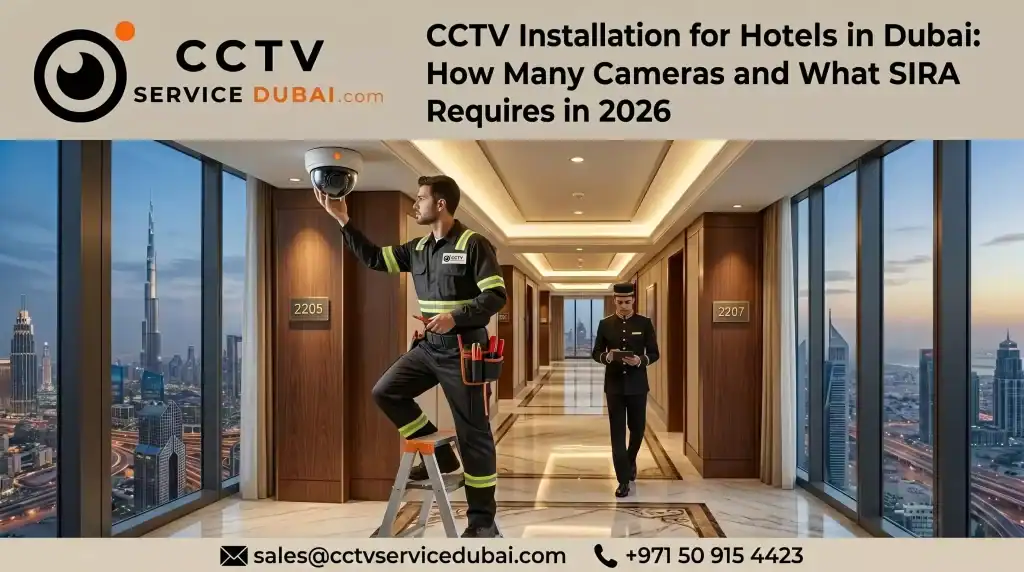
Dubai’s hotel inventory passed 158,700 rooms across more than 800 properties in 2025, with another 4,600 rooms scheduled for delivery this year — and almost every one of those properties is required to run a SIRA-compliant surveillance system. Yet search for guidance on CCTV installation for hotels in Dubai and you’ll find generic commercial CCTV pages that treat a 200-room hotel the same way they’d treat a retail shop or an office floor. This guide breaks down the SIRA CCTV hotel requirements Dubai properties actually face in 2026, and exactly how CCTV installation for hotels in Dubai should be planned — lobby resolution, corridor coverage, valet ANPR, back-of-house, and storage. Almost nothing written about SIRA CCTV hotel requirements Dubai online goes beyond a generic bullet list. This guide is the exception — every section below is built around the specific zones a hotel actually has to cover, not a copy-pasted commercial template. Why Hotels Are a Different SIRA Category Entirely Most SIRA guidance online is written for retail shops, offices, and warehouses. CCTV installation for hotels in Dubai sits in its own category because a hotel has to cover four distinct zones simultaneously — public guest areas, guest-room corridors, vehicle and valet access, and back-of-house staff areas — each with different resolution, placement, and privacy rules. Hotels, hotel apartments, and major hospitality venues are explicitly named under SIRA’s regulated categories, and monitoring entrances, lobbies, and public areas is mandatory to support guest safety, staff accountability, and regulatory compliance. A hotel security camera system Dubai property installs has to satisfy three audiences at once: SIRA inspectors checking technical compliance, hotel insurers requiring documented incident coverage, and guests who expect visible security without feeling surveilled in private spaces. Getting CCTV installation for hotels in Dubai right means designing for all three from day one, not retrofitting compliance after a failed inspection. Understanding the SIRA CCTV hotel requirements Dubai authorities enforce is the first step before any camera goes on a wall. Unlike a retail unit, a hotel is assessed zone by zone during inspection — lobby, corridors, vehicle areas, and back-of-house are reviewed separately, and a strong lobby setup will not compensate for a weak back-of-house one. Treat every zone in a CCTV installation for hotels in Dubai as its own mini-project with its own checklist, and the full-property inspection takes care of itself. Lobby and Reception: Where SIRA’s Highest Resolution Applies The lobby is the single most scrutinised zone in any CCTV installation for hotels in Dubai project, and the zone where cutting corners is most likely to be noticed first during inspection. SIRA’s 2026 update pushes general commercial surveillance toward a 4MP minimum, with 8MP (sometimes described as 4K-equivalent) required at high-risk, facial-identification zones — and a five-star hotel’s main entrance and reception desk are treated the same way as a bank’s primary entrance or a jewellery display: an 8 Megapixel resolution mandate to guarantee usable facial identification. For the lobby and reception area, a proper hotel CCTV system Dubai design — and a properly scoped CCTV installation for hotels in Dubai more broadly — typically includes: Main entrance — one 8MP camera capturing every guest entering and leaving, angled to avoid backlighting from daylight glass doors. Reception/front desk — overhead coverage of the transaction counter, since this is where cash, passports, and payment cards change hands. Concierge and bell desk — covers luggage handling and guest belongings, a common source of disputed-item claims in hotels. Lobby seating and lounge areas — wide-angle coverage for general guest safety and incident documentation. Skimping on lobby resolution is the most common mistake we see in existing hotel CCTV system Dubai installations — a 2MP camera technically “covers” the lobby, but produces footage too blurry to identify a guest’s face if a dispute or theft is reported days later. Lobby cameras are also the first thing a SIRA inspector reviews on any CCTV installation for hotels in Dubai, simply because it’s the highest-traffic, highest-liability zone in the building. Getting this single zone wrong is enough to delay an entire property’s approval, regardless of how well the rest of the system is specified. Corridor Coverage: Mini-Dome Specs for Guest Floors Guest-room corridors are the second-largest coverage zone in any CCTV installation for hotels in Dubai, and the most frequently under-specified. Getting this section right is just as important to a successful CCTV installation for hotels in Dubai as the lobby, even though corridors rarely get the same design attention. SIRA requires adequate coverage of critical areas including entrances, exits, and other high-priority zones — and on guest floors, that means every lift lobby, stairwell exit, and corridor junction, without creating blind spots between cameras. For corridor coverage, the standard hotel CCTV system Dubai specification — and the backbone of any guest-floor CCTV installation for hotels in Dubai — is: Mini-dome cameras at each lift lobby — 4MP minimum, mounted to capture faces of everyone entering or leaving the lift, not just the lift doors themselves. Corridor mid-point cameras — spaced so that no guest room door sits in a blind spot between two cameras’ fields of view; on long corridors this typically means one camera every 15 to 20 metres. Stairwell and fire-exit cameras — frequently skipped in budget CCTV installation for hotels in Dubai quotes, despite being a SIRA-mandated exit point requiring identification-grade footage. Service corridor junctions — where housekeeping carts and staff cross into guest-facing areas, a common spot for in-room theft disputes. Crucially, SIRA prohibits cameras in certain areas including private offices, changing rooms, and toilets — and for hotels this extends to guest-room interiors and bathrooms entirely. Corridor coverage stops at the guest room door; nothing inside the room or visible through it should ever be captured by a compliant hotel security camera system Dubai design. This privacy boundary is one of the most frequently misunderstood parts of CCTV installation for hotels in Dubai. Some installers angle corridor cameras too wide in an attempt to “future-proof” coverage, accidentally capturing
CCTV for Clinics in Dubai: DHA Compliance and SIRA Rules 2026
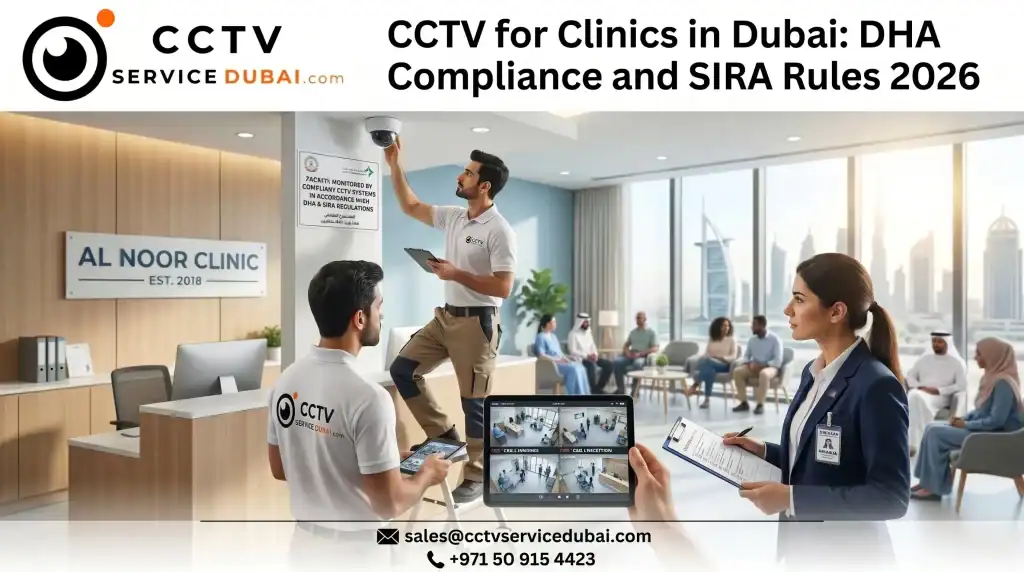
Dubai has over 4,000 licensed medical facilities — general practice clinics, specialist centres, dental clinics, physiotherapy units, day surgery centres, and pharmacies — and every one of them needs CCTV for clinics in Dubai that satisfies two competing regulatory frameworks simultaneously. SIRA requires comprehensive CCTV coverage of commercial premises for security. DHA requires the protection of patient privacy and dignity in clinical spaces. Getting this balance wrong — cameras where DHA prohibits them, or missing cameras where SIRA mandates them — puts any CCTV for clinics in Dubai project at risk of simultaneous DHA and SIRA compliance failures. CCTV for clinics in Dubai is one of the most practically challenging and least-explained compliance topics in the UAE healthcare sector. Clinic managers searching for clear answers on what cameras are required, what is strictly prohibited, and how to design a system that satisfies both SIRA and DHA simultaneously find almost nothing useful. This post fills that gap entirely — covering the exact zones where cameras are mandatory, the zones where cameras are prohibited, the DHA privacy framework that governs clinical CCTV footage, SIRA’s 2026 technical standards as applied to healthcare settings, pharmacy-specific CCTV requirements, and what a compliant CCTV system for a Dubai clinic actually looks like in practice. The Dual Compliance Framework for CCTV for Clinics in Dubai: SIRA and DHA Every CCTV for clinics in Dubai project operates under two regulatory frameworks simultaneously, and neither takes precedence over the other. Both must be satisfied. SIRA (Security Industry Regulatory Agency) governs all commercial surveillance systems in Dubai. SIRA mandates that commercial establishments — including all healthcare facilities — install CCTV covering entrances, exits, public areas, and cash handling zones, with cameras meeting minimum resolution, frame rate, and footage retention standards. SIRA’s requirements are security-focused and do not account for the clinical context of healthcare settings. DHA (Dubai Health Authority) governs all healthcare facilities in Dubai under Local Law No. (6) of 2018 and its 2021 amendment. DHA’s Health Facility Guidelines establish design and operational standards that protect patient wellbeing, safety, privacy, and dignity. The DHA considers CCTV within clinical areas a patient rights and confidentiality matter, imposing strict prohibitions on camera placement in spaces where patients have an expectation of clinical privacy. The correct approach for any CCTV for clinics in Dubai installation is to map the full facility into SIRA-mandatory and DHA-protected zones, then design a camera plan that achieves security coverage in the permitted areas while respecting the clinical privacy boundaries DHA establishes. Every compliant clinic CCTV plan in Dubai starts with this zone mapping exercise. Zone 1 — CCTV for Clinics in Dubai: Entrance, Reception, and Waiting Areas The entrance, reception desk, and waiting area are the primary SIRA-mandatory zones for CCTV for clinics in Dubai. These are non-clinical spaces where patients are neither undressed nor receiving medical treatment, which means DHA’s clinical privacy rules do not apply. SIRA’s full commercial surveillance standards apply here in the same way they do to any other commercial property. Entrance door (exterior and interior): An 8MP camera covering the full door width is mandatory. For clinics with automatic sliding doors—common in Dubai medical centers—the camera should be positioned to capture both the approach from outside and the entry into the reception area, eliminating the blind spot caused by the door itself. Reception desk: An 8MP camera covering the reception desk and the transaction zone between patient and receptionist is required. This zone involves financial transactions (insurance card presentation, copay collection), identity verification, and patient registration—all activities that SIRA treats as requiring high-resolution coverage equivalent to a cash counter in any commercial setting. Patient waiting area: A 4MP wide-angle camera or cameras providing full coverage of the waiting area floor plan. For clinics with a large waiting room, multiple cameras may be needed to eliminate blind spots—SIRA’s standard that cameras must not monitor bathrooms, changing rooms, or any private living areas does not restrict waiting room coverage. SIRA 2026 technical specifications for CCTV for clinics in Dubai in these zones: Entrance/exit points: 8MP minimum Cash counter equivalent (reception desk): 8MP General waiting area: 4MP minimum 25 FPS minimum frame rate IR night vision mandatory 31 days footage retention minimum Zone 2 — CCTV for Clinics in Dubai: Pharmacy and Dispensing Areas Pharmacy CCTV Dubai DHA requirements are the most specific zone rules in any CCTV for clinics in Dubai project. <cite index=”1-1″>CCTV must cover the dispensing area, and DHA inspection may request CCTV recording access for pharmacy compliance purposes.</cite> This makes the pharmacy the zone where SIRA and DHA requirements are most explicitly aligned. Dispensing counter: Pharmacy CCTV Dubai DHA requirements mandate an 8MP camera covering the full dispensing counter — capturing the pharmacist, the medication being dispensed, and the patient receiving the prescription. This camera serves dual purposes: SIRA security coverage of the cash/transaction zone, and DHA’s requirement for an auditable record of controlled substance dispensing. Controlled substance storage cabinet: A dedicated camera covering the controlled substance and high-risk medication storage area is required. This is not explicitly a SIRA mandate in the same way a cash counter is, but it is strongly implied by both DHA’s requirement for dispensing area coverage and the practical security need of any pharmacy. CCTV for clinics in Dubai should treat controlled substance storage as a mandatory zone equivalent to a safe or vault in any other commercial setting. Consultation booth (new 2026 DHA requirement): <cite index=”1-1″>Pharmacist consultation booths require a minimum 2 sqm enclosed or screened space for auditory privacy under DHA’s new 2026 requirement.</cite> The enclosed consultation booth is explicitly a privacy zone — cameras inside the consultation booth are prohibited under DHA’s patient privacy framework. The camera plan should confirm coverage of the consultation area entrance and pharmacy floor without capturing the interior of the consultation booth. Cold storage area: <cite index=”1-1″>DHA now requires continuous digital temperature logging with cloud-based data backup for all pharmaceutical cold storage, and physical paper temperature logs are not accepted for new pharmacy approvals from