
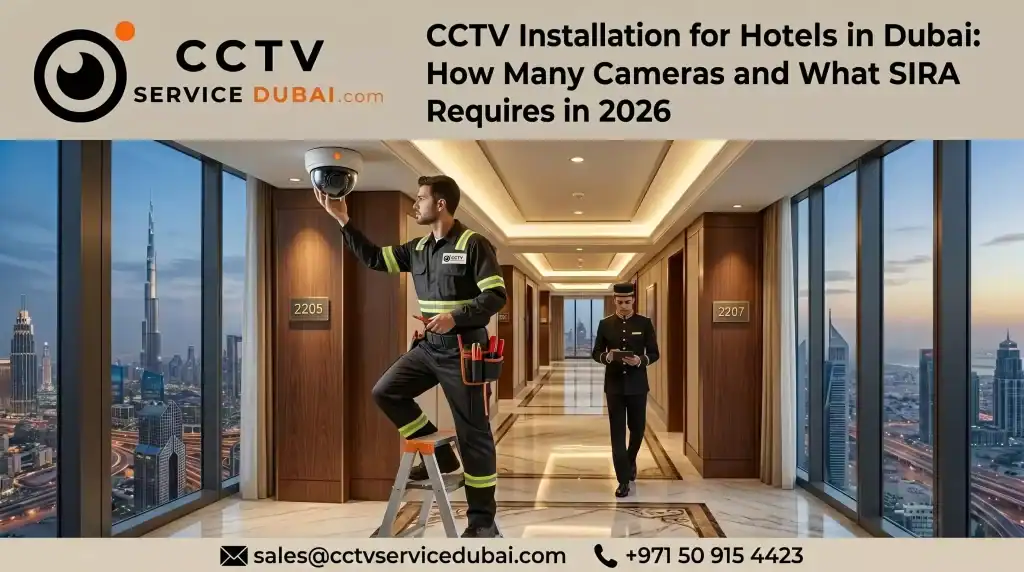
Dubai’s hotel inventory passed 158,700 rooms across more than 800 properties in 2025, with another 4,600 rooms scheduled for delivery this year — and almost every one of those properties is required to run a SIRA-compliant surveillance system. Yet search for guidance on CCTV installation for hotels in Dubai and you’ll find generic commercial CCTV pages that treat a 200-room hotel the same way they’d treat a retail shop or an office floor. This guide breaks down the SIRA CCTV hotel requirements Dubai properties actually face in 2026, and exactly how CCTV installation for hotels in Dubai should be planned — lobby resolution, corridor coverage, valet ANPR, back-of-house, and storage.
Almost nothing written about SIRA CCTV hotel requirements Dubai online goes beyond a generic bullet list. This guide is the exception — every section below is built around the specific zones a hotel actually has to cover, not a copy-pasted commercial template.
Table of Contents
ToggleWhy Hotels Are a Different SIRA Category Entirely
Most SIRA guidance online is written for retail shops, offices, and warehouses. CCTV installation for hotels in Dubai sits in its own category because a hotel has to cover four distinct zones simultaneously — public guest areas, guest-room corridors, vehicle and valet access, and back-of-house staff areas — each with different resolution, placement, and privacy rules. Hotels, hotel apartments, and major hospitality venues are explicitly named under SIRA’s regulated categories, and monitoring entrances, lobbies, and public areas is mandatory to support guest safety, staff accountability, and regulatory compliance.
A hotel security camera system Dubai property installs has to satisfy three audiences at once: SIRA inspectors checking technical compliance, hotel insurers requiring documented incident coverage, and guests who expect visible security without feeling surveilled in private spaces. Getting CCTV installation for hotels in Dubai right means designing for all three from day one, not retrofitting compliance after a failed inspection.
Understanding the SIRA CCTV hotel requirements Dubai authorities enforce is the first step before any camera goes on a wall. Unlike a retail unit, a hotel is assessed zone by zone during inspection — lobby, corridors, vehicle areas, and back-of-house are reviewed separately, and a strong lobby setup will not compensate for a weak back-of-house one. Treat every zone in a CCTV installation for hotels in Dubai as its own mini-project with its own checklist, and the full-property inspection takes care of itself.
Lobby and Reception: Where SIRA's Highest Resolution Applies
The lobby is the single most scrutinised zone in any CCTV installation for hotels in Dubai project, and the zone where cutting corners is most likely to be noticed first during inspection.
SIRA’s 2026 update pushes general commercial surveillance toward a 4MP minimum, with 8MP (sometimes described as 4K-equivalent) required at high-risk, facial-identification zones — and a five-star hotel’s main entrance and reception desk are treated the same way as a bank’s primary entrance or a jewellery display: an 8 Megapixel resolution mandate to guarantee usable facial identification.
For the lobby and reception area, a proper hotel CCTV system Dubai design — and a properly scoped CCTV installation for hotels in Dubai more broadly — typically includes:
- Main entrance — one 8MP camera capturing every guest entering and leaving, angled to avoid backlighting from daylight glass doors.
- Reception/front desk — overhead coverage of the transaction counter, since this is where cash, passports, and payment cards change hands.
- Concierge and bell desk — covers luggage handling and guest belongings, a common source of disputed-item claims in hotels.
- Lobby seating and lounge areas — wide-angle coverage for general guest safety and incident documentation.
Skimping on lobby resolution is the most common mistake we see in existing hotel CCTV system Dubai installations — a 2MP camera technically “covers” the lobby, but produces footage too blurry to identify a guest’s face if a dispute or theft is reported days later.
Lobby cameras are also the first thing a SIRA inspector reviews on any CCTV installation for hotels in Dubai, simply because it’s the highest-traffic, highest-liability zone in the building. Getting this single zone wrong is enough to delay an entire property’s approval, regardless of how well the rest of the system is specified.
Corridor Coverage: Mini-Dome Specs for Guest Floors
Guest-room corridors are the second-largest coverage zone in any CCTV installation for hotels in Dubai, and the most frequently under-specified. Getting this section right is just as important to a successful CCTV installation for hotels in Dubai as the lobby, even though corridors rarely get the same design attention. SIRA requires adequate coverage of critical areas including entrances, exits, and other high-priority zones — and on guest floors, that means every lift lobby, stairwell exit, and corridor junction, without creating blind spots between cameras.
For corridor coverage, the standard hotel CCTV system Dubai specification — and the backbone of any guest-floor CCTV installation for hotels in Dubai — is:
- Mini-dome cameras at each lift lobby — 4MP minimum, mounted to capture faces of everyone entering or leaving the lift, not just the lift doors themselves.
- Corridor mid-point cameras — spaced so that no guest room door sits in a blind spot between two cameras’ fields of view; on long corridors this typically means one camera every 15 to 20 metres.
- Stairwell and fire-exit cameras — frequently skipped in budget CCTV installation for hotels in Dubai quotes, despite being a SIRA-mandated exit point requiring identification-grade footage.
- Service corridor junctions — where housekeeping carts and staff cross into guest-facing areas, a common spot for in-room theft disputes.
Crucially, SIRA prohibits cameras in certain areas including private offices, changing rooms, and toilets — and for hotels this extends to guest-room interiors and bathrooms entirely. Corridor coverage stops at the guest room door; nothing inside the room or visible through it should ever be captured by a compliant hotel security camera system Dubai design.
This privacy boundary is one of the most frequently misunderstood parts of CCTV installation for hotels in Dubai. Some installers angle corridor cameras too wide in an attempt to “future-proof” coverage, accidentally capturing the interior of a room when a door is left open — a clear compliance failure that a careful CCTV installation for hotels in Dubai design avoids entirely with correct lens selection and mounting angle.
Valet and Parking: ANPR for Vehicle Identification
Valet operations are one of the most overlooked zones in CCTV installation for hotels in Dubai planning, yet they’re where high-value disputes — damaged vehicles, missing items, wrong car handed back — happen most often. Properly scoped, vehicle-area coverage should be treated as its own line item in any CCTV installation for hotels in Dubai quote, not bundled loosely into “exterior coverage.” A proper valet and parking setup includes:
- ANPR (Automatic Number Plate Recognition) at the valet drop-off point — captures the plate, time, and condition of every vehicle entering valet service, which is the single best protection against liability disputes.
- Parking area and entrances — full coverage of parking structure entry/exit points, in line with SIRA’s requirement that entrances, exits, cash handling zones, and parking areas all fall under mandatory coverage for regulated facilities.
- Valet podium camera — overhead coverage of the key-handling point, documenting every handover.
Hotels running self-parking alongside valet often forget that both systems need this level of coverage — a security cameras hotel Dubai property installs only at the valet stand, while leaving the self-park ramp uncovered, still fails a full SIRA review of vehicle areas.
Vehicle-area coverage is consistently underbudgeted in CCTV installation for hotels in Dubai quotes, partly because ANPR hardware costs more per camera than a standard dome. Cutting this corner is a false economy — a single disputed valet damage claim, without ANPR evidence, typically costs a hotel far more than the camera would have.
Back-of-House: The Zone Most Hotels Get Wrong
Back-of-house coverage is consistently the weakest part of any CCTV installation for hotels in Dubai we’re asked to audit, despite carrying real financial and operational risk. Kitchens, loading docks, staff entrances, laundry, and the cashier’s cage all carry real operational risk, yet hotel owners frequently treat them as an afterthought once the guest-facing budget is spent.
Minimum back-of-house coverage for a compliant hotel CCTV system Dubai install should include:
- Staff entrance and time-clock area — documents every staff member’s arrival and departure, important for both security and HR disputes.
- Loading dock and goods-in — covers deliveries, a common point of inventory shrinkage in F&B-heavy properties.
- Cashier’s cage / finance office corridor — treated with the same resolution standard as a bank’s cash-counting area, since hotel finance offices handle comparable cash volumes during peak season.
- Laundry and linen store — lower priority than the above, but still a frequent loss point in larger properties.
Back-of-house is where most budget overruns in CCTV installation for hotels in Dubai actually originate — not because the cameras themselves cost more, but because cabling through service corridors, kitchens, and loading areas is more complex than running cable through a finished guest-facing lobby.
Why Hotels Need a Different AMC Approach Too
A hotel’s CCTV installation for hotels in Dubai doesn’t end at handover, and treating it as a one-time project rather than an ongoing service is one of the most expensive mistakes a property can make. Hotels run 24/7, with constant guest turnover, contractor access, and staff changes — which means cameras get knocked, lenses get smudged during housekeeping, and NVR storage fills up faster than in a standard office. An AMC contract built specifically around hospitality should include quarterly lens cleaning on all corridor and lobby cameras, priority same-day response for any lobby or valet camera outage (since these are the two highest-liability zones), and a documented escalation path for SIRA-related incidents.
Generic commercial AMC contracts rarely account for this — which is another reason a hotel-specific CCTV installation for hotels in Dubai partner is worth the extra diligence during vendor selection. Ask any potential vendor how many active hotel AMC contracts they currently hold before signing — it tells you far more than a generic “we service all of Dubai” claim.
Conference Rooms, Ballrooms and Event Spaces
Large hotels with conference centres, ballrooms, and event spaces add an entirely separate layer to CCTV installation for hotels in Dubai planning that boutique properties don’t need to worry about. These spaces host external guests who aren’t hotel residents, high-value AV and catering equipment moves through them constantly, and access changes hour by hour depending on what event is booked.
For properties with meaningful event space, a hotel CCTV system Dubai design should add:
- Pre-function and registration area cameras — covering the entrance to ballrooms and conference halls during event check-in, where badge scanning and guest lists create a separate identification need from the main lobby.
- Loading and AV staging corridor coverage — equipment for large events is frequently wheeled in through back corridors that overlap with back-of-house staff routes, making this a shared coverage zone.
- Ballroom perimeter cameras — wide-angle units covering exits and entrances rather than the room interior itself, since event organisers and guests expect privacy during private functions.
Skipping event-space coverage is a common gap in CCTV installation for hotels in Dubai projects scoped before construction is finished, since conference centres are often the last part of a property to be fitted out and the easiest section to deprioritise when budgets tighten late in a build. Any CCTV installation for hotels in Dubai quote that excludes event space entirely should be treated as incomplete, not as a cost-saving option.
How Many Cameras Does a Hotel Actually Need?
This is the question every GM asks before approving a budget for CCTV installation for hotels in Dubai, and it’s also the question most quotes answer badly with a flat number regardless of property size.
The honest answer is that camera count scales with room count and property type, not a fixed number — but here’s a practical range based on real CCTV installation for hotels in Dubai projects we’ve scoped:
| Hotel Size | Rooms | Public Area Cameras | Corridor Cameras | Back-of-House | Total Cameras |
|---|---|---|---|---|---|
| Boutique | 20–80 | 8–12 | 10–15 | 6–8 | 25–35 |
| Mid-size | 80–250 | 15–25 | 30–50 | 12–18 | 60–95 |
| Large hotel | 250–500 | 25–40 | 60–100 | 20–30 | 110–170 |
| Resort/large luxury | 500+ | 40–70 | 100+ | 30–50 | 180–250+ |
These ranges assume one mini-dome per lift lobby per floor and corridor cameras spaced every 15–20 metres — actual numbers shift based on floor plate shape, number of wings, and whether the property includes a spa, conference centre, or multiple F&B outlets, each of which adds its own coverage requirement to the overall CCTV installation for hotels in Dubai scope.
Resorts and large luxury properties almost always need a phased rollout rather than a single CCTV installation for hotels in Dubai project, simply because 200+ cameras can’t be cabled, configured, and tested in one visit without disrupting daily hotel operations.
Storage and Retention for Hospitality Properties
Storage planning is the part of CCTV installation for hotels in Dubai that gets cut first when budgets tighten, and it’s exactly the wrong place to economise.
SIRA’s baseline retention requirement is a minimum of 31 days of continuous recording for most regulated businesses, with high-security categories such as banks and data centres required to hold footage for 90 days. Hotels generally sit under the standard 31-day rule — but most experienced hotel security consultants recommend extending retention to 60–90 days regardless, since guest disputes, insurance claims, and lost-item complaints are frequently reported well after a stay has ended, sometimes during a follow-up booking weeks later.
For any serious hotel CCTV system Dubai deployment, plan for:
- Surveillance-grade hard drives rated for continuous 24/7 recording, not standard desktop drives
- RAID redundancy for properties above 100 rooms, so a single drive failure doesn’t wipe weeks of footage
- Encrypted, password-protected storage with regular firmware updates, since unsecured hotel CCTV systems are an increasingly common cybersecurity target
- VideoGuard integration, which most commercial Dubai properties are now required to connect to SIRA’s monitoring network
Storage sizing should always be calculated before, not after, a CCTV installation for hotels in Dubai is finalised — retrofitting extra retention onto an undersized NVR later usually means replacing the recorder entirely.
AED Pricing Guide for Hotel CCTV in Dubai (2026)
Pricing for CCTV installation for hotels in Dubai varies more by room count and zone complexity than by star rating alone — a 150-room mid-scale property with a large back-of-house can cost more to cover properly than a smaller boutique luxury hotel with a simpler floor plan.
| Hotel Size | Camera Count | Typical Scope | Estimated Cost (AED) |
|---|---|---|---|
| Boutique (20–80 rooms) | 25–35 | IP cameras, NVR, basic ANPR | 45,000 – 85,000 |
| Mid-size (80–250 rooms) | 60–95 | Full IP system, RAID storage, ANPR | 120,000 – 220,000 |
| Large hotel (250–500 rooms) | 110–170 | Enterprise NVR, VideoGuard integration | 250,000 – 450,000 |
| Resort/large luxury (500+ rooms) | 180–250+ | Multi-site NVR, full ANPR, AMC included | 480,000 – 900,000+ |
These figures cover supply, installation, and basic configuration for a compliant CCTV installation for hotels in Dubai. SIRA documentation, VideoGuard connection, and ongoing AMC support are typically quoted as separate line items, so always ask for an itemised breakdown of any CCTV installation for hotels in Dubai quote before signing.
Common Mistakes Hotel Owners and GMs Make
These are the five mistakes our technicians flag most often when auditing an existing or proposed CCTV installation for hotels in Dubai before a SIRA inspection:
- Under-speccing lobby resolution. A 2MP lobby camera will pass a casual glance but fail identification-grade scrutiny the moment it’s actually needed for an incident report.
- Leaving stairwells and fire exits uncovered. These are mandatory SIRA coverage points, not optional extras, in every CCTV installation for hotels in Dubai we’ve reviewed during pre-inspection audits.
- Covering valet but not self-parking. Partial vehicle-area coverage is one of the fastest ways to fail a full SIRA review, and it’s a gap we still find in a surprising number of finished CCTV installation for hotels in Dubai projects.
- Treating back-of-house as low priority. Staff entrances and loading docks carry as much real operational risk as guest-facing areas, even though they’re rarely visible to guests.
- Sticking to the 31-day minimum on a security cameras hotel Dubai system without considering guest dispute timelines. Many claims surface 30–45 days after checkout, right at the edge of standard retention — a gap that a slightly more generous CCTV installation for hotels in Dubai storage spec closes for a relatively small extra cost.
Frequently Asked Questions
Contact Us
 Email: sales@cctvservicedubai.com
 Phone / WhatsApp: +971 50 915 4423
 Website: https://cctvservicedubai.com/
to request your free site survey. Our SIRA-Approved CCTV Company In Dubai Will respond within 2 hours for all Dubai locations.

Afsal, SEO Content Writer at CCTV Service Dubai
Afsal writes the guides, cost breakdowns, and compliance explainers published on CCTV Service Dubai. His work covers CCTV camera installation, security system planning, and regulatory requirements across Abu Dhabi, Dubai, and the wider UAE, researched and written in close collaboration with the company’s installation and compliance team to keep every article accurate and current.
With a background in SEO and digital content across multiple UAE-based businesses, Afsal focuses on turning technical, regulation-heavy topics — ADMCC and SIRA requirements, camera specifications, storage and retention rules, installation costs — into guides that are actually useful for someone trying to make a decision, not just technically correct.
What Afsal Covers
CCTV camera installation guides for Abu Dhabi, Dubai, and Sharjah
ADMCC and SIRA compliance explainers
CCTV system costs, camera types, and equipment comparisons
Security camera maintenance and best practices
Buying guides for businesses choosing an installation company
How This Content Is Put Together
Every guide is developed alongside CCTV Service Dubai’s installation team, who bring the hands-on project experience — 5+ years in the field and 500+ completed installations across the UAE. Afsal’s role is to research, verify, and write that experience into guides that are clear, accurate, and genuinely helpful, rather than generic content pulled from unrelated sources.