
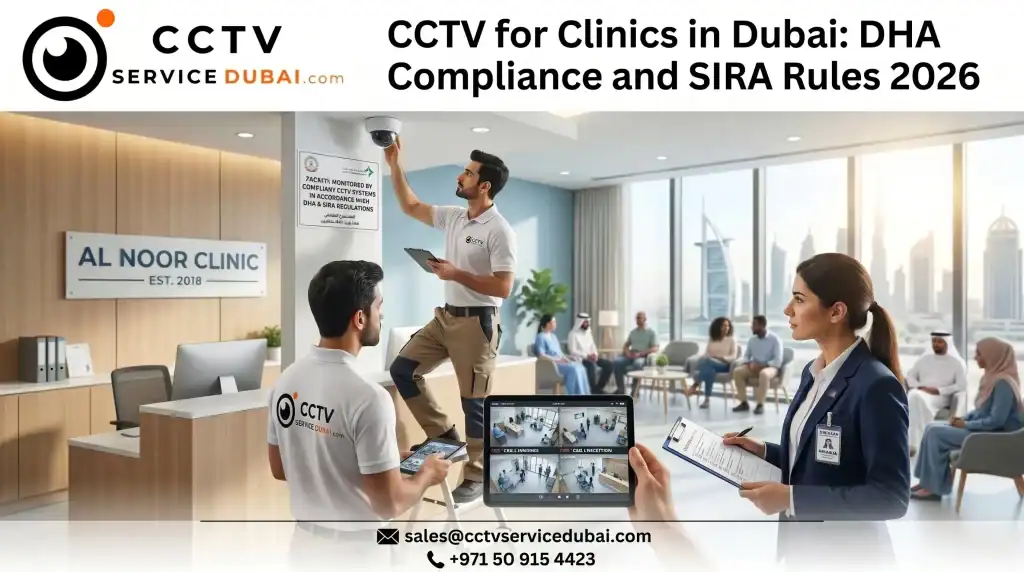
Dubai has over 4,000 licensed medical facilities — general practice clinics, specialist centres, dental clinics, physiotherapy units, day surgery centres, and pharmacies — and every one of them needs CCTV for clinics in Dubai that satisfies two competing regulatory frameworks simultaneously. SIRA requires comprehensive CCTV coverage of commercial premises for security. DHA requires the protection of patient privacy and dignity in clinical spaces. Getting this balance wrong — cameras where DHA prohibits them, or missing cameras where SIRA mandates them — puts any CCTV for clinics in Dubai project at risk of simultaneous DHA and SIRA compliance failures.
CCTV for clinics in Dubai is one of the most practically challenging and least-explained compliance topics in the UAE healthcare sector. Clinic managers searching for clear answers on what cameras are required, what is strictly prohibited, and how to design a system that satisfies both SIRA and DHA simultaneously find almost nothing useful. This post fills that gap entirely — covering the exact zones where cameras are mandatory, the zones where cameras are prohibited, the DHA privacy framework that governs clinical CCTV footage, SIRA’s 2026 technical standards as applied to healthcare settings, pharmacy-specific CCTV requirements, and what a compliant CCTV system for a Dubai clinic actually looks like in practice.
Table of Contents
ToggleThe Dual Compliance Framework for CCTV for Clinics in Dubai: SIRA and DHA
Every CCTV for clinics in Dubai project operates under two regulatory frameworks simultaneously, and neither takes precedence over the other. Both must be satisfied.
SIRA (Security Industry Regulatory Agency) governs all commercial surveillance systems in Dubai. SIRA mandates that commercial establishments — including all healthcare facilities — install CCTV covering entrances, exits, public areas, and cash handling zones, with cameras meeting minimum resolution, frame rate, and footage retention standards. SIRA’s requirements are security-focused and do not account for the clinical context of healthcare settings.
DHA (Dubai Health Authority) governs all healthcare facilities in Dubai under Local Law No. (6) of 2018 and its 2021 amendment. DHA’s Health Facility Guidelines establish design and operational standards that protect patient wellbeing, safety, privacy, and dignity. The DHA considers CCTV within clinical areas a patient rights and confidentiality matter, imposing strict prohibitions on camera placement in spaces where patients have an expectation of clinical privacy.
The correct approach for any CCTV for clinics in Dubai installation is to map the full facility into SIRA-mandatory and DHA-protected zones, then design a camera plan that achieves security coverage in the permitted areas while respecting the clinical privacy boundaries DHA establishes. Every compliant clinic CCTV plan in Dubai starts with this zone mapping exercise.
Zone 1 — CCTV for Clinics in Dubai: Entrance, Reception, and Waiting Areas
The entrance, reception desk, and waiting area are the primary SIRA-mandatory zones for CCTV for clinics in Dubai. These are non-clinical spaces where patients are neither undressed nor receiving medical treatment, which means DHA’s clinical privacy rules do not apply. SIRA’s full commercial surveillance standards apply here in the same way they do to any other commercial property.
Entrance door (exterior and interior): An 8MP camera covering the full door width is mandatory. For clinics with automatic sliding doors—common in Dubai medical centers—the camera should be positioned to capture both the approach from outside and the entry into the reception area, eliminating the blind spot caused by the door itself.
Reception desk: An 8MP camera covering the reception desk and the transaction zone between patient and receptionist is required. This zone involves financial transactions (insurance card presentation, copay collection), identity verification, and patient registration—all activities that SIRA treats as requiring high-resolution coverage equivalent to a cash counter in any commercial setting.
Patient waiting area: A 4MP wide-angle camera or cameras providing full coverage of the waiting area floor plan. For clinics with a large waiting room, multiple cameras may be needed to eliminate blind spots—SIRA’s standard that cameras must not monitor bathrooms, changing rooms, or any private living areas does not restrict waiting room coverage.
SIRA 2026 technical specifications for CCTV for clinics in Dubai in these zones:
- Entrance/exit points: 8MP minimum
- Cash counter equivalent (reception desk): 8MP
- General waiting area: 4MP minimum
- 25 FPS minimum frame rate
- IR night vision mandatory
- 31 days footage retention minimum
Zone 2 — CCTV for Clinics in Dubai: Pharmacy and Dispensing Areas
Pharmacy CCTV Dubai DHA requirements are the most specific zone rules in any CCTV for clinics in Dubai project. <cite index=”1-1″>CCTV must cover the dispensing area, and DHA inspection may request CCTV recording access for pharmacy compliance purposes.</cite> This makes the pharmacy the zone where SIRA and DHA requirements are most explicitly aligned.
Dispensing counter: Pharmacy CCTV Dubai DHA requirements mandate an 8MP camera covering the full dispensing counter — capturing the pharmacist, the medication being dispensed, and the patient receiving the prescription. This camera serves dual purposes: SIRA security coverage of the cash/transaction zone, and DHA’s requirement for an auditable record of controlled substance dispensing.
Controlled substance storage cabinet: A dedicated camera covering the controlled substance and high-risk medication storage area is required. This is not explicitly a SIRA mandate in the same way a cash counter is, but it is strongly implied by both DHA’s requirement for dispensing area coverage and the practical security need of any pharmacy. CCTV for clinics in Dubai should treat controlled substance storage as a mandatory zone equivalent to a safe or vault in any other commercial setting.
Consultation booth (new 2026 DHA requirement): <cite index=”1-1″>Pharmacist consultation booths require a minimum 2 sqm enclosed or screened space for auditory privacy under DHA’s new 2026 requirement.</cite> The enclosed consultation booth is explicitly a privacy zone — cameras inside the consultation booth are prohibited under DHA’s patient privacy framework. The camera plan should confirm coverage of the consultation area entrance and pharmacy floor without capturing the interior of the consultation booth.
Cold storage area: <cite index=”1-1″>DHA now requires continuous digital temperature logging with cloud-based data backup for all pharmaceutical cold storage, and physical paper temperature logs are not accepted for new pharmacy approvals from 2026. </cite> While this is a monitoring system rather than CCTV, it is part of the overall pharmacy surveillance compliance requirement that clinic managers must address alongside the CCTV plan.
Zone 3 — CCTV for Clinics in Dubai: Corridor and Shared Clinical Zones
Corridors present the most nuanced CCTV for clinics in Dubai planning challenge — caught between SIRA’s mandate and DHA’s patient privacy rules. On one hand, SIRA’s commercial surveillance mandate extends to all common areas of a building. On the other, DHA’s patient privacy framework extends to any space where patients may be in clinical gowns, transporting between treatment areas, or in a state of clinical vulnerability.
Corridor cameras — DHA-compliant approach: For CCTV for clinics in Dubai, corridor cameras should be angled toward the end of the corridor (covering it longitudinally) rather than positioned to look into open treatment room doorways. The camera captures movement through the corridor for security purposes without recording clinical activity inside treatment rooms even when doors are open.
Camera height matters significantly here: a camera mounted at 3–3.5 metres with a downward tilt of 10–15 degrees provides useful security footage of the corridor without a line of sight into adjacent rooms through open doorways.
Shared clinical areas (physiotherapy floors, imaging waiting areas): Where patients are waiting but clothed and not in treatment, standard CCTV coverage is acceptable under DHA’s framework. Where patients are in clinical gowns, on treatment plinths, or in imaging positions, cameras are prohibited.
Zone 4 — CCTV for Clinics in Dubai: Prohibited Clinical Treatment Rooms
This is the most important zone ruling for CCTV for clinics in Dubai. It is the answer clinic managers most frequently need: cameras are prohibited inside clinical consultation rooms, examination rooms, and treatment areas under DHA’s patient privacy framework.
DHA’s Health Facility Guidelines establish patient wellbeing, safety, privacy, and dignity as core design and operational principles. Installing a camera inside a consultation room where a GP examines a patient, inside a gynaecology room, inside a physiotherapy treatment bay, or inside a dental treatment room violates the patient’s right to privacy and dignity — and would constitute a DHA compliance failure that could result in licence sanctions.
The legal basis: <cite index=”8-1″>Sector-specific guidelines issued by regulatory bodies like the Dubai Health Authority may impose additional rules for CCTV usage within their jurisdictions beyond the base UAE privacy framework.</cite> The UAE Data Protection Law and associated regulations additionally establish clear limits on justifying camera use in spaces where individuals have a reasonable expectation of privacy — clinical examination rooms are unequivocally such spaces.
The complete list of prohibited zones for CCTV for clinics in Dubai:
- Consultation/examination rooms (GP, specialist, dental, physiotherapy, ophthalmology)
- Treatment rooms (injection rooms, infusion rooms, minor procedure rooms)
- Operating theatres and recovery areas
- Radiology and imaging rooms (X-ray, MRI, ultrasound examination positions)
- Patient bathrooms and changing areas
- Lactation/breastfeeding rooms
- Any space where a patient is required to remove clothing or be in clinical examination position
Zone 5—CCTV for Clinics in Dubai: Day Surgery Centres and Hospital Wards
CCTV hospital Dubai SIRA requirements add complexity beyond standard CCTV for clinics in Dubai, particularly in day surgery centres and hospital settings. These facilities have additional zones that require specific camera planning decisions.
Pre-operative waiting area: Patients are clothed, waiting in a clinical but non-examination context. CCTV coverage is acceptable for security purposes, following the same standard as a general waiting area.
Recovery area: Post-operative patients are in clinical beds in gowns, often connected to monitoring equipment. Camera coverage is prohibited in the recovery bays themselves. A camera positioned at the recovery area entrance — capturing who enters and exits the zone rather than the patients — is an acceptable SIRA compromise that does not violate DHA’s patient dignity standards.
Hospital corridors: Standard corridor coverage rules apply, with cameras angled to avoid patient bay interiors.
Nursing stations and medication rooms: Camera coverage of nursing stations and medication dispensing rooms within hospitals is both SIRA-recommended (as cash/transaction-equivalent zones) and DHA-acceptable, since these are staff operational areas rather than patient examination spaces.
Designing Compliant CCTV for Clinics in Dubai: Step-by-Step
CCTV for clinics in Dubai must be designed before fit-out begins — installing it as an afterthought is one of the costliest mistakes a clinic manager can make. The reason: DHA’s four-authority approval process requires compliance documentation at submission stage, and camera positions must be shown on the facility floor plan submitted to DHA via the Sheryan portal.
Step 1: Floor Plan Zone Mapping This is the foundation of every compliant CCTV for clinics in Dubai design. Mark every room on the clinic floor plan with its zone classification:
- DHA-prohibited (treatment rooms, examination areas, changing rooms)
- Conditional (corridors — coverage permitted with placement restrictions)
- SIRA-mandatory (entrance, reception, pharmacy dispensing, cash areas, waiting rooms)
- Staff-only (nursing stations, medication rooms, back office)
Step 2: Camera Plan Design Place cameras only in and zones, with careful positioning in zones. This placement discipline is what distinguishes a compliant CCTV for clinics in Dubai installation from one that creates DHA exposure. The camera plan for CCTV for clinics in Dubai should show each camera’s field of view on the floor plan, confirming that no treatment room interior is captured by any camera.
Step 3: DHA Submission <cite index=”1-1″>The Sheryan portal (sheryan.dha.gov.ae) is DHA’s primary platform for all Healthcare Facility Licence applications and renewals.</cite> The CCTV plan — showing camera positions, fields of view, and zone classifications — is submitted as part of the facility design documentation. DHA’s health inspectors check this against the physical installation during the facility inspection.
Step 4: SIRA-Licensed Installation Security camera installation clinic Dubai must always be carried out by a SIRA-licensed company — a requirement that applies both to SIRA compliance and DHA documentation. An installation certificate from an unlicensed contractor is not accepted for either SIRA or DHA documentation purposes.
Step 5: NVR Configuration and Access Controls The NVR storing CCTV for clinics in Dubai footage must have access controls restricting who can view and retrieve footage. <cite index=”6-1″>Healthcare facilities are responsible for the security of their information systems and networks and should act in a timely and co-operative manner to prevent, detect, and respond to security incidents.</cite> This extends to CCTV footage — role-based NVR access (clinic manager can access all footage; reception staff cannot) is a DHA data governance expectation.
CCTV for Clinics in Dubai — Camera Count and Cost in AED
| Clinic Type | SIRA-Compliant Cameras | Estimated Installation Cost (AED) |
|---|---|---|
| Small GP/general clinic (3–5 rooms) | 6–8 cameras | 6,000 – 10,000 |
| Dental clinic (4–6 chairs) | 8–10 cameras | 8,000 – 13,000 |
| Specialist clinic (8–12 rooms) | 10–15 cameras | 11,000 – 20,000 |
| Medical centre (20+ rooms) | 16–25 cameras | 20,000 – 38,000 |
| Day surgery centre | 20–30 cameras | 25,000 – 45,000 |
| Pharmacy (standalone) | 4–6 cameras | 4,500 – 8,000 |
Important: All estimates for CCTV for clinics in Dubai above include only cameras in DHA-permitted zones. Treatment room cameras that some general CCTV contractors might propose are excluded from all estimates above — these would constitute a DHA compliance violation.
Common Mistakes Clinics Make With CCTV for Clinics in Dubai
Mistake 1: Installing cameras in consultation rooms This is the most common and serious CCTV for clinics in Dubai error. Some general CCTV contractors propose cameras inside examination rooms as part of a standard commercial plan. Any camera inside a consultation or examination room is a DHA compliance violation. Ensure your CCTV installer understands the clinical privacy framework before the design stage.
Mistake 2: Using the CCTV footage for purposes beyond security CCTV footage from a Dubai clinic must be used for security purposes only. Using lobby or reception footage to monitor staff attendance or patient flow for operational purposes without explicit consent crosses into DHA’s data governance framework.
Mistake 3: No footage retention policy SIRA requires a minimum 31 days of footage retention. For CCTV for clinics in Dubai,, the clinic’s information governance policy should specify exactly how long footage is retained, who has access, and under what circumstances footage is reviewed — DHA’s data protection framework requires this documentation.
Mistake 4: No access control on the NVR Clinic CCTV footage may contain incidental images of patients in clinical areas adjacent to permitted camera zones. Unrestricted access to the NVR or cloud storage for all clinic staff creates a DHA data governance exposure. NVR access must be role-restricted from the outset.
Mistake 5: Skipping the Sheryan submission step Clinics that install CCTV for clinics in Dubai during fit-out without submitting the camera plan risk a non-compliance finding during the DHA facility inspection — requiring camera repositioning or removal before the licence is issued.
Getting CCTV for Clinics in Dubai Installed Correctly
CCTV for clinics in Dubai is a specialist installation. It requires an installer who understands both SIRA’s technical standards and DHA’s patient privacy framework. A general CCTV company unfamiliar with DHA rules will propose a standard commercial camera plan that violates DHA’s zone rules — creating a CCTV for clinics in Dubai compliance risk you only discover during the DHA facility inspection.
CCTV Service Dubai is the specialist for CCTV for clinics in Dubai across all medical facility types — general practice clinics, dental clinics, specialist centres, day surgery centres, medical centres, and standalone pharmacies. Our SIRA-certified technicians design CCTV for clinics in Dubai camera plans that satisfy both SIRA and DHA’s clinical privacy framework, with full documentation for the Sheryan portal submission.
Call +971 50 915 4423 for a free CCTV for clinics in Dubai consultation or visit cctvservicedubai.com/service/ to request a quotation.
Frequently Asked Questions — CCTV for Clinics in Dubai 2026
Contact Us
Looking for professional CCTV repair in Hamdan Street Abu Dhabi services?
 Email: sales@cctvservicedubai.com
 Phone / WhatsApp: +971 50 915 4423
 Website: https://cctvservicedubai.com/
to request your free site survey. Our SIRA-Approved CCTV Company In Dubai Will respond within 2 hours for all Dubai locations.

Afsal, SEO Content Writer at CCTV Service Dubai
Afsal writes the guides, cost breakdowns, and compliance explainers published on CCTV Service Dubai. His work covers CCTV camera installation, security system planning, and regulatory requirements across Abu Dhabi, Dubai, and the wider UAE, researched and written in close collaboration with the company’s installation and compliance team to keep every article accurate and current.
With a background in SEO and digital content across multiple UAE-based businesses, Afsal focuses on turning technical, regulation-heavy topics — ADMCC and SIRA requirements, camera specifications, storage and retention rules, installation costs — into guides that are actually useful for someone trying to make a decision, not just technically correct.
What Afsal Covers
CCTV camera installation guides for Abu Dhabi, Dubai, and Sharjah
ADMCC and SIRA compliance explainers
CCTV system costs, camera types, and equipment comparisons
Security camera maintenance and best practices
Buying guides for businesses choosing an installation company
How This Content Is Put Together
Every guide is developed alongside CCTV Service Dubai’s installation team, who bring the hands-on project experience — 5+ years in the field and 500+ completed installations across the UAE. Afsal’s role is to research, verify, and write that experience into guides that are clear, accurate, and genuinely helpful, rather than generic content pulled from unrelated sources.