
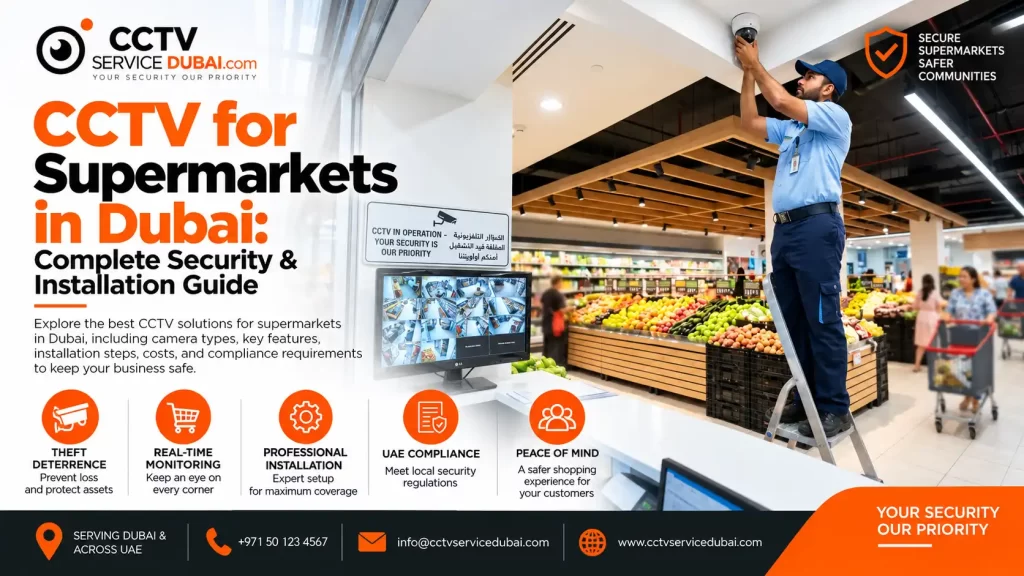
A supermarket has a different CCTV requirement from a typical office or small retail shop. There are multiple entrances, long aisles, checkout counters, storage areas, staff zones, loading bays and parking areas—all with different security risks.
For supermarket owners and operations managers, CCTV for supermarkets in Dubai is not just about recording what happens inside the store. A properly planned system should help deter theft, monitor cash counters, investigate incidents, protect employees and customers, and give the security team a clear view of important areas.
The challenge is choosing the right cameras and placing them correctly without creating unnecessary blind spots or spending money on equipment that does not improve coverage.
Table of Contents
ToggleKey Takeaway
The best supermarket CCTV system combines the right camera types, strategic placement, sufficient recording storage and professional installation.
For a Dubai supermarket, the CCTV plan should consider:
- Customer entrances and exits
- Checkout and cashier areas
- Shopping aisles
- High-value product sections
- Emergency exits
- Warehouses and storage rooms
- Loading and unloading areas
- Staff entrances
- Elevators and stairways where applicable
- Parking and vehicle entrances
- Security/control rooms
For applicable Dubai facilities, CCTV planning also needs to consider SIRA requirements. SIRA’s current security requirements for large and diverse stores specify camera coverage for areas including entrances, emergency exits, elevators and stairs, cashier/reception desks, display areas, main store areas and shelf aisles.
Why Do Supermarkets Need CCTV in Dubai?
Supermarkets need CCTV because they have a combination of high customer traffic, valuable inventory, cash transactions and multiple access points that can be difficult to monitor manually.
A well-designed system can help with:
- Theft prevention
- Employee safety
- Customer incident investigation
- Cash-counter monitoring
- Inventory-related investigations
- Monitoring restricted areas
- Reviewing accidents
- Monitoring deliveries
- Parking security
- Identifying suspicious activity
CCTV does not eliminate theft or guarantee that every incident will be prevented. Its value comes from combining visible surveillance, proper camera positioning, recording and an effective security process.
What Areas Should CCTV Cover in a Supermarket?
Camera placement is more important than simply increasing the number of cameras.
A supermarket may need different camera views for different purposes.
| Area | Recommended CCTV purpose |
|---|---|
| Main entrance | Identify people entering and leaving |
| Store exits | Monitor customer movement and incidents |
| Checkout counters | Monitor transactions and cashier areas |
| Shopping aisles | Detect and investigate suspicious activity |
| High-value products | Provide closer coverage |
| Emergency exits | Monitor unauthorized use |
| Warehouse | Monitor inventory and staff activity |
| Loading bay | Monitor deliveries and vehicle movement |
| Staff entrance | Control and monitor employee access |
| Parking area | Monitor vehicles and surrounding activity |
| Cash office | Restricted-area monitoring |
| Storage rooms | Protect inventory |
Dubai’s SIRA requirements for large and diverse stores specifically identify entrances, emergency exits, elevators/stairs, cashier and reception desks, display tables, main store areas and shelf aisles as CCTV coverage areas.
This is why a supermarket CCTV design should begin with a site survey and coverage plan, rather than simply deciding how many cameras to purchase.
What Is the Best CCTV Camera for a Supermarket?
There is no single best CCTV camera for every supermarket. The right choice depends on the location, lighting, viewing distance and type of activity being monitored.
Dome Cameras
Dome cameras are often suitable for indoor supermarket areas.
They can work well in:
- Shopping aisles
- Checkout areas
- Customer service desks
- Indoor entrances
- General retail areas
Their compact appearance also makes them practical where aesthetics matter.
Bullet Cameras
Bullet cameras can be useful where longer-distance or outdoor coverage is required.
They may be suitable for:
- Parking areas
- Loading bays
- Building entrances
- External approaches
- Perimeter areas
PTZ Cameras
PTZ cameras can pan, tilt and zoom, making them useful for monitoring larger areas.
However, a PTZ should not automatically be used as a replacement for fixed cameras. When a PTZ is looking in another direction, it cannot provide continuous coverage of the previous area.
Varifocal Cameras
Varifocal cameras allow the lens to be adjusted to achieve the desired field of view.
They can be useful where the exact viewing distance needs to be fine-tuned during installation.
How Should Checkout Counters Be Monitored?
Checkout areas require careful camera positioning because the objective is not simply to record the entire checkout zone.
A supermarket may need cameras positioned to provide useful views of:
- Cashier activity
- Checkout lanes
- Customer interaction
- Payment areas
- Surrounding movement
The camera should be positioned so important activity is visible without being obstructed by displays, signage or equipment.
For large retail environments, SIRA’s published requirements specify recognition view for cashier and reception desks.
This highlights an important principle: camera placement should be based on the required level of identification or observation, not just camera megapixels.
How Can CCTV Help Prevent Supermarket Theft?
CCTV can act as a deterrent and provide recorded evidence when suspicious activity or theft occurs.
High-risk areas may include:
- Small high-value products
- Electronics
- Cosmetics
- Pharmacy sections
- Alcohol sections where applicable
- Self-checkout areas
- Store exits
- Stockrooms
However, simply placing a camera above an aisle does not guarantee useful footage.
The camera needs the correct:
- Lens
- Height
- Angle
- Resolution
- Lighting
- Field of view
For example, a wide-angle camera may cover an entire aisle but provide insufficient detail to identify a person at the far end.
That is why supermarket CCTV design should balance coverage and identification.
Should Supermarkets Use CCTV at Emergency Exits?
Yes, emergency exits can require dedicated surveillance coverage, subject to the applicable security plan and requirements.
Emergency exits can be vulnerable to unauthorized access, particularly when they lead directly outside the building or into parking areas.
SIRA’s requirements for large and diverse stores identify emergency exit doors as CCTV coverage points, with different view requirements depending on the location.
The installation should also avoid interfering with the operation of emergency exits or other life-safety equipment.
What About Supermarket Warehouses and Loading Areas?
Warehouse and loading areas should be treated as separate surveillance zones because they involve inventory movement, staff activity and delivery vehicles.
Useful camera locations can include:
- Loading dock
- Delivery entrance
- Goods receiving area
- Warehouse aisles
- Storage rooms
- Staff-only doors
- Waste disposal areas
- External service areas
These cameras can help investigate questions such as:
- When did a delivery arrive?
- Who entered the warehouse?
- Was stock moved?
- Was a restricted door opened?
- Which vehicle was present?
- What happened during a disputed delivery?
For larger supermarkets, these recordings can become particularly useful during inventory investigations.
What Type of Security System Does a Supermarket Need?
A supermarket normally benefits from more than CCTV alone.
A complete security system for a supermarket may combine:
- CCTV surveillance
- Access control
- Intruder alarm
- Intercom
- Panic/emergency communication where applicable
- ANPR for suitable parking applications
- Security monitoring
- Network infrastructure
- Central control-room monitoring
The systems do not necessarily have to be fully integrated, but they should be planned together.
For example:
CCTV → Visual monitoring
Access control → Restricted-area access
Intruder alarm → Unauthorized entry detection
ANPR → Vehicle identification
This layered approach is more useful than expecting CCTV to solve every security problem.
SIRA describes integrated security systems as frameworks combining approved security technologies with operations-room connectivity to improve security and emergency response.
Is CCTV Installation for a Supermarket in Dubai Different From Normal CCTV Installation?
Yes. Supermarket CCTV installation requires more detailed planning because of the size, customer traffic, shelving, checkout areas and multiple operational zones.
A professional installation should normally involve:
1. Site Survey
The installer assesses:
- Store layout
- Ceiling height
- Lighting
- Entrances
- Aisle arrangement
- Checkout locations
- Warehouse areas
- Parking
- Existing network/cabling
2. Camera Planning
Each camera should have a defined purpose.
Instead of saying “we need 40 cameras,” the design should identify:
Camera 01 → Main entrance identification
Camera 02 → Exit monitoring
Camera 03 → Checkout 1
Camera 04 → High-value aisle
This makes the final system easier to manage and maintain.
3. Cabling and Network
For an IP CCTV system, the installer needs to plan:
- Cat6 or appropriate network cabling
- PoE switches
- Network racks
- NVR/server
- VLAN/network configuration where appropriate
- UPS/power protection
4. Recording Configuration
The system should be configured according to the required recording period, camera count, resolution and frame rate.
5. Testing
Every camera should be checked during day and night conditions where relevant.
Does SIRA Apply to Supermarket CCTV in Dubai?
SIRA requirements can apply to supermarket and retail security systems in Dubai, depending on the facility and activity classification.
SIRA’s Preventive Systems Manual specifically includes large and diverse stores, covering large retail chains and large individual stores. The published requirements include defined CCTV coverage for entrances, cashier areas, aisles, emergency exits and other locations.
SIRA also provides a security-plan certification service for applicable camera and alarm systems. The service requires documents such as a trade license, planning map and project plan.
SIRA also states that cameras and recorders used in approved security systems are subject to its security-equipment approval process, with applications submitted through licensed security service providers.
Because requirements can depend on the specific facility and activity, supermarket operators should verify the applicable requirements before installation or major system changes.
What Should You Ask a CCTV Company Before Installation?
Before accepting a quotation, ask the installer:
- How many cameras are actually required?
- What is the purpose of each camera?
- Which cameras are for identification?
- Which cameras are for general observation?
- What resolution is being proposed?
- What lens will be used?
- How many days of recording are included?
- Is the NVR included?
- Is storage included?
- Are PoE switches included?
- Is network cabling included?
- Does the quotation include installation?
- Will the system be configured for remote monitoring?
- Is SIRA documentation included where applicable?
- Is testing and commissioning included?
- What warranty is provided?
- Is AMC available?
A detailed quotation is much easier to compare than a quote that simply says “CCTV package – 30 cameras.”
How Much Does Supermarket CCTV Installation Cost in Dubai?
There is no fixed supermarket CCTV installation price because the project scope can vary significantly.
The main cost factors include:
- Number of cameras
- Camera resolution
- Camera type
- Lens type
- NVR capacity
- Hard-drive storage
- PoE switches
- Network cabling
- Ceiling height
- Installation difficulty
- Number of floors
- Parking coverage
- External cameras
- Control-room requirements
- Remote monitoring
- Compliance and documentation
- Maintenance requirements
A small neighborhood supermarket and a large hypermarket should not be expected to have the same CCTV budget.
The most useful way to compare quotations is to request an itemized proposal with a camera schedule and storage calculation.
What Makes a Good Supermarket CCTV System?
A good system should provide more than high-resolution video.
Look for:
Good coverage – important areas are not left with blind spots.
Useful identification – cameras are positioned for the level of detail required.
Reliable recording – the recorder and storage are properly sized.
Good night performance – external and low-light areas remain usable after dark.
Secure infrastructure – cameras, network equipment and recording devices are protected.
Scalability – additional cameras can be added if the supermarket expands.
Professional maintenance – faults are detected and corrected before they become serious problems.
SIRA also offers a Video Guard service for monitoring the performance and faults of CCTV systems, and its published information lists supermarkets among the facility categories covered by the service.
Final Takeaway
CCTV for supermarkets in Dubai should be designed around the way the supermarket actually operates.
The best system is not necessarily the one with the highest number of cameras or the most expensive specifications.
It is the system that gives the right level of visibility at:
- Entrances
- Checkout counters
- Shopping aisles
- High-value product areas
- Emergency exits
- Warehouses
- Loading bays
- Staff areas
- Parking
- Other security-sensitive locations
For Dubai supermarkets, the CCTV design should also be reviewed against applicable SIRA requirements before installation.
If you are opening a new supermarket, renovating an existing store or replacing an outdated CCTV system, start with a site survey and camera coverage plan rather than purchasing cameras first.
Need CCTV Installation for a Supermarket in Dubai?
CCTV Service Dubai provides CCTV installation, IP camera systems, CCTV maintenance and AMC, remote monitoring, access control and other security solutions for commercial properties.
Phone: +971549953360
Email: sales@cctvservicedubai.com
Website: https://cctvservicedubai.com/
SIRA – Security Plans Certification
SIRA – Security System Certification

Afsal, SEO Content Writer at CCTV Service Dubai
Afsal writes the guides, cost breakdowns, and compliance explainers published on CCTV Service Dubai. His work covers CCTV camera installation, security system planning, and regulatory requirements across Abu Dhabi, Dubai, and the wider UAE, researched and written in close collaboration with the company’s installation and compliance team to keep every article accurate and current.
With a background in SEO and digital content across multiple UAE-based businesses, Afsal focuses on turning technical, regulation-heavy topics — ADMCC and SIRA requirements, camera specifications, storage and retention rules, installation costs — into guides that are actually useful for someone trying to make a decision, not just technically correct.
What Afsal Covers
CCTV camera installation guides for Abu Dhabi, Dubai, and Sharjah
ADMCC and SIRA compliance explainers
CCTV system costs, camera types, and equipment comparisons
Security camera maintenance and best practices
Buying guides for businesses choosing an installation company
How This Content Is Put Together
Every guide is developed alongside CCTV Service Dubai’s installation team, who bring the hands-on project experience — 5+ years in the field and 500+ completed installations across the UAE. Afsal’s role is to research, verify, and write that experience into guides that are clear, accurate, and genuinely helpful, rather than generic content pulled from unrelated sources.