
Planning effective CCTV area coverage is not simply about choosing a camera with a high megapixel count. A camera might show a wide area on screen but still fail to capture enough detail to identify a person or read a vehicle registration plate.
For homes, offices, shops, warehouses, and commercial properties in the UAE, proper CCTV area coverage depends on the camera lens, resolution, mounting height, viewing angle, lighting, and the level of detail required.
Dome cameras are popular for indoor and outdoor surveillance, but how far can they really see? And which software can help you plan camera positions before installation?
This guide explains dome camera coverage, field of view, blind spots, camera placement, and CCTV coverage software to help you plan a more effective security system.
Table of Contents
ToggleWhat Does CCTV Area Coverage Actually Mean?
CCTV area coverage describes the physical area visible to a camera and the level of detail it can capture within that area.
There are two important considerations:
Field of view (FOV): How much of the scene the camera can see.
Useful image detail: Whether the footage provides enough information to detect movement, recognize a person, or identify a subject.
A wide-angle camera may cover an entire room, but distant faces can appear too small for identification. A narrower lens may capture more detail in a specific location but leave other areas outside its view.
Effective CCTV area coverage means balancing the viewing area with the detail needed for the security objective.
Add Your Heading Text Here
There is no single distance that applies to every dome camera. Actual coverage depends on the lens, sensor, resolution, lighting, camera position, and the size of the object being observed.
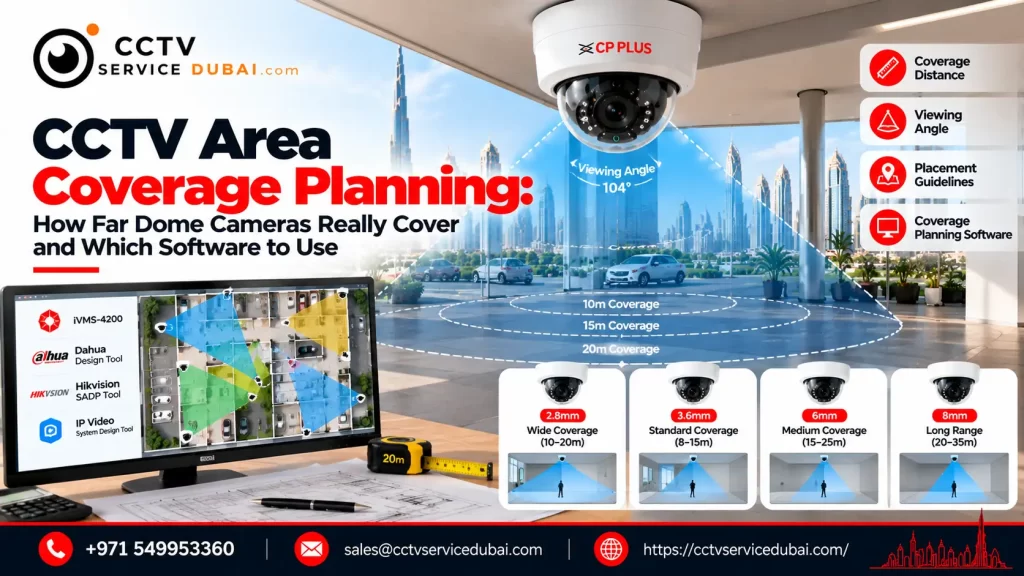
Wide-angle dome cameras
A wide-angle dome camera is useful for covering rooms, reception areas, corridors, and entrances. It can capture a broad scene from a suitable mounting position.
However, widening the field of view spreads the available image detail across a larger area. People at the far end of a large room may be visible without being identifiable.
Varifocal dome cameras
A varifocal dome camera allows its lens to be adjusted across a supported focal-length range.
This helps installers choose between a wider view and a narrower view with more detail concentrated on a particular area.
For example, a reception desk may need a focused view of visitors, while a corridor may benefit from broader coverage.
Infrared dome cameras
Infrared-equipped dome cameras can support monitoring in low-light or dark environments, subject to their specifications.
The manufacturer’s rated infrared distance is not a guarantee that a face will be identifiable at that distance. Scene reflectivity, ambient light, lens selection, and the available pixels all affect the result.
When planning CCTV area coverage, select the camera according to the actual task rather than relying only on its advertised night-vision range.
What Factors Affect CCTV Area Coverage?
Several factors determine how much useful coverage a camera can provide.
1. Lens focal length: A shorter focal length generally produces a wider view, while a longer focal length provides a narrower, more magnified view.
2. Camera resolution: More pixels can provide greater detail, provided the lens, lighting, and recording configuration support it.
3. Mounting height: Mounting a camera too high can make faces harder to identify because the viewing angle becomes steeper.
4. Camera angle: The direction of the camera affects which objects are visible and how much detail is captured.
5. Lighting: Backlighting, glare, shadows, and poor night-time illumination can reduce image quality.
6. Obstacles: Walls, pillars, shelves, vehicles, and furniture can block important parts of the scene.
A professional CCTV area coverage plan considers these factors together instead of choosing camera positions based only on convenience.
What Is the Difference Between Detection, Recognition and Identification?
Camera planning often uses the DORI framework: Detection, Observation, Recognition, and Identification.
Axis Communications references the following pixel-density guidelines for visible-light surveillance cameras, based on the relevant IEC standard:
DORI level | Indicative pixel density | Practical purpose |
|---|---|---|
Detection | 25 pixels/metre | Determine that someone or something is present |
Observation | 63 pixels/metre | Observe general characteristics and activity |
Recognition | 125 pixels/metre | Recognize a familiar person or object |
Identification | 250 pixels/metre | Support identification with greater image detail |
These are planning guidelines, not guarantees of identification. Actual results can vary with lighting, movement, image compression, camera positioning, and the target itself.
For CCTV area coverage, decide what each camera must achieve. A camera monitoring general movement in a warehouse may have different requirements from one covering a cash counter or entrance.
How Should You Plan Dome Camera Placement?
Good placement reduces blind spots and makes better use of the available cameras.
For homes and villas
Prioritize main entrances, accessible windows, parking areas, and important perimeter access points. Indoor domes may suit hallways, entrances, and shared indoor spaces.
For offices and retail shops
Plan coverage for reception areas, entrances, corridors, cash-handling points, and restricted rooms, while respecting privacy requirements.
For warehouses and factories
Consider loading bays, stock areas, dispatch points, building entrances, and long corridors. Larger environments may need a mix of dome, bullet, and PTZ cameras.
For every proposed location, check whether doors, shelving, columns, or vehicles could obstruct the view.
An effective CCTV area coverage plan also considers overlapping views at critical entrances. This can preserve useful coverage if one camera is obstructed or temporarily unavailable.
What Is CCTV Coverage Software?
CCTV coverage software helps you plan camera positions and estimate what each camera will see before installing the equipment.
Depending on the tool, it can support:
Uploading floor plans or site maps
Placing cameras at proposed locations
Visualizing fields of view
Estimating image detail at different distances
Identifying potential blind spots
Comparing cameras and lens options
Estimating bandwidth and storage
Preparing layouts and project documentation
Using CCTV coverage software can reduce guesswork, improve quotations, and help installers explain the expected result to a customer.
However, a software simulation is still a planning estimate. The completed installation must be tested under the actual lighting and site conditions.
Which CCTV Coverage Software Should You Use?
Two useful options are available, depending on the project and camera brands.
1. AXIS Site Designer
AXIS Site Designer is a browser-based planning tool for Axis security products. It lets users add floor plans, position compatible devices, visualize coverage, and estimate system requirements such as storage and bandwidth.
It is particularly useful when designing a system primarily around Axis equipment.
2. JVSG IP Video System Design Tool
JVSG IP Video System Design Tool provides more detailed 2D and 3D surveillance planning. Its features include field-of-view calculations, camera placement, DORI zones, cable planning, and storage and bandwidth estimates.
JVSG also offers JVSG Online, a browser-based option for site surveys, camera placement, and coverage visualization.
For projects involving different camera brands, check the available camera database and the parameters supported for your selected models.
Both tools can help improve CCTV area coverage planning, but neither replaces a site survey or physical testing.
How to Calculate CCTV Area Coverage Before Installation
You can estimate the camera’s horizontal viewing width using the field of view and the distance to the monitored area.
For a simplified lens model:
Covered width ≈ 2 × distance × tan(horizontal FOV ÷ 2)
For example, a camera with a horizontal field of view of 90° positioned 5 metres from a scene would cover approximately 10 metres horizontally under this simplified geometric model.
That calculation estimates width, not image detail. It does not tell you whether someone at the far edge will be identifiable.
When planning CCTV area coverage, combine field-of-view calculations with the manufacturer’s lens specifications and the DORI level required for each location.
Common CCTV Area Coverage Mistakes
Avoid these common planning errors:
Assuming high megapixels automatically provide identification at long distances.
Mounting cameras too high for the required face detail.
Ignoring night-time conditions and glare.
Relying on a single PTZ camera to watch several directions continuously.
Leaving blind spots behind pillars, walls, and shelves.
Buying cameras before checking lens and coverage requirements.
Relying entirely on software simulations without testing the installed system.
A better approach is to define the purpose of each camera, plan its location, check expected detail, and then verify the result after installation.
Final Takeaway
Effective CCTV area coverage depends on more than the camera’s advertised range. Lens choice, resolution, lighting, mounting height, viewing angle, and the required level of detail all influence the result.
Dome cameras can provide excellent coverage for suitable locations, but the best setup depends on what you need to monitor. Use CCTV coverage software to compare layouts and identify potential blind spots before installation, then confirm the coverage through real-world testing.
Need CCTV Area Coverage Planning in Dubai?
CCTV Service Dubai provides CCTV installation, camera placement, surveillance planning, structured cabling, and security-system maintenance for residential and commercial properties.

Afsal, SEO Content Writer at CCTV Service Dubai
Afsal writes the guides, cost breakdowns, and compliance explainers published on CCTV Service Dubai. His work covers CCTV camera installation, security system planning, and regulatory requirements across Abu Dhabi, Dubai, and the wider UAE, researched and written in close collaboration with the company’s installation and compliance team to keep every article accurate and current.
With a background in SEO and digital content across multiple UAE-based businesses, Afsal focuses on turning technical, regulation-heavy topics — ADMCC and SIRA requirements, camera specifications, storage and retention rules, installation costs — into guides that are actually useful for someone trying to make a decision, not just technically correct.
What Afsal Covers
CCTV camera installation guides for Abu Dhabi, Dubai, and Sharjah
ADMCC and SIRA compliance explainers
CCTV system costs, camera types, and equipment comparisons
Security camera maintenance and best practices
Buying guides for businesses choosing an installation company
How This Content Is Put Together
Every guide is developed alongside CCTV Service Dubai’s installation team, who bring the hands-on project experience — 5+ years in the field and 500+ completed installations across the UAE. Afsal’s role is to research, verify, and write that experience into guides that are clear, accurate, and genuinely helpful, rather than generic content pulled from unrelated sources.