
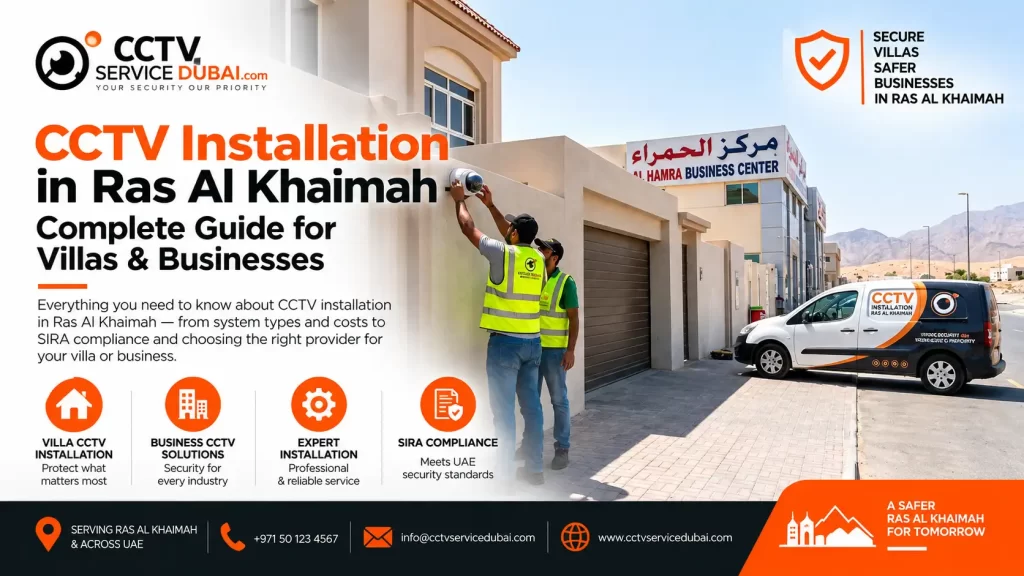
Choosing the right CCTV system is not simply about buying cameras with the highest megapixel rating. In Ras Al Khaimah, a villa, retail shop, warehouse and office can have completely different surveillance requirements.
A villa may need protection around gates, entrances, driveways and outdoor areas. A business may need additional coverage for reception areas, cash counters, storage rooms, loading zones, parking and restricted spaces.
That is why CCTV Installation in Ras Al Khaimah should start with the property and its security risks—not with a ready-made camera package.
Ras Al Khaimah has also developed its own technical security framework through the Hemaya system. RAK Police states that applicable establishments must use approved technical security systems and that building owners should select an approved integrator through the official Hemaya system.
This guide explains what villa and business owners should know before installing or upgrading CCTV in the emirate.
Table of Contents
ToggleKey Takeaway
A good CCTV system in Ras Al Khaimah combines correct camera selection, proper positioning, secure cabling, sufficient recording storage and compliance with applicable local requirements.
Before installation, consider:
- Property size and layout
- Number of entrances and exits
- Indoor and outdoor coverage
- Lighting conditions
- Parking and vehicle movement
- Storage and retention requirements
- Existing network infrastructure
- Remote monitoring requirements
- Maintenance and AMC
- Applicable Hemaya requirements
What Does CCTV Installation in Ras Al Khaimah Involve?
Professional CCTV Installation in Ras Al Khaimah normally begins with a site survey, followed by system design, cabling, camera installation, recording configuration and testing.
A typical project includes:
1. Site survey — The installer identifies vulnerable areas, blind spots, lighting conditions and practical cable routes.
2. Camera planning — Each camera is assigned a purpose, such as entrance identification, general observation or vehicle monitoring.
3. Cabling and infrastructure — Network, power, PoE switches and other equipment are planned according to the system.
4. Installation — Cameras are mounted, connected and positioned.
5. Recorder configuration — NVR/DVR settings, storage and recording schedules are configured.
6. Testing — Cameras, recording, playback and remote access are checked before handover.
This process is much more reliable than installing cameras first and trying to solve coverage problems later.
What Are the CCTV Requirements in Ras Al Khaimah?
RAK’s Hemaya security framework includes specific technical and operational requirements for CCTV systems.
The official Hemaya technical material states that cameras should be appropriately positioned, systems should use network-compatible infrastructure, cabling should be professionally secured and labelled, and CCTV equipment should be connected through appropriate UPS arrangements. It also states that wireless cameras are prohibited unless permission is obtained from the competent authority.
RAK Police has also stated that its security system requirements apply across various types of establishments, including residential and commercial buildings, villas, shops, hotels and other facilities.
This is important for anyone planning CCTV camera installation in Ras Al Khaimah: do not assume that a consumer Wi-Fi camera package will automatically meet the requirements of a regulated property.
The applicable requirements should be confirmed for the specific property before purchasing equipment.
What Is the Best CCTV System for a Villa in Ras Al Khaimah?
The best villa CCTV system depends on the size of the property, entrances, perimeter, lighting and the areas that need identification.
A typical villa installation may include cameras covering:
- Main entrance
- Front gate
- Driveway
- Garage
- Side entrances
- Rear entrance
- Garden or perimeter
- Parking area
For entrance cameras, the objective should be to capture useful identification rather than simply provide a wide view.
Outdoor cameras should also be selected according to the environmental conditions and mounting location.
For larger villas, an IP CCTV system can provide a practical network-based solution. However, the final design should still be based on the property’s layout and applicable requirements.
What CCTV System Is Suitable for Businesses?
Commercial CCTV requirements are usually more detailed because businesses have more people, assets, access points and operational areas to monitor.
A shop may need:
- Entrance coverage
- Cash-counter monitoring
- Customer areas
- Storage rooms
- Back entrances
An office may require:
- Reception
- Main entrance
- Corridors
- Server or restricted rooms
- Parking
A warehouse may need:
- Loading docks
- Receiving areas
- Storage aisles
- Dispatch
- Vehicle gates
- External yards
A professional commercial CCTV system in Ras Al Khaimah should therefore be designed around how the business operates rather than using the same camera package for every property.
Which CCTV Cameras Should You Choose?
There is no single “best” camera for every location.
Dome Cameras
Dome cameras are commonly useful for indoor spaces where a discreet appearance is preferred.
They can suit:
- Offices
- Reception areas
- Shops
- Corridors
- Indoor entrances
Bullet Cameras
Bullet cameras are often considered for outdoor surveillance and longer viewing distances.
They may be suitable for:
- Gates
- Parking
- Driveways
- Loading bays
- Building perimeters
PTZ Cameras
PTZ cameras can pan, tilt and zoom, which makes them useful for large areas such as yards and parking facilities.
However, they should generally complement fixed cameras rather than replace them. A PTZ cannot continuously watch two different directions at once.
Varifocal Cameras
Varifocal models allow installers to adjust the lens during installation.
They can be useful where the required viewing distance is not known precisely until the camera is positioned.
How Should CCTV Cameras Be Positioned?
Correct camera positioning is often more important than simply increasing the number of cameras.
A camera installed in the wrong location can produce footage that is technically clear but practically useless.
For example, an entrance camera may need to identify a person, while a warehouse camera may only need to provide general observation across a large area.
Consider:
- Mounting height
- Camera angle
- Lens type
- Viewing distance
- Lighting
- Obstructions
- Sunlight
- Required identification level
RAK’s published Hemaya material specifically discusses camera functions such as detect, observe, recognize and identify, reinforcing the need to design camera locations according to their intended purpose.
How Long Should CCTV Footage Be Stored in Ras Al Khaimah?
Applicable RAK CCTV requirements can require extended video retention, so storage should be calculated before installation rather than added later.
RAK Police has publicly stated requirements for retaining surveillance recordings for at least 90 days across covered systems.
The amount of storage required depends on:
- Number of cameras
- Camera resolution
- Frame rate
- Compression
- Continuous or event recording
- Recording schedule
- Required retention period
For example, increasing an installation from eight to sixteen cameras does not simply mean buying a larger recorder. The hard-drive capacity and overall storage architecture also need to be recalculated.
This is an area where a professional installer can prevent costly under-sizing.
Is Wireless CCTV Allowed in Ras Al Khaimah?
You should not assume that wireless CCTV is acceptable for regulated installations in Ras Al Khaimah.
The official Hemaya technical material states that wireless cameras are strictly prohibited, and wireless video transmission requires permission from the competent authority. It also specifies secure cabling and network requirements.
That makes the distinction between a consumer home security camera and a professionally designed CCTV system particularly important.
For projects subject to Hemaya requirements, the installer should confirm the approved architecture before installation.
How Much Does CCTV Installation Cost in Ras Al Khaimah?
CCTV installation cost in Ras Al Khaimah varies according to the number of cameras, equipment specifications, storage, cabling and installation complexity.
Major factors include:
- Camera quantity
- Resolution
- Lens type
- Indoor/outdoor requirements
- NVR/DVR
- HDD capacity
- PoE switches
- Network cabling
- Mounting height
- Conduit requirements
- Parking and perimeter coverage
- Remote monitoring
- Compliance-related work
- Maintenance
Some local providers advertise residential systems starting from several hundred dirhams, while larger villa and commercial projects can cost several thousand dirhams or significantly more. These advertised prices are provider-specific and should not be treated as an official RAK market tariff.
The most useful way to compare CCTV Installation in Ras Al Khaimah quotations is to check exactly what equipment, storage, cabling and labour are included.
What Should You Check Before Hiring a CCTV Company in Ras Al Khaimah?
The installer should be able to explain both the technical design and the applicable approval process.
Before signing a quotation, ask:
- Has a site survey been completed?
- Is there a camera layout?
- Are exact camera models listed?
- What recording period is included?
- Is the NVR/DVR specified?
- Is hard-drive storage included?
- What cabling will be used?
- Are PoE switches included?
- Is remote viewing configured?
- Is testing included?
- Is documentation included?
- Is an AMC available?
- Is the company an approved integrator for applicable Hemaya requirements?
RAK Police specifically directs building owners to select an approved integrator through its Hemaya system for applicable properties.
Why Is CCTV Maintenance Important?
CCTV needs regular maintenance because a system can appear operational while a camera, storage drive or network component is actually failing.
A maintenance contract can help with:
- Camera cleaning
- Camera health checks
- HDD checks
- NVR/DVR inspection
- Network troubleshooting
- Cable inspection
- Configuration checks
- Fault replacement
RAK’s published security requirements also call for a maintenance contract and state that system faults should be reported to the maintenance provider.
For businesses, this is particularly important because losing several days of recording can become a major problem if an incident occurs during that period.
What Are Common CCTV Mistakes in Ras Al Khaimah?
The most common mistake is choosing cameras based only on price or resolution.
Other problems include:
Too few cameras: Important areas remain uncovered.
Wrong lens: The camera sees the area but cannot provide useful detail.
Poor positioning: Faces or number plates cannot be captured clearly.
Insufficient storage: Important footage gets overwritten too quickly.
Weak infrastructure: Network or power problems affect recording.
No maintenance: Faults go unnoticed.
Ignoring local requirements: The system may need modifications after installation.
A proper design prevents many of these problems before the cameras are mounted.
How Does CCTV Installation Differ Between Villas and Businesses?
Villa CCTV generally focuses on entrances, driveways and perimeter protection, while business systems usually require more structured coverage and operational monitoring.
| Requirement | Villa | Business |
|---|---|---|
| Entrance monitoring | ✓ | ✓ |
| Perimeter | Often important | Often important |
| Cashier monitoring | — | Where applicable |
| Warehouse monitoring | — | Where applicable |
| Loading dock | — | Often required |
| Employee access areas | Limited | Important |
| Parking | Often | Often |
| Long-term recording | Project-specific | Usually more demanding |
| Access control integration | Optional | Often useful |
The distinction is why a professional CCTV installation in Ras Al Khaimah should be customized to the property rather than sold as a one-size-fits-all package.
Final Takeaway
A successful CCTV project in Ras Al Khaimah is about much more than installing cameras.
Whether you are securing a villa, retail shop, office, warehouse or larger commercial facility, the system should be designed around where people, vehicles and assets move, what needs to be identified and how long footage needs to remain available.
Before approving CCTV Installation in Ras Al Khaimah, make sure you have:
- A site survey
- A camera layout
- Appropriate camera types
- Adequate storage
- Professional cabling
- Secure network infrastructure
- Testing and commissioning
- Maintenance support
- Confirmation of applicable Hemaya requirements
Most importantly, use the official RAK channels to verify current requirements and approved integrator status before beginning a regulated installation. RAK Police currently directs applicable building owners toward the Hemaya system and approved integrators.
Need CCTV Installation in Ras Al Khaimah?
CCTV Service Dubai provides CCTV installation, IP camera systems, remote monitoring, CCTV maintenance and AMC, access control and structured cabling solutions for residential and commercial properties across the UAE.
Phone: +971549953360
Email: sales@cctvservicedubai.com
Website: https://cctvservicedubai.com/

Afsal, SEO Content Writer at CCTV Service Dubai
Afsal writes the guides, cost breakdowns, and compliance explainers published on CCTV Service Dubai. His work covers CCTV camera installation, security system planning, and regulatory requirements across Abu Dhabi, Dubai, and the wider UAE, researched and written in close collaboration with the company’s installation and compliance team to keep every article accurate and current.
With a background in SEO and digital content across multiple UAE-based businesses, Afsal focuses on turning technical, regulation-heavy topics — ADMCC and SIRA requirements, camera specifications, storage and retention rules, installation costs — into guides that are actually useful for someone trying to make a decision, not just technically correct.
What Afsal Covers
CCTV camera installation guides for Abu Dhabi, Dubai, and Sharjah
ADMCC and SIRA compliance explainers
CCTV system costs, camera types, and equipment comparisons
Security camera maintenance and best practices
Buying guides for businesses choosing an installation company
How This Content Is Put Together
Every guide is developed alongside CCTV Service Dubai’s installation team, who bring the hands-on project experience — 5+ years in the field and 500+ completed installations across the UAE. Afsal’s role is to research, verify, and write that experience into guides that are clear, accurate, and genuinely helpful, rather than generic content pulled from unrelated sources.