
Many Dubai business owners pick an access control system based on what they saw in a brochure, or whatever the cheapest quote included. That’s the wrong starting point. Choosing the right door access control system in Dubai starts with your compliance obligations, your building type, and how the entry system connects to the rest of your security setup. Get those three things right first, and the technology choice becomes obvious.
At CCTV Service Dubai, a SIRA-approved installer operating across Dubai, the calls we remember most are from business owners who already installed a system and just failed a SIRA inspection. It happens more than it should, and it’s almost always avoidable. That experience shapes how this comparison works: compliance first, technology second.
By the end of this article, you’ll know which technology fits your property type, what a realistic budget looks like in AED, and how to vet an installer before signing anything.
Table of Contents
ToggleWhy SIRA compliance comes before technology choice
What SIRA approval actually means for door access control installations in Dubai
SIRA, the Security Industry Regulatory Agency, governs security system installations across Dubai. Any commercial property, including retail shops, offices, hotels, and warehouses, must use a SIRA-approved contractor for access control work. Using an uncertified installer doesn’t just risk a failed inspection; it can jeopardize your trade licence and may leave you liable for a full redo at your own cost. The approval covers both the company doing the work and the process they follow, from equipment specification to testing documentation.
For the installing company, SIRA requires a valid trade licence with the relevant security activity listed, qualified staff with cadre cards, and a minimum team structure. For the system itself, equipment must meet SIRA-approved specifications. None of this is optional, and none of it gets waived because you got a cheaper quote from an uncertified contractor.
Civil defense egress rules some installers miss
Dubai Civil Defense adds another layer that some smaller installers miss entirely. Any door on an emergency egress route that has electronic access control fitted must fail safe, meaning it unlocks automatically on fire alarm activation or power loss. Doors must also allow free exit from inside without requiring a credential swipe. Clear width minimums of 915 mm, maximum opening force of 133 N, and self-closing requirements on fire-rated doors all apply.
If your installer doesn’t raise these points during the survey, treat it as a red flag. A proper SIRA-approved contractor builds civil defense compliance into the design from day one, not as an afterthought when the inspector shows up. This is one of the clearest ways to separate experienced installers from those who will leave you with a compliance problem to fix later.
Biometric vs. card vs. mobile: which door access control system fits your Dubai property
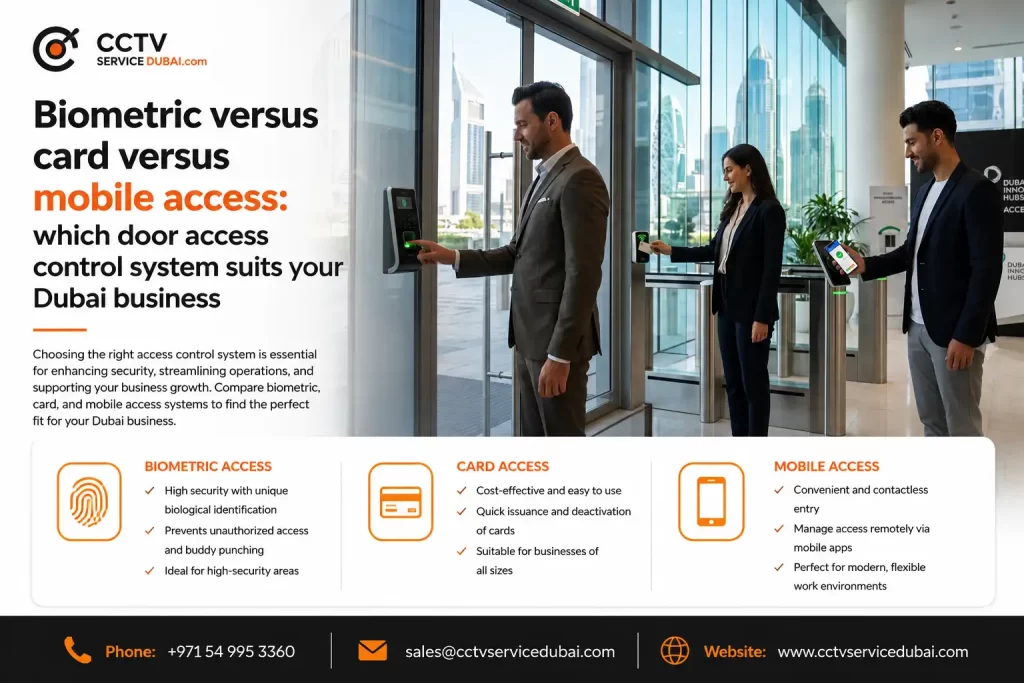
RFID cards and fobs: the workhorse for most Dubai businesses
RFID card systems are the most common door access control option across Dubai offices, retail units, and warehouses. They’re fast, contactless, and straightforward to manage. Adding or revoking a card takes seconds.
The trade-off is that the system verifies the card, not the person. Cards get lost, lent to colleagues, or in some cases cloned. Security strength varies significantly depending on whether you’re using modern encrypted credentials or older low-frequency proximity cards, which are relatively easy to copy.
For many businesses with fewer than 50 staff, a good-quality RFID system with encrypted cards hits a practical balance of cost and reliability. It’s not a perfect system, but it’s dependable, affordable, and easy to operate without specialist knowledge on site.
Biometric readers: fingerprint and facial recognition
Biometric systems tie access to the individual, which removes the shared-credential problem entirely. They work well for sensitive areas: server rooms, back-of-house in hospitality, or any space where accountability matters.
The costs are higher, enrollment takes time, and you need a clear policy for how biometric data is stored and protected. The UAE’s Federal Decree-Law No. 45 of 2021 on Personal Data Protection requires businesses to document how personal data, including biometrics, is collected, stored, and deleted.
For most retail or small-office applications, biometrics are overkill at the main entrance but genuinely useful as a second layer in restricted zones. Think of them as a complement to RFID, not a replacement for every door in the building.
Mobile credentials: convenient but phone-dependent
App-based access using NFC or Bluetooth is growing fast in Dubai, especially for serviced offices and co-working spaces. These smart access solutions give you the ability to issue or revoke credentials instantly without printing or handing over a physical card.
The catch is straightforward: it only works when the employee has a charged, compatible phone with the app installed and functioning.
For businesses where phone use is restricted on the floor, such as labs, kitchens, or warehouses, mobile credentials create more problems than they solve. They’re a strong fit for the right environment and a poor fit for the wrong one. Know which you’re running before you commit.
How CCTV and intruder alarm integration turns entry control into real security
The gap a standalone access control system leaves open
An access control system that operates in isolation tells you who badged in at the door. It doesn’t show you what happened next, whether the door was held open after the credential swipe, or whether someone tailgated through behind an authorized user.
That’s the gap.
A standalone system logs entries; an integrated system gives you the context to act on them.
The difference is important.
Many businesses only notice this gap after an incident. By then, the footage either doesn’t exist or isn’t linked to the access event.
A door held open for 90 seconds after a card swipe, for example, won’t appear in an access log, but it will appear on a camera feed tied to that entry event.
That’s the difference the right setup makes, and it’s only possible if the systems are connected from installation day.
What a unified setup looks like for retail, hospitality, and villas
When your door entry system is linked to your CCTV cameras and intruder alarms on a single platform, the picture changes significantly.
An access event triggers the nearest camera to record and timestamp automatically. A forced-door alert sends both an alarm notification and a live camera feed to your phone.
For a retail shop in Dubai, this means you can review any access event visually, not just as a log entry.
For a hotel, you can verify staff movement through back-of-house areas with a single click.
For a villa, a motion alarm paired with access control gives you a complete picture of who was where.
CCTV Service Dubai installs access control as part of an integrated system, combining electronic door locks, IP cameras, and intruder alarms on one unified platform, so you’re not managing separate apps or separate maintenance contracts for each component.
What a door access control system in Dubai actually costs in 2026
Entry-level, mid-range, and enterprise price ranges (AED)
The cost range for electronic door access in Dubai is wide because the technology gap between a basic single-door keypad and a 16-door enterprise system with cloud management is enormous.
Here’s how the market breaks down in 2026:
Entry-level
Single door, RFID or basic fingerprint: AED 500 to 3,500
Mid-range
4-door RFID or biometric, basic management software: AED 2,800 to 10,500
Enterprise
16+ doors, networked controllers, cloud management, integrations: AED 13,000 to 50,000+
These figures cover hardware. Installation labor, cabling, and software licensing sit on top and vary significantly by site complexity.
A 4-door office setup typically takes one to two working days to install, assuming clean cable runs and existing power infrastructure near the doors.
What pushes the final number up or keeps it down
The biggest cost variables are:
- Cable run length
- Number of doors
- Whether you need new power infrastructure for magnetic locks
- The software licensing model, whether it is a one-time purchase or an ongoing subscription
These four factors alone can shift a mid-range project by thousands of dirhams.
A 4-door office with simple cabling and power already nearby will land very differently from a 4-door retail unit that needs new conduit, a separate power supply, and civil defense documentation.
Always ask for a written, itemized quotation that separates hardware, cabling, labor, and software.
Verbal ballparks are unreliable in this market, and a quote that bundles everything together is often hiding something.
Annual maintenance contracts for access control systems in Dubai typically run at 5% to 10% of the original project value, so factor that into the total cost of ownership, not just the day-one installation figure.
From site survey to sign-off: choosing the right door access control installer in Dubai
The procurement checklist for landlords and business owners
Before you shortlist any installer, confirm these basics:
- SIRA contractor certification — ask for the licence number so you can verify it directly
- Experience with your specific property type — retail, villa, office, or hospitality
- Written quotation that separates hardware, cabling, labor, and software costs
- Civil defense compliance built into the design scope, not added as an afterthought
- AMC availability with documented response time guarantees
- Same-day emergency repair capability, not a multi-day wait that leaves your building unsecured
Be cautious of any installer who gives you a price over the phone without a site visit.
Access control costs depend heavily on physical conditions that can’t be assessed remotely.
Quotes given without a survey are higher risk and likely to change once work begins. Site conditions like existing conduit, door frame material, and power proximity all affect the final number in ways no phone call can capture.
What to expect when you work with CCTV Service Dubai
CCTV Service Dubai is a SIRA-approved contractor serving retail shops, offices, hotels, and villas across Dubai.
The process starts with a free site survey, followed by a written quotation that breaks down every cost line.
Civil defense egress requirements are handled as part of the standard installation scope, not as a paid add-on.
Post-installation, AMC plans keep your system serviced and documented.
Emergency repair support is available to minimize the window between a fault and a fix, so a problem doesn’t leave your building unsecured any longer than necessary.
For properties across Dubai, that combination of compliance, integration capability, and ongoing support is what separates a properly installed system from one that creates problems down the line.
The bottom line on access control for Dubai businesses
The technology you choose matters less than most suppliers want you to believe.
RFID cards work fine for most Dubai businesses.
Biometrics add real value in specific zones.
Mobile credentials suit the right building type.
What matters most is a door access control system in Dubai that carries a SIRA-approved installation, meets civil defense requirements, connects to your CCTV and alarm infrastructure, and comes with a maintenance plan that keeps the system working after handover.
The biggest mistake Dubai business owners make is treating access control as a one-off hardware purchase rather than part of a compliant, integrated security system.
Skip the compliance step and you’re buying trouble.
Skip integration and you’re buying half a solution.
If you’re ready to compare door access control system options for your Dubai property, CCTV Service Dubai offers a free site survey and written quotation with no obligation.
Call us, describe your property, and we’ll give you a realistic AED number with the compliance requirements already built in.

Afsal, SEO Content Writer at CCTV Service Dubai
Afsal writes the guides, cost breakdowns, and compliance explainers published on CCTV Service Dubai. His work covers CCTV camera installation, security system planning, and regulatory requirements across Abu Dhabi, Dubai, and the wider UAE, researched and written in close collaboration with the company’s installation and compliance team to keep every article accurate and current.
With a background in SEO and digital content across multiple UAE-based businesses, Afsal focuses on turning technical, regulation-heavy topics — ADMCC and SIRA requirements, camera specifications, storage and retention rules, installation costs — into guides that are actually useful for someone trying to make a decision, not just technically correct.
What Afsal Covers
CCTV camera installation guides for Abu Dhabi, Dubai, and Sharjah
ADMCC and SIRA compliance explainers
CCTV system costs, camera types, and equipment comparisons
Security camera maintenance and best practices
Buying guides for businesses choosing an installation company
How This Content Is Put Together
Every guide is developed alongside CCTV Service Dubai’s installation team, who bring the hands-on project experience — 5+ years in the field and 500+ completed installations across the UAE. Afsal’s role is to research, verify, and write that experience into guides that are clear, accurate, and genuinely helpful, rather than generic content pulled from unrelated sources.