
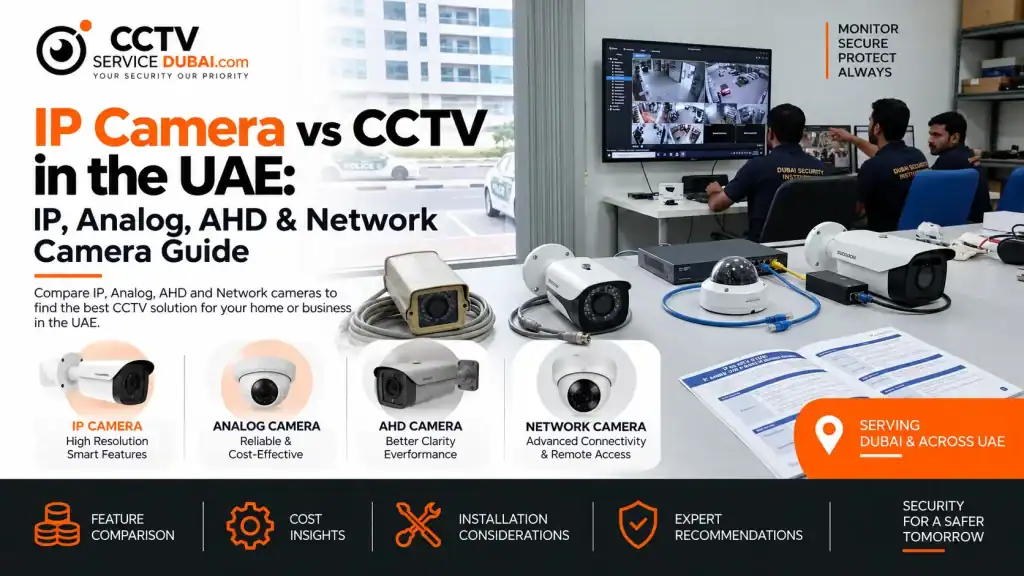
Choosing a CCTV system in the UAE is no longer as simple as picking a camera with the highest megapixel rating. You also need to decide how the cameras will communicate with the recorder, what type of cabling the property already has, how much storage you need, and whether the system needs to support remote monitoring or intelligent features.
That is why the IP camera vs CCTV in the UAE question matters.
For a new office, villa, retail shop, warehouse, or commercial building, an IP system is often the more flexible choice. But if you already have coaxial cabling and a working analog system, upgrading with HD-over-coax technology such as AHD, TVI, or HDCVI can sometimes be more practical.
This guide explains the differences in simple terms so you can choose based on your property rather than simply following a brand or salesperson’s recommendation.
Table of Contents
ToggleKey Takeaway
IP cameras are network-based and normally connect to an NVR or network infrastructure, while traditional CCTV cameras use coaxial cabling and a DVR/XVR. Modern HD-over-coax systems can deliver high-resolution video over existing coaxial infrastructure, making them useful for upgrades.
The right option depends on whether you are building a new system, upgrading an existing installation, the required resolution, networking infrastructure, budget, and future expansion plans.
What Is the Difference Between an IP Camera and CCTV Camera?
The main difference is how video is transmitted and recorded.
An IP camera converts video into digital data and sends it over a network, normally using Ethernet cabling. The system commonly uses an NVR for recording.
A traditional analog CCTV camera sends video through coaxial cable to a DVR. Modern HD-over-coax technologies have significantly improved the image quality available from this type of infrastructure.
| Feature | IP Camera | Analog / HD CCTV |
|---|---|---|
| Transmission | Network/Ethernet | Coaxial cable |
| Recorder | NVR | DVR/XVR |
| Typical cabling | Cat5e/Cat6 | Coaxial |
| Network features | Strong | More limited |
| Expansion | Generally flexible | Depends on DVR/XVR |
| Remote viewing | Yes, with network setup | Yes, with suitable recorder |
| Existing coax reuse | No, not directly | Yes |
| Intelligent features | Widely available | Available on modern systems |
| Best suited for | New installations | Existing coaxial systems and upgrades |
So, IP camera vs CCTV in the UAE isn’t simply about which technology is newer. It is about matching the system to the building.
Is an IP Camera Better Than an Analog CCTV Camera?
For many new installations, IP cameras offer greater flexibility, but analog or HD-over-coax can be a better choice when existing coaxial cabling is still usable.
IP systems make it easier to build a networked surveillance system with features such as centralized management, PoE connectivity, higher-resolution options, and integration with other systems.
However, replacing a complete coaxial infrastructure simply to move to IP may not make financial sense for every existing property.
Modern HDCVI systems, for example, are designed specifically to upgrade existing coaxial surveillance infrastructure and can support resolutions including 4K.
What Is the Difference Between IP vs Analog Cameras?
The most important difference is the infrastructure behind the cameras.
IP cameras
An IP camera connects to a network. In a typical installation:
IP Camera → PoE Switch → Network → NVR
Power and data can often travel through the same Ethernet cable when PoE equipment is used.
This can simplify installation and make it easier to connect cameras across a structured network.
Analog cameras
A traditional analog system generally follows:
Camera → Coaxial Cable → DVR/XVR → Monitor/Network
It is a straightforward architecture and can be particularly useful when the property already has coaxial CCTV cabling.
For a business replacing old cameras but keeping the existing cable routes, this can reduce unnecessary rewiring.
What Is AHD vs IP Camera?
AHD stands for Analog High Definition and is an HD-over-coax technology designed to deliver higher-resolution video through coaxial infrastructure.
AHD can be useful when you have an existing analog CCTV installation and want better image quality without completely rebuilding the cabling.
This is one reason you should not automatically assume that an old coaxial system must be replaced with IP.
Before deciding, an installer should inspect:
- Existing coaxial cable condition
- Cable length
- Connectors
- Power supply
- DVR/XVR compatibility
- Existing camera locations
- Required resolution
- Future expansion requirements
If the cabling is damaged or unsuitable, a complete infrastructure upgrade may still be the better option.
What Is the Difference Between Analog HD and IP Cameras?
Analog HD systems such as AHD, TVI and HDCVI can provide significantly better image quality than older standard-definition analog CCTV.
The important distinction is that analog HD still uses coaxial-based transmission, while IP cameras use network communication.
For example, Dahua’s HDCVI technology is designed to deliver HD video over coaxial cable and support upgrades of existing analog infrastructure. Its current HDCVI range includes cameras with 4K capability.
That makes HD-over-coax particularly interesting for:
- Older villas
- Existing shops
- Small offices
- Warehouses
- Buildings with established coaxial routes
Analog CCTV vs Digital CCTV: Which Should You Choose?
The phrase digital CCTV can refer to several different technologies, so it is important to clarify what is actually being proposed.
If you are comparing a traditional analog CCTV system with a modern IP surveillance system, IP generally provides more networking and integration flexibility.
However, a modern XVR with HD-over-coax cameras can still provide high-resolution surveillance without replacing existing coaxial cabling.
The better choice depends on the project rather than the label.
Choose IP when:
- You are installing a new CCTV system.
- You want a scalable network-based system.
- You need extensive remote management.
- You want PoE connectivity.
- You expect to add cameras later.
- You need advanced analytics or integrations.
Consider HD-over-coax when:
- The property already has good coaxial cabling.
- You are replacing old cameras.
- You want better resolution without major rewiring.
- The project has a limited number of cameras.
- Existing DVR/XVR infrastructure can be reused.
What Is the Difference Between an Analog Security Camera and a Digital Camera?
An analog security camera traditionally sends a video signal through coaxial infrastructure.
A digital/IP camera processes video digitally and communicates across a network.
But there is an important point: image quality is not determined by IP versus analog alone.
Lens quality, sensor size, lighting, WDR, infrared or white-light performance, compression, bitrate, installation height and camera positioning can all affect the final result.
A poorly positioned 8MP camera can produce less useful evidence than a properly installed lower-resolution camera.
What Is the Difference Between an Analog and Network Camera?
A network camera is another common name for an IP camera.
The difference is mainly the communication method:
Analog:
Camera → Coax → DVR/XVR
Network/IP:
Camera → Ethernet/Network → NVR
Network cameras are particularly useful when CCTV needs to become part of a larger security and IT environment.
For example, an office might have:
- IP cameras
- Access control
- Intercom
- Structured cabling
- Network switches
- Remote monitoring
- Centralized security management
This type of environment can make an IP-based architecture attractive.
Hikvision DarkFighter vs ColorVu: Which Is Better?
DarkFighter and ColorVu address different low-light surveillance requirements, so neither should automatically be considered “better.”
Hikvision‘s DarkFighter technology is designed for strong low-light performance, while ColorVu focuses on maintaining color imaging in very low-light conditions using specialized imaging and illumination technologies. Current Hikvision products can also combine ColorVu with IR, white light and WDR depending on the model.
DarkFighter can be suitable when:
- The scene has very low ambient light.
- You want strong night-time imaging.
- IR-based surveillance is appropriate.
- The camera needs to monitor large or challenging areas.
ColorVu can be useful when:
- Color information is important.
- Identification may depend on clothing or vehicle color.
- You want color imaging during low-light conditions.
- Controlled white-light illumination is acceptable.
The exact model matters more than simply choosing the technology name.
Does SIRA Affect the Choice Between IP and CCTV in Dubai?
Yes. CCTV installations in Dubai may need to comply with SIRA requirements, so technology selection should be considered alongside the applicable security specifications.
SIRA’s published technical specifications cover both analog and digital/IP video surveillance systems. For digital systems, the specifications include requirements such as Full HD 1080p minimum resolution, suitable outdoor protection, WDR for cameras facing light sources, and other technical requirements.
SIRA also provides a security-plan certification process for applicable camera and alarm projects.
This means you should not buy cameras first and worry about compliance later.
A professional installer should review the property, camera locations, equipment and applicable requirements before installation.
Which Is Better for a New CCTV Installation in the UAE?
For most new projects, an IP CCTV system is worth considering because it provides a flexible network architecture and makes future expansion easier.
For example:
Villa
An IP system can be a good choice when you want:
- Front gate coverage
- Driveway cameras
- Entrance monitoring
- Outdoor cameras
- Remote viewing
- Smart detection
Office
IP is particularly useful when the office already has structured network infrastructure and requires integration with access control or other security systems.
Retail shop
Either technology can work. The decision may depend on camera count, existing cabling, storage requirements and whether the system is new or an upgrade.
Warehouse
IP can be attractive for larger installations where scalability, networking and centralized management are important.
Existing CCTV system
If the building already has good coaxial infrastructure, an HD-over-coax upgrade may provide better value than replacing everything.
What Should You Check Before Choosing IP or CCTV?
Before requesting a quotation, ask the installer these questions:
- What cabling will be used?
- Can my existing cables be reused?
- Is the proposed system IP, AHD, TVI, HDCVI or another technology?
- What resolution will each camera provide?
- What happens in low-light areas?
- How many days of recording will I get?
- Is the recorder included?
- Are hard drives included?
- Can I monitor the system remotely?
- Does the proposed equipment meet the applicable UAE/Dubai requirements?
- What warranty is included?
- Is CCTV maintenance or AMC available after installation?
These questions can reveal important differences between two quotations that appear similar on price.
How Much Does an IP or CCTV System Cost in the UAE?
There is no single price because the total project depends on the number and type of cameras, cabling, recorder, storage, installation difficulty, brand and compliance requirements.
A professional quotation should normally separate:
- Cameras
- NVR/DVR/XVR
- Hard drives
- Cabling
- PoE switches or power supplies
- Racks and accessories
- Installation labor
- Configuration
- Remote access
- Testing and commissioning
- Maintenance/AMC
A very low quotation may not include all of these items.
For Dubai projects, compliance and documentation requirements can also affect the project scope.
Should You Choose IP Camera or CCTV for Your Property?
The simplest way to decide is:
| Your situation | Recommended direction |
|---|---|
| New villa installation | IP |
| New office installation | IP |
| Large commercial project | IP |
| Need extensive networking | IP |
| Existing good coaxial cabling | HD-over-coax |
| Replacing old analog cameras | HD-over-coax or hybrid |
| Small existing CCTV system | Depends on infrastructure |
| Need future expansion | IP |
| Need to minimize rewiring | HD-over-coax |
This is a starting point, not a universal rule. A proper site survey can change the recommendation.
Why Professional CCTV Installation Matters in the UAE
Buying a good camera does not automatically produce a good surveillance system.
Installation quality affects:
- Camera coverage
- Blind spots
- Cable reliability
- Night-time visibility
- Recording quality
- Network performance
- Storage configuration
- Remote access
- System security
- Long-term maintenance
For Dubai projects, professional installation is also important because the system may need to meet applicable SIRA requirements and documentation processes. SIRA states that security equipment applications are submitted through appropriately licensed security service providers for applicable approvals.
Final Verdict: IP Camera vs CCTV in the UAE
The answer to IP camera vs CCTV in the UAE is not simply “IP is better.”
Choose IP when you are building a new, scalable network-based surveillance system. Choose HD-over-coax when you have usable existing coaxial infrastructure and want to upgrade camera quality without completely rewiring the property.
For either option, focus on the complete system—not just the camera megapixels.
A professional CCTV installer should assess your property, recommend the appropriate camera technology, calculate storage requirements, check cabling, position cameras correctly and configure the system for reliable day-and-night surveillance.
Need Help Choosing the Right CCTV System in the UAE?
CCTV Service Dubai provides CCTV installation, IP camera setup, CCTV upgrades, maintenance and AMC solutions for residential and commercial properties.
Call: +971549953360
Email: sales@cctvservicedubai.com
Website: CCTV Service Dubai

Afsal, SEO Content Writer at CCTV Service Dubai
Afsal writes the guides, cost breakdowns, and compliance explainers published on CCTV Service Dubai. His work covers CCTV camera installation, security system planning, and regulatory requirements across Abu Dhabi, Dubai, and the wider UAE, researched and written in close collaboration with the company’s installation and compliance team to keep every article accurate and current.
With a background in SEO and digital content across multiple UAE-based businesses, Afsal focuses on turning technical, regulation-heavy topics — ADMCC and SIRA requirements, camera specifications, storage and retention rules, installation costs — into guides that are actually useful for someone trying to make a decision, not just technically correct.
What Afsal Covers
CCTV camera installation guides for Abu Dhabi, Dubai, and Sharjah
ADMCC and SIRA compliance explainers
CCTV system costs, camera types, and equipment comparisons
Security camera maintenance and best practices
Buying guides for businesses choosing an installation company
How This Content Is Put Together
Every guide is developed alongside CCTV Service Dubai’s installation team, who bring the hands-on project experience — 5+ years in the field and 500+ completed installations across the UAE. Afsal’s role is to research, verify, and write that experience into guides that are clear, accurate, and genuinely helpful, rather than generic content pulled from unrelated sources.