

Many buyers start by comparing camera prices online. They find a decent-looking 4-camera kit, check the spec sheet, and assume the rest sorts itself out. It doesn’t. Choosing a CCTV camera with installation in Dubai requires more than picking the right hardware, in a regulated market, the gap between buying cameras and having a legal, working, inspected security system is where many projects run into trouble, and where most of the real cost hides.
This guide covers everything you need to make a confident decision in 2026: which camera type suits your property, what SIRA actually requires, what a complete CCTV installation package should include, and what it all costs. The benchmarks and compliance details below are drawn from current UAE market data and regulatory sources across residential, retail, commercial, and industrial project types.
Table of Contents
ToggleChoosing the right camera type for your property
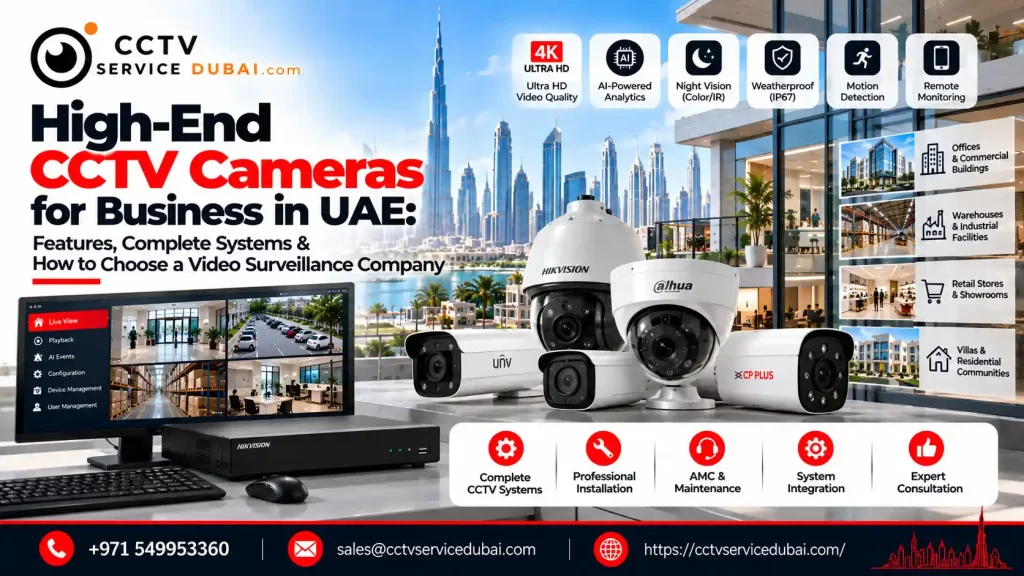
Dome cameras are low-profile, vandal-resistant, and wide-angle. They work well in indoor retail, lobbies, offices, and corridors where discretion matters and coverage angles are tight. Bullet cameras are directional, long-range, and highly visible, the right choice for parking areas, building perimeters, and warehouse entrances where deterrence is part of the function. PTZ cameras use motorized pan, tilt, and zoom to cover wide open areas like hotel courtyards, industrial yards, and large car parks from a single mounting point.
Most commercial properties need a mix. A retail shop might use domes indoors and a bullet or two at the entrance. A warehouse typically needs outdoor bullets at the perimeter and a PTZ covering the yard. A single camera type across the whole site almost always leaves coverage gaps.
Analog vs. IP cameras: the honest difference
Analog HD-CVI cameras cost less upfront and work with existing coaxial cabling, which makes them a practical option for small residential installs or basic retail upgrades where the infrastructure is already in place. IP cameras offer higher resolution (up to 4K and above), run on PoE cabling, support remote access via mobile app, and handle smarter features like motion zones and AI-based detection. For commercial properties and new builds, IP camera installation in the UAE is the standard.
SIRA requires a minimum of Full HD 1080p for all cameras and recording devices. Any analog option that falls below that threshold is non-compliant from day one. If a supplier quotes you budget analog cameras without confirming their resolution, check the spec sheet before signing anything.
Outdoor specs you cannot ignore in the UAE
The UAE climate is not forgiving on hardware. IP66 dust and water resistance is a SIRA baseline requirement for all outdoor cameras, not an optional upgrade. Cameras facing direct sunlight or vehicle headlights must have Wide Dynamic Range (WDR) with at least 110 dB gain ratio; without it, you get washed-out footage that is useless for identification. An IR cut filter is required for reliable night imaging, and an auto iris lens is necessary wherever lighting changes significantly, such as shop entrances that shift from daylight to artificial lighting.
What SIRA compliance actually requires in Dubai
SIRA (the Security Industry Regulatory Agency) sets the technical and procedural standards for all CCTV installations in Dubai. Non-compliance is not a paperwork inconvenience; it puts your trade license at risk and can create serious liability exposure during insurance or regulatory events.
The core technical requirements SIRA enforces
Color cameras are mandatory; covert or hidden cameras are prohibited unless SIRA explicitly approves them for the specific site. The minimum resolution is Full HD 1080p for both cameras and recording devices. The camera system must be PAL-compatible with a minimum signal-to-noise ratio of 48 dB. Any camera mounted at 4 meters or higher requires remote zoom and focus capability, a detail that trips up many DIY installs. These requirements are published in SIRA’s technical guidelines and enforced at inspection.
Audio recording is prohibited without direct SIRA authorization. Video retention must be a minimum of 31 days for commercial systems (some categories require 45 days, and ATM cameras require 75 days). These are not suggestions. They are the baseline that every system must meet before a SIRA inspection will pass.
CCTV camera with installation: the SIRA documentation checklist
SIRA approval is not just a technical inspection, it is a documentation exercise that runs in parallel. The submission package requires the following:
- Trade license
- Detailed site layout
- Proposed camera placement plan
- Equipment schedule with model numbers and IP addresses
- Schematic and network diagram
- Maintenance agreement
- As-built drawings
- Commissioning test certificates
All of this is submitted through the SIRA portal by a licensed Security System Provider (SSP). Once submitted, SIRA assigns an auditor and schedules a site inspection. The timeline runs from approximately three business days to a few weeks, depending on site complexity and how complete the documentation is at submission. Incomplete documentation is the single most common cause of delays. An SSP who manages this end to end, rather than leaving it to the client, is worth far more than a few hundred dirhams in savings.
Why your installer's approval status matters more than their price
Only SIRA-licensed Security System Providers can submit applications and attend SIRA inspections on your behalf. An unlicensed installer cannot complete this process for you, which means the project stalls, your system cannot be legally certified, and any inspection or insurance event exposes you to significant liability. Before signing any quote, ask for the installer’s SIRA approval number and verify it against the official SIRA company directory. A website badge is not verification.
What a professional CCTV installation package should include
A complete CCTV camera with installation is more than hardware on a wall. Understanding what should be in scope helps you evaluate quotes properly and avoid accepting an artificially low price that excludes critical work.
From free site survey to written quotation
A professional installer conducts a site survey before quoting. Camera placement, cable routing, storage sizing, and blind spot identification cannot be done accurately over the phone. At CCTV Service Dubai, every project starts with a free on-site survey followed by a written, itemized quotation that specifies camera models, resolutions, cable runs, storage capacity, and exactly what is and is not included. Any installer who quotes based on room count alone, without visiting the site, is guessing, and you will pay for those guesses later.
Cabling, mounting, commissioning, and remote access setup
A complete installation covers physical mounting of cameras and brackets, cable runs with conduit where required, DVR or NVR setup, hard drive configuration, recording schedules, and motion zone setup. Remote viewing setup via mobile app is often included in professional CCTV packages with installation, but confirm this before signing the quote, some installers charge it as an add-on.
Commissioning means testing every camera angle, confirming recording is functioning, and handing over a working system with documentation. It does not mean installing the hardware and leaving. If a quote does not mention commissioning or system handover, ask specifically what the sign-off process includes.
AMC and warranty: what to clarify upfront
Annual Maintenance Contracts cover scheduled health checks, fault response, and preventive servicing. They are typically separate from the installation price, running at roughly AED 450 to AED 750 per camera per year depending on camera type and service level. These are market-average estimates and can vary by brand, site complexity, and service tier. Installer labor warranty should cover at least 12 months, and equipment warranty depends on brand. Get both in writing.
Also confirm whether the AMC covers all brands or only cameras the installer supplied. This matters significantly if you are maintaining a system originally installed by someone else.
Realistic costs for CCTV with installation in Dubai in 2026
Pricing varies by camera count, resolution, property type, and whether SIRA documentation is bundled. The benchmarks below reflect current UAE market averages and give you a realistic starting point for budgeting, actual figures will vary based on site-specific factors.
Residential CCTV camera with installation packages
A basic 2-camera home setup with installation runs approximately AED 800 to AED 1,750, covering an apartment main door and parking spot. A 4-camera villa package sits at around AED 1,500 to AED 3,500, covering entrances, garden, and driveway with Full HD IP cameras and NVR storage. An 8-camera system for a larger villa or townhouse typically costs AED 6,000 to AED 12,000, including longer cable runs and higher-resolution cameras.
These ranges assume standard cabling distances and typical wall materials. Extended conduit runs, elevated mounting on concrete rooftops, or additional network infrastructure push the final figure up. Always get the site surveyed before accepting a quote as final.
Retail, office, and commercial property costs
Small retail shops requiring SIRA-compliant systems with 4 to 8 cameras should budget AED 3,500 to AED 12,000, depending on camera specification, mounting complexity, and whether SIRA submission fees are included in the quote or billed separately. Mid-size offices and multi-tenant buildings with 16 cameras typically fall in the AED 12,000 to AED 25,000 range, inclusive of NVR, structured cabling, and SIRA commissioning documentation.
Industrial and warehouse deployments vary most widely. Large sites with outdoor PTZ cameras, long cable runs, and integration with access control systems, such as those in areas like Jebel Ali, can exceed these ranges significantly. Request a site-specific quote rather than applying a per-camera average.
What drives the price up or down
Camera count and resolution are the biggest cost levers. Moving from 1080p to 4K cameras roughly doubles the per-camera cost. Cable run length and wall or ceiling material directly affect labor time, concrete walls take longer than drywall. Storage matters too: a 2TB hard drive covers a 4-camera system for approximately 30 days at 1080p; larger sites need more storage, which adds to the total. Finally, confirm whether SIRA documentation and submission fees are bundled into the quote or billed as a separate line item. Both approaches are legitimate, but you need to compare quotes on the same basis.ectetur adipiscing elit. Ut elit tellus, luctus nec ullamcorper mattis, pulvinar dapibus leo.
Installation timelines: residential, retail, and industrial
Planning the installation around your operational schedule requires knowing realistic timelines from survey to SIRA handover, not just the time the technician spends on-site.
How long a residential install actually takes
A standard 4 to 8 camera home installation is typically completed in a single day, assuming the site survey has been done beforehand and materials are pre-ordered. Larger villas with 12 or more cameras, or difficult cable routing through concrete walls or rooftop runs, may take two days. SIRA approval for residential properties adds time to the overall process: plan for three to ten business days for documentation submission and inspection scheduling on top of the installation itself.
Retail and commercial timelines
A 4 to 8 camera retail shop installation generally takes one to two days, including commissioning. Schedule the install during a low-traffic period or before opening hours to minimize disruption. Mid-size commercial properties with 16 or more cameras and access control integration typically take three to five working days from installation start to SIRA handover. Industrial and warehouse projects with 20 or more cameras can run one to two weeks, depending on site size, cable infrastructure, and any permit requirements from the building management or free zone authority.
Common delays and how to avoid them
The most common source of delay is incomplete documentation at the SIRA submission stage. Working with a SIRA-approved installer who manages the submission end to end eliminates this problem. Non-standard camera placements, cameras above 4 meters without remote zoom, or cameras facing direct sunlight without WDR that are not specified in the original design can trigger rework and push back the inspection date. Confirm that your installer reviews the SIRA technical specification list during the site survey, not after the cameras are already mounted.
How to shortlist and choose the right CCTV installer in Dubai
A clear criteria framework helps you cut through marketing claims and evaluate surveillance camera installers in the UAE on what actually matters.
Questions to ask every installer before signing
- Are you SIRA-approved, and what is your SSP license number? (Verify it against the SIRA company directory, not just the website.)
- Does your written quote itemize cameras by model, resolution, cable run lengths, storage size, and remote access setup?
- Is SIRA documentation, submission, and inspection coordination included in the quote, or billed separately?
- What is the warranty on installation labor, and do you offer an AMC after the project is complete?
Why SIRA approval is the non-negotiable filter
Price differences between installers often come down to whether SIRA compliance work is properly included. A cheaper quote that excludes SIRA submission, uses non-compliant camera specifications, or comes from an unlicensed installer creates a much larger problem down the line: a failed inspection, a regulatory fine, or a system that cannot be legally certified. That outcome costs more than the savings ever were.
Cross-check the SIRA approval number on the regulator’s official online directory. Do not rely on a website badge or a verbal claim. Any legitimate SIRA-approved installer will have no objection to you verifying their credentials directly.
Working with CCTV Service Dubai
CCTV Service Dubai is a SIRA-approved security system provider serving Dubai and the wider UAE, with an extensive portfolio of residential, retail, commercial, and industrial installations completed across the region. Every project starts with a free on-site survey and a written, itemized quotation with no obligation. Installation is carried out by certified technicians, SIRA documentation is managed end to end, and AMC is available for all systems regardless of the original brand or installer.
For properties with tight schedules, whether a retail shop preparing for a SIRA inspection or a new build with a handover deadline, the team works to typical industry timelines: residential installs completed within one to two days and commercial projects within approximately five working days, depending on site scope. Contact CCTV Service Dubai directly to arrange your free site survey.
Make the right call from the start
The decision framework is straightforward: identify the CCTV camera with installation package that suits your property type, confirm the installer holds a verified SIRA approval, get a written itemized quote, and check the timeline against your operational needs. Use the 2026 cost benchmarks in this guide as a reality check before accepting any quote, if a price looks too low, it is almost certainly missing SIRA compliance work, proper commissioning, or both.
In a regulated market like Dubai, the cheapest CCTV installation option is rarely the safest one. Compliance failures cost significantly more than the margin saved on the quote. A failed SIRA inspection means rework, reinspection fees, and potential business disruption, particularly for retail operators whose trade license depends on a compliant system.
If you want a free site survey and a written quote from a SIRA-approved team with no obligation, contact CCTV Service Dubai directly. The survey takes less than an hour, and you leave with a clear picture of exactly what your property needs and what it will cost.

Afsal, SEO Content Writer at CCTV Service Dubai
Afsal writes the guides, cost breakdowns, and compliance explainers published on CCTV Service Dubai. His work covers CCTV camera installation, security system planning, and regulatory requirements across Abu Dhabi, Dubai, and the wider UAE, researched and written in close collaboration with the company’s installation and compliance team to keep every article accurate and current.
With a background in SEO and digital content across multiple UAE-based businesses, Afsal focuses on turning technical, regulation-heavy topics — ADMCC and SIRA requirements, camera specifications, storage and retention rules, installation costs — into guides that are actually useful for someone trying to make a decision, not just technically correct.
What Afsal Covers
CCTV camera installation guides for Abu Dhabi, Dubai, and Sharjah
ADMCC and SIRA compliance explainers
CCTV system costs, camera types, and equipment comparisons
Security camera maintenance and best practices
Buying guides for businesses choosing an installation company
How This Content Is Put Together
Every guide is developed alongside CCTV Service Dubai’s installation team, who bring the hands-on project experience — 5+ years in the field and 500+ completed installations across the UAE. Afsal’s role is to research, verify, and write that experience into guides that are clear, accurate, and genuinely helpful, rather than generic content pulled from unrelated sources.