
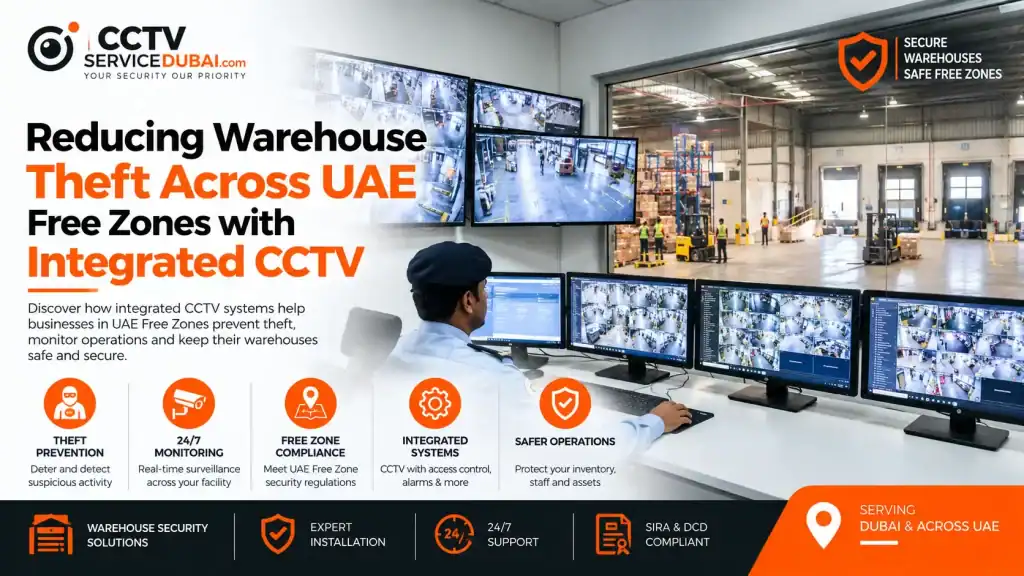
Warehouses in UAE free zones handle everything from electronics and spare parts to food products, machinery, e-commerce inventory and high-value goods. With trucks coming and going, employees working different shifts and multiple companies operating around logistics areas, keeping track of every movement can be difficult.
This is where CCTV for warehouses in Dubai becomes more than a recording system.
A properly designed surveillance system can help warehouse operators monitor entrances, loading docks, storage areas, vehicle movements and restricted zones while providing recorded footage when an incident needs to be investigated.
For warehouses in Dubai and other UAE free zones, the bigger question is not simply “How many cameras do we need?” It is:
Can the CCTV system give us useful visibility across the points where inventory enters, moves and leaves the warehouse?
Table of Contents
ToggleKey Takeaway
Warehouse theft is easier to investigate when CCTV is planned around inventory movement rather than simply covering the building with cameras.
A practical warehouse surveillance strategy should focus on:
- Goods receiving areas
- Loading and unloading docks
- Main entrances
- Staff entrances
- Storage aisles
- High-value inventory
- Dispatch areas
- Vehicle gates
- Parking and yards
- Emergency exits
- Restricted areas
For larger warehouses, CCTV can also work alongside access control, intruder alarms and other security technologies to create a more complete warehouse security system.
Where Does Warehouse Theft Usually Become Difficult to Track?
The biggest challenge is often not detecting that something is missing, but determining where and when the loss occurred.
Consider a typical warehouse process:
Supplier delivery → Receiving → Storage → Picking → Packing → Dispatch → Delivery
If cameras only cover the main entrance, there can still be significant gaps in the process.
For example, a warehouse manager may discover that 10 units are missing from inventory.
The CCTV investigation may need to answer:
- When did the stock arrive?
- Who received it?
- Where was it stored?
- Who accessed that area?
- When was it picked?
- Who moved it to dispatch?
- Which vehicle collected it?
- When did the vehicle leave?
This is why warehouse CCTV needs to follow the movement of goods, not just the movement of people.
How Can CCTV Reduce Warehouse Theft in UAE Free Zones?
CCTV can help deter unauthorized activity and provide a visual record that supports investigations after suspected theft or inventory loss.
A warehouse can use cameras strategically at different stages of its operations.
1. Receiving Area
Install cameras where goods are unloaded and checked.
The footage can help establish:
- Delivery vehicle arrival
- Goods unloading
- Staff activity
- Movement of packages
- Loading-bay activity
2. Storage Areas
Storage areas need coverage that matches the rack layout.
A wide camera view may show general activity, while closer cameras may be required around high-value goods.
3. Dispatch Area
The dispatch zone is particularly important because this is where inventory leaves the warehouse.
Cameras can monitor:
- Packed goods
- Dispatch staff
- Loading activity
- Delivery vehicles
- Exit routes
4. Vehicle Gates
A camera positioned at the vehicle entrance can provide a record of vehicles entering and leaving the property.
For larger facilities, additional vehicle-identification technologies may be considered depending on the security requirements.
What Is the Best CCTV Camera for Warehouses?
The best CCTV camera for warehouses depends on the area being monitored, viewing distance, lighting and required level of identification.
There is no universal camera that works equally well everywhere.
Fixed Dome Cameras
These can be suitable for indoor areas where a compact camera is preferred.
Potential locations include:
- Warehouse offices
- Corridors
- Staff entrances
- Indoor storage areas
Bullet Cameras
Bullet cameras can be useful for longer-distance and outdoor surveillance.
They may be considered for:
- Loading docks
- Vehicle gates
- Parking
- External walls
- Warehouse yards
PTZ Cameras
PTZ cameras can cover large outdoor areas and allow operators to pan, tilt and zoom.
They can be useful for:
- Large yards
- Parking areas
- Loading zones
- Perimeter monitoring
However, PTZ cameras should generally complement rather than replace strategically positioned fixed cameras.
Varifocal Cameras
Varifocal cameras can be useful when the installer needs to fine-tune the field of view based on the actual distance and layout.
This can be particularly helpful in warehouses with changing rack configurations.
Why Is Camera Placement More Important Than Camera Count?
A warehouse with 50 poorly positioned cameras can provide less useful surveillance than a properly designed system with fewer strategically placed cameras.
This is especially important in large warehouses.
Tall storage racks can create:
- Blind spots
- Obstructed views
- Dark areas
- Long viewing distances
For example, a camera mounted too high may show that someone entered an aisle but provide insufficient detail to identify what happened.
A professional security camera installation for warehouses should therefore consider:
- Camera height
- Lens selection
- Viewing distance
- Lighting
- Rack height
- Aisle width
- Camera angle
- Required identification level
The goal should be useful coverage, not simply maximum coverage.
How Can CCTV Help With Loading Dock Security?
Loading docks are one of the most important areas to monitor because inventory, employees and vehicles interact there continuously.
A good loading-dock CCTV design can capture:
- Delivery vehicles
- Driver activity
- Loading and unloading
- Packages and pallets
- Dock doors
- Employee movement
- Vehicle entry and exit
Consider positioning cameras so that one view provides a wider overview while another provides closer detail of important activity.
This makes it easier to investigate disputes involving damaged, missing or incorrectly delivered goods.
Can CCTV Be Integrated With Access Control?
Yes. CCTV and access control can complement each other by combining visual information with information about who accessed a restricted area.
For example:
Access control: An employee uses a credential to enter a restricted stockroom.
CCTV: A nearby camera records the person entering.
If an inventory discrepancy is later discovered, the security team has two useful sources of information.
This approach can be particularly valuable for:
- High-value storage
- Cash offices
- IT rooms
- Restricted stock areas
- Management areas
- Server rooms
The systems do not necessarily need to be completely integrated to work together, but coordinated planning can make investigations much easier.
What About Intruder Alarms?
Intruder alarms and CCTV serve different purposes and can provide stronger protection when used together.
CCTV provides visual information.
An intruder alarm can generate an alert when a monitored security condition occurs.
For example:
After-hours movement → Alarm event → Security team receives alert → CCTV view is checked
This can help reduce the time required to investigate an unexpected event.
For warehouses operating 24/7, the combination can be particularly useful because security teams cannot continuously watch every camera.
How Does Remote CCTV Monitoring Help Warehouses?
Remote monitoring allows authorized personnel to check warehouse cameras without being physically present in the facility.
This can be useful for warehouses with:
- Night shifts
- Weekend operations
- Multiple locations
- Limited on-site security
- Large external yards
- Remote free-zone locations
A manager may want to check:
- Whether a loading area is active
- Whether a vehicle has arrived
- Whether an entrance is secure
- Whether an alarm event requires attention
Remote access should be configured securely and should use appropriate user permissions.
What Should Warehouse Operators Consider in UAE Free Zones?
Every free zone and warehouse property can have different operational requirements, so the CCTV design should be based on the actual facility.
Before installation, consider:
Warehouse Layout
Map:
- Entrances
- Loading docks
- Storage racks
- Offices
- Dispatch areas
- Restricted zones
- Vehicle routes
Operating Hours
A warehouse operating 24/7 has different monitoring requirements from one that closes overnight.
Inventory Value
High-value products may require closer surveillance and additional access controls.
Vehicle Movement
If trucks regularly enter and exit, external cameras should provide suitable views of gates and loading areas.
Existing Infrastructure
Check whether the building already has:
- Network cabling
- Coaxial CCTV
- PoE switches
- NVR/DVR
- Security racks
Reusing suitable infrastructure may reduce unnecessary work.
How Much Does CCTV for Warehouses in Dubai Cost?
Warehouse CCTV pricing depends heavily on the size and complexity of the facility rather than simply the number of cameras.
Important cost factors include:
- Number of cameras
- Camera resolution
- Camera type
- Lens requirements
- Mounting height
- Cable length
- PoE switches
- NVR capacity
- Hard-drive storage
- Network infrastructure
- Outdoor coverage
- PTZ cameras
- Remote monitoring
- Control-room equipment
- Installation complexity
- Maintenance requirements
A small storage facility and a large logistics warehouse can have completely different project requirements.
For this reason, an itemized quotation is more useful than a simple “warehouse CCTV package” price.
What Should a Professional Warehouse CCTV Installation Include?
A good CCTV installation for warehouses should begin with a site survey.
Site Survey
The installer should inspect:
- Building structure
- Ceiling height
- Rack layout
- Lighting
- Loading areas
- Entrances
- Network infrastructure
- Power availability
Camera Design
Each camera should have a defined purpose.
For example:
Camera 01 – Main gate: Vehicle and entry monitoring
Camera 02 – Receiving: Delivery monitoring
Camera 03 – Storage aisle: Inventory monitoring
Camera 04 – Dispatch: Outgoing goods monitoring
Camera 05 – Loading dock: Loading activity
This approach makes the system easier to manage.
Installation & Configuration
The installer should configure:
- Cameras
- NVR
- Storage
- Network
- Remote access
- Recording schedules
- User permissions
Testing
Every camera should be checked for:
- Correct angle
- Focus
- Night performance
- Recording
- Network connectivity
- Storage
- Remote access
What Should You Ask Before Choosing a Warehouse CCTV Company?
Before approving a project, ask the installer:
- Has a site survey been completed?
- Is there a camera layout?
- What is the purpose of each camera?
- Which cameras are designed for identification?
- What storage period is provided?
- Is the NVR included?
- Are hard drives included?
- Are PoE switches included?
- Is network cabling included?
- How will loading docks be monitored?
- How will high-ceiling areas be covered?
- Is remote monitoring available?
- Can access control be integrated?
- Is CCTV maintenance or AMC available?
- What warranty is included?
- What applicable Dubai/UAE compliance requirements have been considered?
A detailed proposal should make these points clear before installation begins.
Final Takeaway
Reducing warehouse theft across UAE free zones starts with understanding how goods, people and vehicles move through the facility.
For warehouses in Dubai, CCTV for warehouses in Dubai should not be treated as a simple camera-count exercise.
The system should provide meaningful visibility across:
- Receiving
- Storage
- Picking
- Packing
- Dispatch
- Loading docks
- Entrances
- Vehicle gates
- High-value inventory
- Restricted areas
The best CCTV camera for warehouses is also not necessarily the most expensive model. The right choice depends on the location, lighting, distance and security objective.
For larger warehouses, combining CCTV with access control, intruder alarms and remote monitoring can create a more complete security strategy.
Most importantly, start with a professional site survey and camera coverage plan. Once the warehouse layout and security risks are understood, it becomes much easier to choose the right cameras, storage and installation approach.
Need Warehouse CCTV Installation in Dubai?
CCTV Service Dubai provides warehouse CCTV installation, security camera installation, IP camera systems, remote monitoring, CCTV maintenance and AMC, access control and structured cabling solutions for commercial and industrial properties.
Phone: +971 50 915 4423
Email: sales@cctvservicedubai.com
Website: https://cctvservicedubai.com/

Afsal, SEO Content Writer at CCTV Service Dubai
Afsal writes the guides, cost breakdowns, and compliance explainers published on CCTV Service Dubai. His work covers CCTV camera installation, security system planning, and regulatory requirements across Abu Dhabi, Dubai, and the wider UAE, researched and written in close collaboration with the company’s installation and compliance team to keep every article accurate and current.
With a background in SEO and digital content across multiple UAE-based businesses, Afsal focuses on turning technical, regulation-heavy topics — ADMCC and SIRA requirements, camera specifications, storage and retention rules, installation costs — into guides that are actually useful for someone trying to make a decision, not just technically correct.
What Afsal Covers
CCTV camera installation guides for Abu Dhabi, Dubai, and Sharjah
ADMCC and SIRA compliance explainers
CCTV system costs, camera types, and equipment comparisons
Security camera maintenance and best practices
Buying guides for businesses choosing an installation company
How This Content Is Put Together
Every guide is developed alongside CCTV Service Dubai’s installation team, who bring the hands-on project experience — 5+ years in the field and 500+ completed installations across the UAE. Afsal’s role is to research, verify, and write that experience into guides that are clear, accurate, and genuinely helpful, rather than generic content pulled from unrelated sources.