
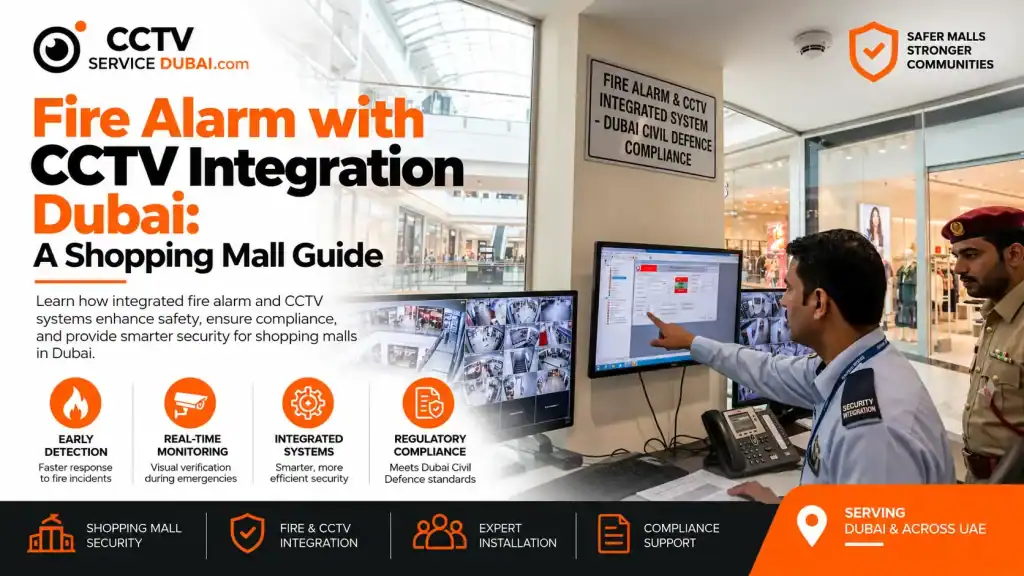
A shopping mall has a very different security and fire-safety challenge from a small office or retail shop. There may be hundreds of shops, food courts, parking areas, cinemas, loading zones, storage rooms, plant rooms and thousands of visitors moving through the building every day.
When a fire alarm activates in a mall, the security team needs more than a notification that says “Fire Alarm – Zone 4.” They need to understand what is happening, where it is happening and what nearby cameras are showing.
This is where fire alarm with CCTV integration in Dubai becomes valuable.
When properly designed, the fire alarm system can provide an event signal to the security or building-management environment, while CCTV can help operators visually assess the affected area. The objective is not to make CCTV a substitute for fire detection. Instead, it is to connect the available information so the response team can act faster and with better situational awareness.
For shopping malls, this approach can become part of a wider integrated fire and security system in the UAE, alongside access control, emergency procedures, building management and other life-safety systems.
Table of Contents
ToggleKey Takeaway
Fire alarm and CCTV systems perform different jobs, but integrating their event information can help mall security teams identify and assess an alarm location more quickly.
A typical solution may connect:
- Fire alarm control panel
- Smoke and heat detectors
- Manual call points
- CCTV/VMS platform
- Security control room
- Access control
- Public-address or voice evacuation systems
- Building management systems
- Other approved emergency systems
The exact architecture depends on the mall, its existing systems, project specifications and authority requirements.
Why Do Shopping Malls Need Fire Alarm and CCTV Integration?
Shopping malls benefit from integration because security operators can use CCTV footage to visually assess an area after receiving a fire alarm event.
Imagine a smoke detector activates in a back-of-house corridor.
Without video integration, the security operator may know the alarm zone but still need to locate the exact area physically or through other systems.
With a properly configured system, the alarm event can be associated with relevant CCTV views.
The operator may then be able to see:
- The affected corridor
- Nearby entrances
- Retail areas
- Escalators
- Service doors
- Loading areas
- Parking approaches
- Other relevant camera views
This does not mean the CCTV camera itself confirms that there is a fire. The fire alarm system remains responsible for fire detection and alarm functions.
The CCTV system provides visual information that supports situational awareness and response.
How Does Fire Detection and CCTV Integration Work in Commercial Buildings?
The integration normally uses an approved interface or communication method between the fire alarm system and the security/video management environment.
A simplified sequence can look like this:
Smoke detector activates → Fire alarm panel receives event → Interface communicates event → CCTV/VMS identifies related camera(s) → Security operator receives visual information
Depending on the system design, additional actions may be configured.
For example:
- A smoke detector activates.
- The fire alarm panel identifies the alarm zone.
- The integration platform receives the event.
- The relevant CCTV camera view is displayed.
- The operator verifies the surrounding conditions visually.
- Mall emergency procedures are initiated.
- Security, facility and emergency-response teams coordinate their actions.
The integration should be designed so that it supports the fire strategy rather than interfering with the fire alarm system’s required operation.
What Should a Fire Alarm System for Shopping Malls in Dubai Include?
A fire alarm system for shopping malls in Dubai is typically much more extensive than a basic system for a small commercial unit.
Depending on the mall’s design and approved fire strategy, the system may include:
- Addressable fire alarm control panels
- Smoke detectors
- Heat detectors
- Manual call points
- Sounders
- Strobes or visual indicators where required
- Fire alarm monitoring
- Fire pumps and related monitoring
- Sprinkler system interfaces
- Emergency communication systems
- Firefighter interfaces
- Cause-and-effect programming
- Emergency control functions
- Interfaces with other building systems
Large malls can have multiple fire alarm panels or networked panels serving different areas.
The important point is that the system should be designed around the building’s approved fire and life-safety strategy rather than simply adding devices to an existing CCTV network.
Dubai Civil Defence publishes the UAE Fire and Life Safety Code of Practice and maintains requirements covering building fire and life-safety systems. Its official resources also include information for shopping-mall risks and approved companies.
What Role Does CCTV Play During a Mall Fire Alarm?
CCTV provides visual information that can help security and facility teams understand conditions around an alarm location.
For a shopping mall, this can be particularly useful because a fire alarm may occur in an area that is difficult for security staff to immediately reach.
Relevant CCTV views may include:
| Mall area | Useful CCTV purpose |
|---|---|
| Retail corridors | View people movement and conditions |
| Food courts | Observe smoke/fire-related conditions |
| Loading bays | Monitor service and delivery areas |
| Parking areas | Support incident assessment |
| Escalators | Observe evacuation routes |
| Entrances/exits | Monitor movement |
| Back-of-house areas | Assess restricted areas |
| Plant rooms | Provide visual awareness |
| Service corridors | Help locate alarm areas |
| Emergency access routes | Support response coordination |
The exact camera coverage should be determined through the mall’s security and fire-safety design.
Can Smoke Detectors Be Integrated With a CCTV Security System?
Smoke detectors can provide alarm events to an integrated security environment, but the CCTV system should not be treated as the primary smoke-detection system unless a separately approved detection technology is specifically designed and approved for that purpose.
A conventional integration might work like this:
Smoke detector → Fire alarm panel → Integration interface → Security/VMS → Relevant CCTV view
This allows the security team to receive useful information without changing the fundamental role of the fire alarm system.
For example, if a detector activates near a mall service corridor, the operator could receive an event associated with cameras covering that corridor and nearby access points.
This can reduce the time spent searching through multiple camera feeds.
What Are Integrated Fire and Security Systems in the UAE?
Integrated fire and security systems bring different building-safety and security technologies together so operators can manage related events more efficiently.
A large mall may have several independent systems:
- Fire alarm
- CCTV
- Access control
- Intruder alarm
- Intercom
- Public address
- Building management system
- Emergency communication
- Parking management
- Elevator controls
Integration does not necessarily mean that every system directly controls every other system.
Instead, the objective is to establish clearly defined interfaces and cause-and-effect actions.
For example:
Fire alarm event → security notification
or
Fire event → relevant CCTV display
or
Emergency condition → predefined access-control response
The exact actions must be approved and programmed according to the project’s fire strategy and authority requirements.
What Are the Mall Fire Safety Regulations in Dubai?
Shopping malls in Dubai must follow the applicable fire and life-safety requirements set by the relevant authorities and approved project documentation.
The Dubai Civil Defence website identifies the UAE Fire and Life Safety Code of Practice as part of its building and facility licensing resources.
For a mall project, compliance can involve much more than installing smoke detectors.
The overall fire-safety design can involve:
- Fire detection
- Fire alarm systems
- Emergency exits
- Emergency lighting
- Firefighting equipment
- Fire pumps
- Sprinkler systems
- Smoke management
- Emergency communication
- Fire-rated construction
- Inspection and maintenance
- Approved drawings and documentation
Dubai Civil Defence also publishes information on approved companies for fire protection and related systems.
Because requirements can vary according to building type, occupancy, design and authority approvals, mall operators should confirm the applicable requirements for their specific project rather than relying on a generic checklist.
How Does SIRA Compliance Relate to Mall CCTV?
In Dubai, CCTV and other security systems may fall under SIRA requirements, while fire and life-safety systems are governed through the applicable fire-safety authority and project requirements.
This distinction is important.
SIRA regulates security systems in Dubai, including CCTV and other security technologies. Its current services include security-plan certification for camera and alarm systems and security-system certification for applicable facilities.
SIRA’s technical specifications also address CCTV infrastructure, recording and maintenance requirements. For example, its published specifications require an annual maintenance contract with a SIRA-registered company for covered security systems.
So a mall project may need to consider both security-system requirements and fire/life-safety requirements, depending on the scope and location.
This is why the phrase SIRA and Dubai Civil Defence compliance should not be treated as one single approval.
They relate to different regulatory areas.
What Should Mall Operators Check Before Integrating Fire Alarm and CCTV?
Before starting an integration project, the mall’s facility or security team should check:
1. Existing fire alarm system
Identify:
- Manufacturer
- Panel model
- Number of panels
- Addressable or conventional architecture
- Available communication interfaces
- Existing cause-and-effect programming
2. Existing CCTV system
Check:
- VMS manufacturer
- NVR/server architecture
- Camera locations
- ONVIF or other supported interfaces
- Network infrastructure
- Control-room displays
- Storage capacity
3. Integration requirements
Define exactly what should happen when a fire event occurs.
For example:
- Which camera should appear?
- Should an alarm pop-up appear?
- Should a preset position be selected?
- Which control-room workstation receives the event?
- Should access-control information also appear?
- What happens if the CCTV server is offline?
4. Compliance
Confirm:
- Approved fire-system design
- Applicable Civil Defence requirements
- Applicable SIRA requirements
- Approved equipment
- Approved drawings
- Testing and commissioning requirements
What Are Common Mistakes in Fire Alarm and CCTV Integration?
One of the biggest mistakes is treating integration as a simple software connection.
For a shopping mall, the project needs to consider the complete operational environment.
Common problems include:
- No clear cause-and-effect matrix
- Incorrect camera-to-zone mapping
- Poor camera coverage
- Outdated CCTV equipment
- Incompatible fire alarm interfaces
- Unmanaged network traffic
- No backup or redundancy strategy
- Poor documentation
- No regular testing
- Integrating systems without considering authority requirements
Another mistake is assuming that CCTV can verify every fire alarm.
A camera may be blocked, positioned incorrectly, affected by smoke or simply unable to see the source of an alarm.
The fire alarm system must therefore continue to perform its intended detection and notification functions independently.
How Should a Shopping Mall Test an Integrated Fire and CCTV System?
Testing should verify both the individual systems and the defined integration events.
A practical test may include:
- Activate a permitted test device.
- Confirm the fire alarm panel receives the event.
- Confirm the correct alarm zone/address.
- Confirm the integration interface receives the event.
- Confirm the correct CCTV camera or view appears.
- Verify the control-room notification.
- Check the response procedure.
- Record the test result.
- Restore the system.
- Update documentation if changes were made.
Dubai Civil Defence materials also emphasize testing, maintenance and approved installation/maintenance arrangements for fire and alarm systems.
For a large mall, testing should be coordinated carefully so it does not unnecessarily disrupt tenants, visitors or emergency services.
Should CCTV, Fire Alarm and Access Control Be Integrated in a Mall?
They can be integrated where the project design and approved interfaces support it, but each system should retain its defined safety and security function.
A modern mall security environment may look like:
Fire Alarm
↓
Event/Integration Layer
↓
Security Control Room
↓
CCTV + Access Control + Other Security Systems
This gives operators a more complete view of an incident.
For example, if a fire alarm occurs in a service area, the security operator may need to understand:
- What cameras cover the area?
- Which access-controlled doors are nearby?
- Is anyone moving through the affected area?
- Are emergency routes clear?
- Is there a related security incident?
The integration should make this information easier to access without creating unsafe or unauthorized automatic actions.
Why Professional Installation Matters for Shopping Malls
Mall security systems are not small installations.
A project may involve hundreds of cameras, multiple fire alarm panels, extensive network infrastructure, control rooms and numerous interfaces.
Professional installation should therefore include:
- Site survey
- Existing-system assessment
- Camera coverage review
- Fire alarm interface assessment
- Network assessment
- Integration design
- Cause-and-effect documentation
- Equipment compatibility checks
- Authority coordination where applicable
- Testing and commissioning
- Operator training
- Maintenance planning
For Dubai security systems, SIRA states that security-system applications and approvals are handled through licensed security service providers for applicable services.
Final Takeaway: Fire Alarm with CCTV Integration in Dubai
For shopping malls, fire alarm with CCTV integration in Dubai is best understood as a coordinated approach to incident awareness—not as a replacement for a dedicated fire detection system.
A well-designed solution can help mall security teams connect a fire alarm event with relevant CCTV information, making it easier to understand what is happening around the affected area.
The most important part is not simply connecting two systems.
It is making sure the complete solution is:
- Properly designed
- Compatible
- Documented
- Tested
- Maintained
- Appropriate for the mall’s operational needs
- Aligned with applicable authority requirements
For mall owners and facility managers, the best time to address integration is during the system design or major CCTV/fire-alarm upgrade, rather than after both systems have already been installed independently.
Need Fire Alarm & CCTV Integration for a Shopping Mall in Dubai?
CCTV Service Dubai can assess your existing surveillance infrastructure and help plan CCTV, security-system integration, access control and related solutions for commercial properties.
Phone: +971549953360
Email: sales@cctvservicedubai.com
Website: CCTV Service Dubai
Authoritative references:
Dubai Civil Defence – UAE Fire and Life Safety Code of Practice
SIRA – Security Plans Certification
SIRA – Security System Certification

Afsal, SEO Content Writer at CCTV Service Dubai
Afsal writes the guides, cost breakdowns, and compliance explainers published on CCTV Service Dubai. His work covers CCTV camera installation, security system planning, and regulatory requirements across Abu Dhabi, Dubai, and the wider UAE, researched and written in close collaboration with the company’s installation and compliance team to keep every article accurate and current.
With a background in SEO and digital content across multiple UAE-based businesses, Afsal focuses on turning technical, regulation-heavy topics — ADMCC and SIRA requirements, camera specifications, storage and retention rules, installation costs — into guides that are actually useful for someone trying to make a decision, not just technically correct.
What Afsal Covers
CCTV camera installation guides for Abu Dhabi, Dubai, and Sharjah
ADMCC and SIRA compliance explainers
CCTV system costs, camera types, and equipment comparisons
Security camera maintenance and best practices
Buying guides for businesses choosing an installation company
How This Content Is Put Together
Every guide is developed alongside CCTV Service Dubai’s installation team, who bring the hands-on project experience — 5+ years in the field and 500+ completed installations across the UAE. Afsal’s role is to research, verify, and write that experience into guides that are clear, accurate, and genuinely helpful, rather than generic content pulled from unrelated sources.