
Table of Contents
ToggleWhat Is Openpath Access Control?
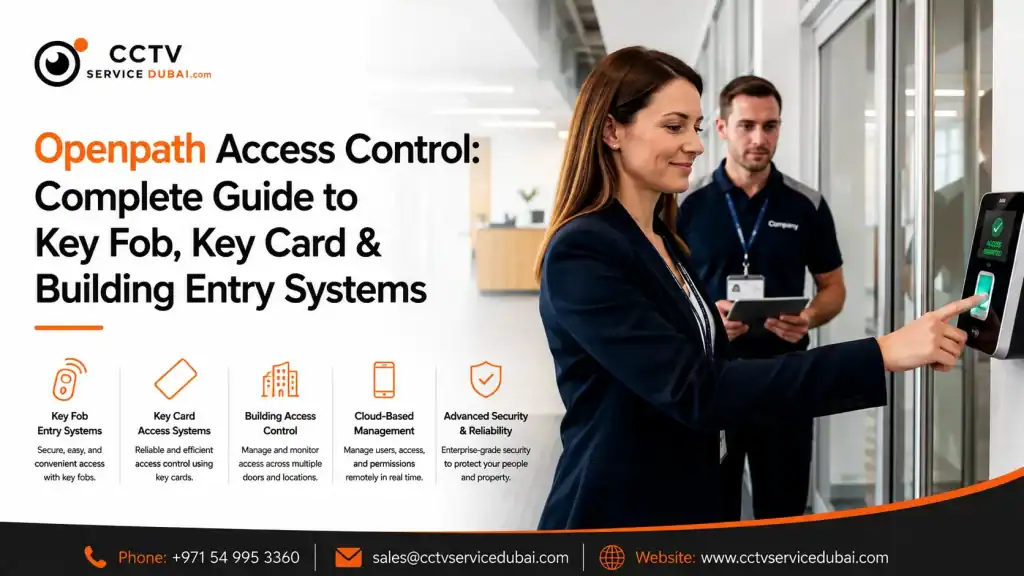
Openpath access control is a modern electronic security solution designed to control who can enter a building, office, or restricted area. Openpath, now part of Motorola Solutions, is known for access-control solutions that can support mobile credentials, key cards, key fobs, and other access methods.
Unlike traditional keys, electronic access control allows businesses to manage user permissions digitally.
Depending on the system, administrators can:
- Add or remove users
- Assign access permissions
- Set access schedules
- Monitor access events
- Restrict specific doors
- Manage multiple locations
- Review entry records
This makes electronic access control particularly useful for modern commercial properties.
Why Do Businesses Need Electronic Access Control?
Traditional keys can become difficult to manage as a business grows.
If an employee loses a key, the business may need to replace or reissue physical keys. With electronic access control, administrators can typically deactivate a lost credential without changing the entire locking system.
A well-designed system can help businesses manage:
- Employee access
- Visitor access
- Restricted areas
- Multiple entrances
- Employee schedules
- Access records
This provides greater control than simply giving employees physical keys.
What Is a Key Fob System for Business?
A key fob system for business uses small electronic credentials that employees can present to an access reader to unlock an authorized door.
A typical setup looks like:
Key Fob → Access Reader → Controller → Electronic Lock → Door
When an employee presents an authorized fob, the system verifies the credential and allows access if the user has the appropriate permission.
Key fobs can be useful for:
- Offices
- Warehouses
- Retail stores
- Apartment buildings
- Commercial buildings
- Staff-only areas
One major advantage is centralized credential management. If a fob is lost, it can generally be disabled through the access-control system.
How Does a Key Card Entry System Work?
A key card entry system uses a card containing an electronic credential.
Employees present the card to a compatible reader installed near the door.
The system checks whether the card is authorized for that particular door and access schedule.
For example:
Employee Card → Reader → Access Controller → Verification → Door Unlocks
Key cards can be assigned to individual employees, making it easier to manage access permissions.
They can also be useful when businesses need to provide temporary or restricted access to contractors, visitors, or specific departments.
What Is a Key Fob Door Entry System?
A key fob door entry system provides electronic access to individual doors using a programmed key fob.
The system can be configured so that different employees have different permissions.
For example:
| User | Main Entrance | Server Room | Management Office |
|---|---|---|---|
| Employee | ✓ | ✕ | ✕ |
| IT Manager | ✓ | ✓ | ✕ |
| Manager | ✓ | ✕ | ✓ |
| Security | ✓ | ✓ | ✓ |
This type of permission structure is particularly useful for businesses with restricted areas.
What Are Door Access Control Systems for Business?
Door access control systems for business are designed to manage and restrict entry to specific areas.
They can use different authentication methods, including:
- Key fobs
- Key cards
- PINs
- Fingerprints
- Facial recognition
- Mobile credentials
A business can choose one method or combine several methods depending on its security requirements.
For example, an office may use key cards for general employees while using biometric authentication for a highly restricted server room.
What Types of Door Entry Systems Are Available?
Modern door entry systems come in several forms.
Key Card Systems
Employees use access cards to enter authorized areas.
Key Fob Systems
Employees use small electronic fobs instead of cards.
Biometric Systems
Employees authenticate using fingerprints or facial recognition.
Mobile Access
Some modern systems allow smartphones to function as digital credentials.
PIN-Based Systems
Users enter a unique PIN to gain access.
The right technology depends on the property, security requirements, employee workflow, and budget.
What Are Building Access Control Systems?
Building access control systems are designed to manage entry across multiple doors and areas within a property.
A larger building may have:
- Main entrances
- Employee entrances
- Parking access
- Elevators
- Office floors
- Server rooms
- Storage areas
- Restricted departments
Rather than managing every door separately, a centralized access-control platform can provide administrators with a single place to manage users and permissions.
This is especially useful for commercial buildings with multiple departments or tenants.
What Is a Key Fob Entry System for Buildings?
A key fob entry system for buildings allows authorized users to access designated areas using electronic fobs.
For example, a commercial building may use fobs for:
- Main entrance
- Parking gate
- Elevator access
- Office floors
- Staff-only areas
Administrators can assign permissions based on the employee’s role.
If an employee changes departments, their access permissions can be updated without replacing their physical key.
What Are Commercial Key Fob Door Entry Systems?
Commercial key fob door entry systems are designed for businesses that need controlled access across one or multiple doors.
They can be particularly useful for:
- Offices
- Warehouses
- Retail stores
- Clinics
- Educational facilities
- Corporate buildings
- Industrial sites
A commercial system should be selected based on the number of doors, number of users, authentication requirements, integration needs, and future expansion.
Openpath vs Traditional Key Systems
Electronic access control offers several advantages over traditional keys.
| Feature | Traditional Key | Electronic Access Control |
|---|---|---|
| User management | Manual | Digital |
| Lost credential | Replace key | Disable credential |
| Access schedules | Limited | Available on many systems |
| Access records | Usually unavailable | Available on many systems |
| Multiple doors | Difficult to manage | Centralized options |
| Remote management | No | Available on some systems |
| Scalability | Limited | Generally easier |
Traditional keys may still be appropriate for certain applications, but electronic systems provide more control for businesses managing multiple employees and access points.
What Is Kisi Access Control?
Kisi access control is another modern access-control solution designed to help businesses manage electronic door access.
Depending on the configuration, access can be managed through digital credentials and centralized administration.
When comparing Kisi access control with Openpath or another platform, consider:
- Number of doors
- Number of users
- Credential options
- Cloud management
- Mobile access
- Reporting
- Integration
- Installation requirements
- Subscription costs
- Technical support
The best system isn’t necessarily the most feature-rich one. It should be the one that fits your organization’s actual requirements.
Can Access Control Be Integrated With CCTV?
Yes. Access control and CCTV can complement each other.
For example:
Door Access Event → CCTV Camera → Recorded Video
If a user enters a restricted area, security personnel may be able to review the associated camera footage.
This can improve visibility around:
- Server rooms
- Warehouses
- Main entrances
- Restricted offices
- Storage areas
Integration capabilities depend on the specific access-control and CCTV platforms.
Can Key Fob Systems Track Employee Entry?
Many electronic access-control systems can record access events.
Depending on the system, administrators may be able to see:
- User identity
- Door accessed
- Date
- Time
- Access granted or denied
These records can help businesses understand building access activity.
However, access records should be managed appropriately, with suitable administrator permissions and data-protection practices.
How Is a Commercial Access Control System Installed?
Professional installation usually involves several steps.
Step 1: Site Survey
The installer evaluates doors, entry points, network infrastructure, and security requirements.
Step 2: Door Assessment
The appropriate electronic lock and access hardware are selected based on the door type.
Step 3: Reader Installation
The key card, fob, biometric, or other reader is installed.
Step 4: Controller Installation
Access controllers are installed and connected to the required network and power infrastructure.
Step 5: Lock Installation
The appropriate electronic locking mechanism is fitted.
Step 6: Software Configuration
Users, doors, access levels, and schedules are configured.
Step 7: Credential Enrollment
Key cards, fobs, mobile credentials, or biometric profiles are registered.
Step 8: Testing
Authorized and unauthorized access scenarios are tested.
Step 9: Handover
Administrators receive guidance on managing users and access permissions.
How Do You Choose the Right Access Control System?
Before purchasing a system, consider these factors:
Number of Doors
How many entrances need access control?
Number of Users
How many employees, contractors, or tenants will need credentials?
Credential Type
Do you prefer cards, fobs, biometrics, mobile credentials, or a combination?
Management
Do you need cloud-based or local administration?
Integration
Will the system need to work with CCTV, attendance, or other security systems?
Scalability
Can additional doors and users be added later?
Support
Does the supplier provide installation, maintenance, and technical support?
What Should You Ask an Access Control Installer?
Before hiring a provider, ask:
- Which access-control brands do you support?
- Can you conduct a site survey?
- Which lock is suitable for my doors?
- How many users can the system support?
- Can lost cards or fobs be disabled?
- Can access permissions be scheduled?
- Can the system integrate with CCTV?
- Is remote management available?
- What warranty is provided?
- Is maintenance available after installation?
These questions can help you compare providers based on the complete solution rather than equipment price alone.
How Can CCTV Service Dubai Help?
CCTV Service Dubai provides access-control and security-system solutions for businesses across Dubai and the UAE.
Our services can include:
Door Access Control
Installation of electronic door-access systems for offices and commercial properties.
Key Card & Key Fob Systems
Configuration and installation of card- and fob-based access systems.
Biometric Access Control
Fingerprint and facial-recognition solutions for businesses requiring stronger identity verification.
Access Control Integration
Integration with CCTV and attendance systems where technically compatible.
Network Cabling
Structured cabling for access readers, controllers, CCTV cameras, and other security equipment.
Maintenance & AMC
Regular inspection, troubleshooting, configuration, and preventive maintenance.
If you’re looking for door access control systems for business, commercial key fob door entry systems, or a complete building access solution, a professional site assessment can help determine the right system.
Contact CCTV Service Dubai:
Frequently Asked Questions
Openpath is an electronic access-control platform associated with Motorola Solutions that supports modern building access management and credentials such as mobile access, cards, and other authentication methods depending on the system.
Yes. A key fob system for business can be useful for controlling employee access to offices, warehouses, restricted areas, and other commercial spaces.
Neither is universally better. Key cards can be convenient for employees, while key fobs are compact and easy to carry. The choice depends on the workplace and access-control system.
Some access-control platforms can integrate with CCTV systems. Compatibility should be confirmed between the specific access-control and surveillance products.
The right building access control system depends on the number of doors, users, credential types, management requirements, integration needs, and future expansion plans.
Final Takeaway
Modern access control gives businesses more control over who can enter, which areas they can access, and when they can enter.
Whether you choose Openpath access control, Kisi, a key card entry system, biometric authentication, or a commercial key fob solution, the system should be selected around your property’s actual requirements.
For a small office, a simple key fob door entry system may be enough. Larger buildings may require centralized management, multiple access points, different permission levels, CCTV integration, and remote administration.
When comparing access-control solutions, focus on the complete package:
Hardware + Software + Installation + Integration + Support + Maintenance
A professionally designed system can provide stronger access management while making it easier for administrators to manage employees, credentials, and restricted areas.

Afsal, SEO Content Writer at CCTV Service Dubai
Afsal writes the guides, cost breakdowns, and compliance explainers published on CCTV Service Dubai. His work covers CCTV camera installation, security system planning, and regulatory requirements across Abu Dhabi, Dubai, and the wider UAE, researched and written in close collaboration with the company’s installation and compliance team to keep every article accurate and current.
With a background in SEO and digital content across multiple UAE-based businesses, Afsal focuses on turning technical, regulation-heavy topics — ADMCC and SIRA requirements, camera specifications, storage and retention rules, installation costs — into guides that are actually useful for someone trying to make a decision, not just technically correct.
What Afsal Covers
CCTV camera installation guides for Abu Dhabi, Dubai, and Sharjah
ADMCC and SIRA compliance explainers
CCTV system costs, camera types, and equipment comparisons
Security camera maintenance and best practices
Buying guides for businesses choosing an installation company
How This Content Is Put Together
Every guide is developed alongside CCTV Service Dubai’s installation team, who bring the hands-on project experience — 5+ years in the field and 500+ completed installations across the UAE. Afsal’s role is to research, verify, and write that experience into guides that are clear, accurate, and genuinely helpful, rather than generic content pulled from unrelated sources.