
Table of Contents
ToggleWhat Is a Biometric Access Control System?
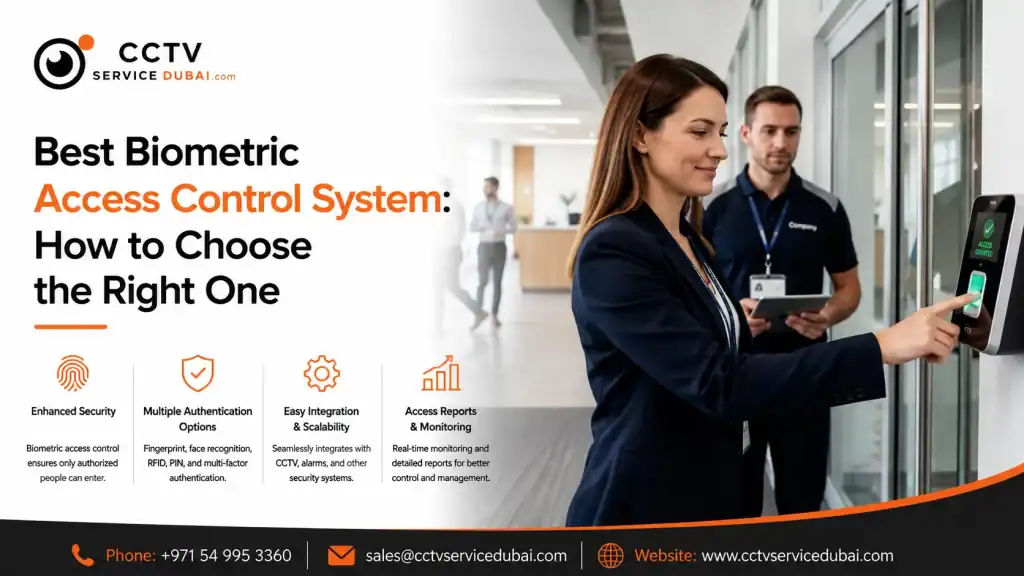
The best biometric access control system allows businesses to control who can enter specific areas using unique biological characteristics such as fingerprints or facial recognition.
Instead of relying only on traditional keys or access cards, biometric systems verify an individual’s identity before granting access.
A typical system can include:
- Fingerprint or facial recognition terminal
- Access controller
- Electronic door lock
- Exit button
- Door sensor
- Access control software
- Power supply
- Network connection
For businesses, this can provide both security and employee management from one system.
Why Are Biometric Access Control Systems Popular?
Traditional keys can be lost, while access cards can be shared or misplaced.
Biometric authentication connects access to the individual using a registered biometric credential.
Businesses can use biometric access control to:
- Restrict sensitive areas
- Monitor employee access
- Manage working hours
- Create access schedules
- Track entry and exit events
- Reduce unauthorized access
- Maintain digital access records
For offices, warehouses, retail stores, and commercial buildings, this can make physical security easier to manage.
What Makes a Good Access Control System?
A good access control system should provide more than simply unlocking a door.
Before selecting a system, consider:
Authentication
Does it support fingerprint, facial recognition, RFID cards, PINs, or multiple methods?
User Capacity
How many employees and users can the system handle?
Access Levels
Can administrators give different employees access to different areas?
Time Schedules
Can access be restricted according to working hours?
Reporting
Can managers view entry and exit records?
Integration
Can the system integrate with attendance, CCTV, or other security systems?
Scalability
Can additional doors and users be added later?
Software
Is the management software easy for administrators to use?
These factors are often more important than choosing a system based purely on brand or price.
What Is the Best Access Control System for an Office?
The best access control system for office environments depends on the company’s size, security requirements, number of doors, and attendance needs.
A small office may only require:
Biometric Terminal + Door Lock + Access Software
A larger organization may need:
Multiple Readers + Controllers + Centralized Software + Attendance + CCTV Integration
For offices, useful features can include:
- Employee access management
- Working-hour schedules
- Department-based permissions
- Visitor management
- Attendance reports
- Multiple-door management
- Remote administration
If access control and time attendance are both required, choosing a platform that supports both functions can simplify administration.
Fingerprint vs Facial Recognition: Which Is Better?
Both technologies can be effective, but they suit different environments.
| Feature | Fingerprint | Facial Recognition |
|---|---|---|
| Contactless | No | Yes |
| Speed | Fast | Fast |
| Physical contact | Required | Not required |
| Employee convenience | High | High |
| Hygiene considerations | More relevant | Lower contact |
| Suitable for | Offices, retail, general use | Offices, high-traffic areas |
| Enrollment | Fingerprint registration | Face registration |
Fingerprint Systems
A fingerprint reader can be a practical option for businesses that want reliable employee identification at a relatively straightforward setup.
Facial Recognition
Facial recognition can be useful for businesses that prefer a contactless authentication experience.
The choice should be based on the workplace environment, employee workflow, security requirements, and system capabilities.
What Are the Benefits of Biometric Access Control?
A biometric system can provide several advantages over traditional access methods.
1. Better Identity Verification
The credential is linked to the registered individual.
2. Reduced Card Management
Employees don’t necessarily need to carry physical access cards.
3. Detailed Access Records
The system can maintain records of access events.
4. Flexible Permissions
Administrators can assign access rights based on employees or departments.
5. Better Security
Restricted areas can be protected using controlled authentication.
6. Attendance Integration
Some biometric platforms can combine access control with employee attendance.
What Are the Top 10 Access Control Systems?
When researching the top 10 access control systems, avoid relying only on generic rankings.
Different systems are designed for different business requirements.
Instead, compare them based on:
- Biometric options
- User capacity
- Door capacity
- Software capabilities
- Cloud availability
- Attendance integration
- CCTV integration
- Mobile access
- Reporting
- Scalability
A system that is excellent for a small office may not be suitable for a large enterprise.
The “best” solution should therefore be determined by the requirements of the actual project.
What Are the Best Cloud Based Access Control Systems?
Best cloud based access control systems allow administrators to manage access remotely through an online platform.
This can be useful for companies with:
- Multiple offices
- Multiple branches
- Remote administrators
- Distributed employees
- Several access-controlled doors
Depending on the platform, administrators may be able to:
- Add or remove users
- Change access permissions
- Review access events
- Manage schedules
- Monitor multiple locations
- Generate reports
Cloud access control can reduce the need for local management infrastructure, but businesses should evaluate internet dependency, cybersecurity, user permissions, data protection, and subscription costs.
How Much Does a ZKTeco Time Attendance Machine Cost?
The ZKTeco time attendance machine price varies depending on the model and features.
Factors that can affect pricing include:
- Fingerprint capability
- Facial recognition
- User capacity
- Attendance features
- Display type
- Network connectivity
- Cloud capabilities
- Software
- Access-control functionality
A basic attendance terminal and an advanced biometric access-control device can have significantly different specifications and prices.
When comparing prices, don’t look at the hardware alone.
Check whether the quotation includes:
- Device
- Software
- Installation
- Configuration
- Employee enrollment
- Network setup
- Training
- Warranty
- Technical support
This gives you a more realistic picture of the total investment.
Can Access Control and Time Attendance Work Together?
Yes.
This is one of the most useful features for businesses.
A biometric terminal can potentially be configured to record both:
Employee Identity → Door Access → Attendance Event
For example, an employee arrives at the office and uses their fingerprint.
The system can verify the employee, unlock the authorized door, and record the event for attendance purposes if the platform supports this functionality.
This can reduce the need for separate attendance and access-control devices.
How Do You Choose Among Access Control System Companies?
When comparing top 10 access control systems companies, focus on the actual services and technical capabilities rather than simply looking at a company ranking.
Ask potential providers:
Do They Provide Site Surveys?
A site survey helps identify door types, access requirements, network infrastructure, and installation challenges.
Do They Handle Installation?
Professional installation is important for readers, controllers, locks, exit buttons, sensors, and power supplies.
Can They Integrate Systems?
Ask whether they can integrate access control with attendance, CCTV, or other systems.
Do They Provide Maintenance?
Access control systems need ongoing technical support and maintenance.
Can They Scale the System?
The provider should be able to add users, doors, and locations as the business grows.
What Is the Access Control Installation Process?
Professional installation usually follows these steps:
Step 1: Requirement Assessment
Identify employees, doors, restricted areas, and access requirements.
Step 2: System Selection
Choose the appropriate biometric reader, controller, lock, and software.
Step 3: Door Assessment
Check the door type and determine the appropriate locking mechanism.
Step 4: Hardware Installation
Install readers, controllers, locks, sensors, and exit devices.
Step 5: Network Configuration
Connect compatible devices to the required network.
Step 6: Software Setup
Configure employees, departments, access levels, and schedules.
Step 7: Biometric Enrollment
Register fingerprints or facial profiles where applicable.
Step 8: Testing
Test authorized and unauthorized access scenarios.
Step 9: Training
Train administrators on user management, reports, and system controls.
What Should You Consider Before Buying?
Use this checklist when comparing access control solutions:
☐ Number of employees
☐ Number of doors
☐ Fingerprint or facial recognition
☐ RFID/PIN requirements
☐ Attendance integration
☐ CCTV integration
☐ Cloud or local management
☐ User capacity
☐ Access schedules
☐ Reporting
☐ Installation
☐ Warranty
☐ Maintenance
☐ Future expansion
This prevents businesses from choosing a system that looks good on paper but doesn’t meet their actual requirements
How Can CCTV Service Dubai Help?
CCTV Service Dubai provides access control, biometric attendance, CCTV, and security infrastructure solutions for businesses across the UAE.
Our services can include:
Biometric Access Control
Installation of fingerprint and facial-recognition access systems.
Time Attendance Systems
Biometric attendance machines and software for employee time tracking.
Door Access Installation
Installation of electronic locks, access readers, controllers, exit buttons, and door sensors.
System Integration
Integration of access control with CCTV and attendance systems where compatible.
Network Cabling
Structured cabling for access control, CCTV, biometric devices, and other business systems.
Maintenance & AMC
Ongoing inspections, troubleshooting, configuration, and preventive maintenance.
If you’re looking for the best biometric access control system for your office or business, CCTV Service Dubai can assess your requirements and recommend a suitable solution.
Contact CCTV Service Dubai:
📞 +971 50 915 4423
📧 sales@cctvservicedubai.com
Frequently Asked Questions
The best system depends on employee numbers, doors, authentication requirements, software, integration needs, and budget. Fingerprint and facial-recognition systems are common options.
A good office system should provide reliable authentication, user management, access schedules, reporting, and the ability to expand as the business grows.
Cloud-based systems can provide strong security when properly configured, but businesses should evaluate the provider's security controls, authentication, data protection, user permissions, and infrastructure.
The price varies by model, biometric technology, user capacity, software, connectivity, and features. Installation and configuration may also affect the total cost.
Compare their technical expertise, installation experience, product knowledge, integration capabilities, support, maintenance, warranty, and ability to scale the system rather than choosing solely based on price.
Final Takeaway
Choosing the best biometric access control system isn’t simply about buying the most advanced fingerprint or facial-recognition device.
The right solution should match your:
Employees + Doors + Security Requirements + Attendance Needs + Software + Future Growth
For a small office, a simple biometric door-access system may be enough. Larger organizations may benefit from centralized software, multiple controllers, cloud management, attendance integration, and CCTV connectivity.
When comparing a good access control system, focus on the complete solution—including installation, configuration, software, support, and maintenance.
A properly designed access control system can give businesses better control over who enters, when they enter, and which areas they can access, while making everyday employee management easier.

Afsal, SEO Content Writer at CCTV Service Dubai
Afsal writes the guides, cost breakdowns, and compliance explainers published on CCTV Service Dubai. His work covers CCTV camera installation, security system planning, and regulatory requirements across Abu Dhabi, Dubai, and the wider UAE, researched and written in close collaboration with the company’s installation and compliance team to keep every article accurate and current.
With a background in SEO and digital content across multiple UAE-based businesses, Afsal focuses on turning technical, regulation-heavy topics — ADMCC and SIRA requirements, camera specifications, storage and retention rules, installation costs — into guides that are actually useful for someone trying to make a decision, not just technically correct.
What Afsal Covers
CCTV camera installation guides for Abu Dhabi, Dubai, and Sharjah
ADMCC and SIRA compliance explainers
CCTV system costs, camera types, and equipment comparisons
Security camera maintenance and best practices
Buying guides for businesses choosing an installation company
How This Content Is Put Together
Every guide is developed alongside CCTV Service Dubai’s installation team, who bring the hands-on project experience — 5+ years in the field and 500+ completed installations across the UAE. Afsal’s role is to research, verify, and write that experience into guides that are clear, accurate, and genuinely helpful, rather than generic content pulled from unrelated sources.